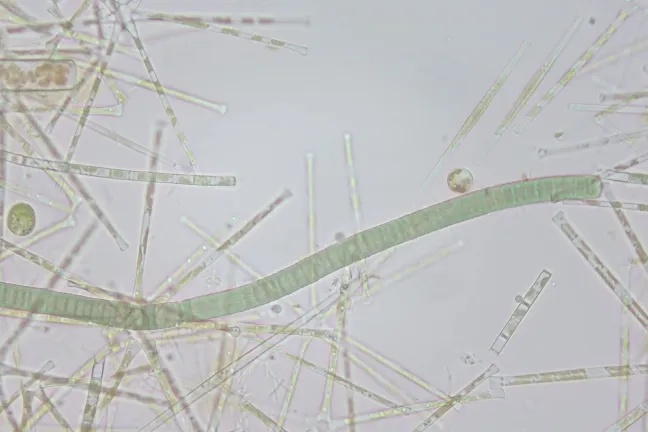
The Lower Willamette River — the stretch of river that passes through Portland — has a dangerous and disruptive water quality problem. During hot stretches in the summer, big blooms of cyanobacteria bubble up in Ross Island Lagoon where they rapidly reproduce, coating the water’s surface with a green scum. As these events become more frequent, more and more Multnomah County residents are becoming familiar with what they’re commonly called: harmful algal blooms (HABs).
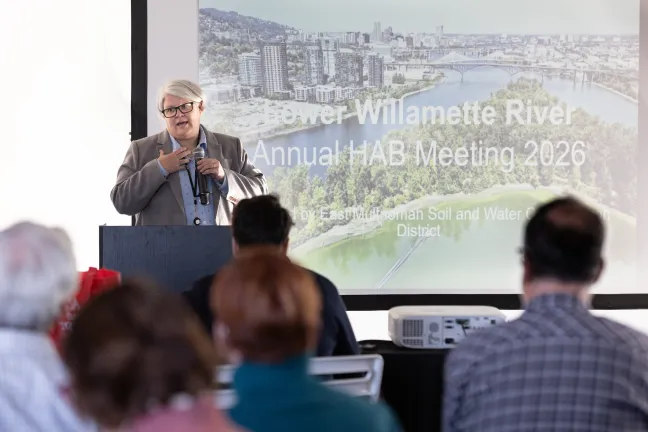
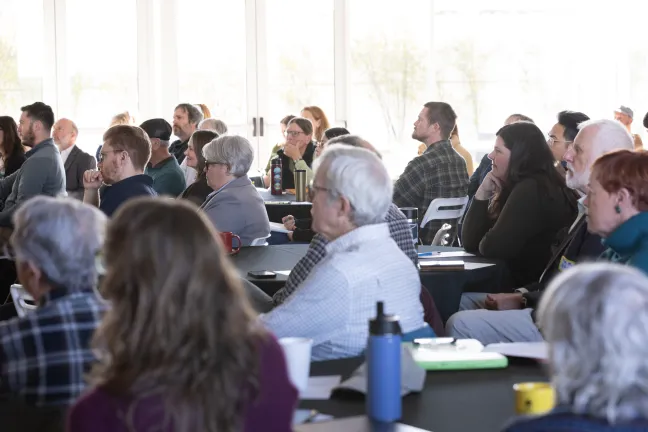
On Jan. 21, 2026, the Multnomah County Office of Sustainability, in partnership with the Human Access Project and Oregon State University, brought together state and local lawmakers, scientists, nonprofit leaders and public officials to discuss strategies for addressing this hazard. The event was funded by a SPACE grant from the East Multnomah Soil and Water Conservation District.
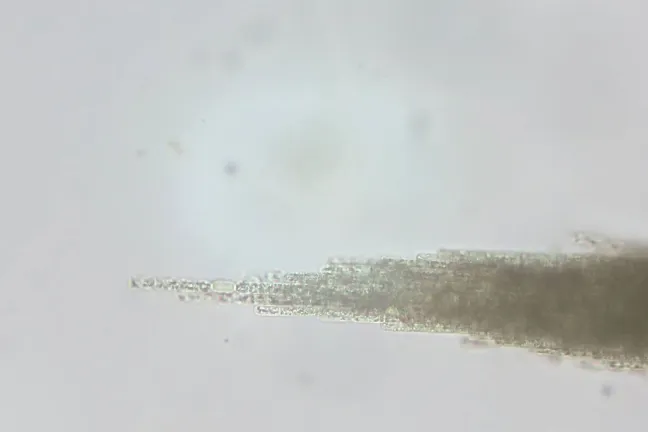
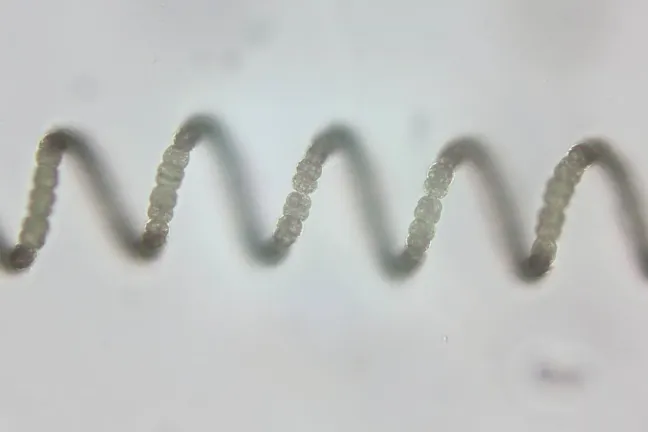
The green slime is actually a group of aquatic organisms called cyanobacteria. Some of these microscopic critters release cyanotoxins, which can be dangerous to pets and humans in sufficient concentrations. When conditions are right, that buildup of toxic scum can escape the lagoon and slosh downstream and upstream, pushed by the tide and river current, where it can present a danger to pets and humans far from where it originated. When that happens, the Oregon Health Authority will warn people to keep themselves and their dogs away from the water. The cyanobacteria can also negatively impact the river ecosystem, including things like pH and the amount of oxygen in the water, as well as the food resources available to salmon and other native fishes in the river.
For swimmers, beachgoers, dog lovers, fish lovers, and people who advocate for water access, these blooms are a big problem — big enough to convene a wide-ranging group of local government officials, scientists, public advocates, and passionate community members for the third annual Lower Willamette River Harmful Algal Bloom meeting.
According to Multnomah County District 1 Commissioner Meghan Moyer, whose district includes Ross Island, there’s more at stake than just swimming.
“There are planned waterfront improvements in virtually every stretch of the Lower Willamette River, including the OMSI District and Tom McCall Park,” she said during her opening remarks. “But unless we solve the HAB problem, those world-class amenities won’t reach their full potential.”
A new relationship with the river
Over the past decade, Portland has gone through a river renaissance of sorts. The completion of the City of Portland’s Big Pipe Project dramatically decreased pollution levels in the Willamette River. The Big Pipe is essentially an underground storage system that prevents sewage from getting into the river during winter rain storms. Unlike the past — when it was common local knowledge that you should avoid going into the Willamette River — the river today, thanks to the pipe and other improvements basin-wide, is safe for swimming in the summer. The pipe can also be credited with improving water quality and contributing to the rebounding health of the ecosystem.
Nowadays, summer weather brings out people to swim in the water or sunbathe on the beaches and docks that line the waterfront. Human Access Project, an organization dedicated to increasing water access along the Willamette River, has been creating more inviting places where Portanders can take a dip by clearing beaches of rubble and adding ladders to make it easier to get in and out of the water at local docks. They also throw some good parties — including the iconic Big Float, and weekly parties on the Kevin Duckworth Memorial Dock adjacent to the Eastbank Esplanade — that reintroduce people to the idea that the Willamette River is a great place to recreate, swim, cool off, and have fun.
Scott Fogerty, the executive director of Human Access Project, views the issue of HABs in stark terms.
“Climate change is impacting our world, our region and our city more than ever. That means hotter summers,” Fogerty said. “The Willamette River offers people a place where they can cool off and connect with nature, but more importantly, to my mind, it’s a case study in hope that shows hard work and dedication can clean up a river and solve big challenges.
“But if we don’t solve the HAB problem, we will lose all the momentum we have built up. We can’t afford not to solve this problem.”
A lake in the river
What we now call Ross Island used to be three islands. In the 1970s, the U.S. Army Corps of Engineers connected those islands with an earthen berm to facilitate sand and gravel mining by the Ross Island Sand and Gravel Company. Mining stopped in the early 2000s, but the earthen berm and a deep in-river hole remain to this day.
According to Dr. Desiree Tullos, a professor of water resources engineering at Oregon State University, the Ross Island Lagoon is like a lake in the middle of a river.
“It’s rare to see HABs in a flowing river because the movement of the water disrupts the growth cycle of the bacteria,” explained Dr. Tullos during the meeting. “The lagoon functions more like a lake than a river. The stagnant conditions of the lagoon create an ideal place for hazardous algal blooms to build up, a problem that is being made worse because climate change is increasing water temperatures in the river.”
There is a long-standing interest in protecting and restoring Ross Island. The State of Oregon has required Ross Island Sand & Gravel to restore the damage caused by decades of gravel mining. Local environmental organizations also value the island as one of the last remaining stretches of natural area on the Lower Willamette River. The forests and beaches on the island are critical habitats for birds such as eagles and osprey, as well as fish, so protecting the island is a priority.
“Fixing the HAB issue and restoring the island is a set of complicated issues,” Commissioner Moyer said. “That is why I am calling on the State of Oregon to convene a table with all partners so that we can collaborate to address these issues holistically.”
Restoring the flow
At the meeting, Dr. Tullos shared results of her team’s research on and engineering designs for mitigating harmful algal blooms. After evaluating many potential approaches to addressing the HABs in Ross Island Lagoon, they determined that restoring river flow to the lagoon was the best long-term solution to mitigating the bloom. At a minimum, that would require removing a section of the berm to allow the river to flow through the lagoon, like it did before the islands were connected by the Army Corps.
“While we know what the best solution is from a cost, long-term maintenance, and ecological perspective,” said Dr. Tullos, “what we needed to determine is the best design so that we don’t spend a lot of money and not solve the problem.”
The Human Access Project worked with Dr. Tullos to stitch together enough funds from various sources to start the work of creating initial designs (also known as 30% designs) for this solution. The East Multnomah Soil and Water Conservation District, Spirit Mountain Community Fund, the Nature Conservancy, an appropriation from Senator Merkley, and Multnomah County each contributed support.
With funding in hand, Dr. Tullos and her team at OSU modeled the river's flow and how various channel designs disrupt the build up of HABs in the lagoon — all of which will help determine the location and size of the flushing channel (or channels) that would make the man-made lagoon function more like a river again.
“Our guiding principles include preserving and enhancing the shallow water habitat that fish need, while also minimizing the long-term maintenance cost,” said Dr. Tullos as she presented her findings to the meeting attendees.
Dr. Tullos aims to unveil the full 30% design for the mixing channel at a public meeting later this spring. In the meantime, Commissioner Moyer and Fogerty, the Human Access Project executive director, are advocating for more state-level coordination to bring parties together to chart a path, not only for full 100% designs, but to resolve longer-term questions of restoration and ownership.
“What’s so exciting about this solution, from my point of view, is that we can expand access to important habitats for fish while at the same time addressing the issue of HAB build up in the lagoon,” said Dr. Tullos.
For Fogerty, there is no question what needs to happen.
“We can’t let this issue fester. We must solve the HAB problem, so we will.”