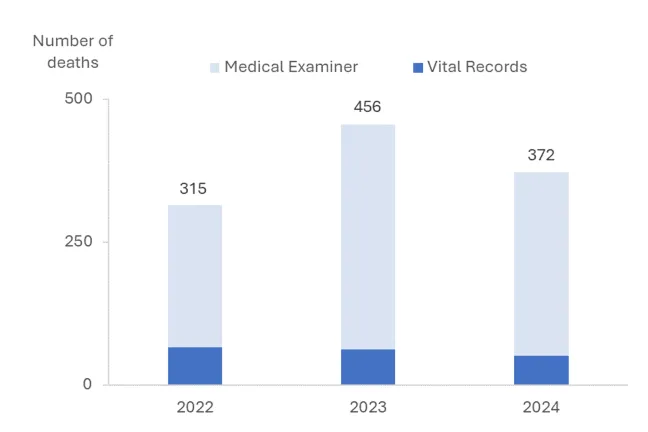
The Multnomah County Health Department’s annual review of deaths among people experiencing homelessness found that during calendar year 2024, at least 372 people died without a home of their own in Multnomah County. A copy of the report is here.
The 2024 number marks an 18% decrease — 84 fewer people — from a peak of 456 deaths in 2023. This is the first year-over-year decrease since 2013, and the largest reduction on record since Multnomah County began its analysis of deaths among people experiencing homelessness in 2011. The 2023 high point coincided with the peak of fentanyl-related deaths, which affected Multnomah County, along with local jurisdictions across the United States.
Overall overdose deaths in 2024 totaled 214 people, down from the peak of 282 overdose deaths reported in 2023. Of the 372 deaths in 2024, 183 were linked to fentanyl: a decrease from 251 fentanyl-related deaths in 2023. However, the number of fentanyl-linked deaths in 2024 was still more than double the 91 reported in 2022 — a clear sign of the synthetic opioid’s continued deadly impact, despite progress in launching new strategies and programs meant to help turn the tide.
“Each year this report provides a stark reminder that there remain far too many tragedies occurring on our streets, especially as fentanyl continues to devastate our community,” said Multnomah County Chair Jessica Vega Pederson. “My heart goes out to the family and friends of those we lost too soon.”
“The downward trend provides hopeful signs that growing our homelessness and behavioral health services is saving lives. Our work ahead is to ensure this decrease becomes a pattern. This report should galvanize our commitment to interventions that provide safety and hope from the harsh realities of addiction and living outside.”
Multnomah County Health Officer Dr. Richard Bruno said the 2024 numbers reflect an encouraging decline in the devastation caused by the use of fentanyl since the height of the synthetic opioid crisis that ripped through the community in 2023. In 2023, Multnomah County saw 779 confirmed overall overdose deaths, compared with 634 overall confirmed deaths in 2024.
“The 2024 data show that the fentanyl crisis peaked in Multnomah County in 2023,” he said. “This decrease in overdose deaths offers a glimmer of hope. We see in some preliminary data that the number of fentanyl overdose deaths have continued to decrease in 2025 and are hopeful that future reports will hold much lower numbers.”
Dr. Bruno, who has spent years working with people with substance use disorder, continued, “For me, this report hits close to the heart. Many of the people outlined in this report were patients I cared for in clinic and I knew their stories well. These were people who fought incredible odds, facing barriers and adversity in healthcare and housing systems.
“Many struggled with an untreated substance use disorder or mental health problem, suffered violent abuse or were victims of a traffic fatality. In every case, we as a society could have done better to help people — both housed and unhoused — get the care and stability they needed.”
Third year for additional source of death reports
Each year since 2012, the County’s Health Department has released the Domicile Unknown report to determine the number, characteristics and causes of deaths in the previous calendar year among people experiencing homelessness in Multnomah County. The goal of Domicile Unknown is to provide elected officials and the public an understanding of the primary contributions to the increased risks these community members face.
The report examines both the accidental or suspicious deaths of people experiencing homelessness investigated by the Multnomah County Medical Examiner — 321 in 2024 — as well as the deaths of 51 people who died at the hospital or under medical care, tallied from certificates recorded by funeral homes.
The inclusion of hospital and medical care deaths began after Senate Bill 850 took effect on Jan. 1, 2022, establishing mandatory reporting of housing status at death. This is the third report in Multnomah County to include these kinds of deaths. Prior reports could not include that additional data because it was not available at the time.
(Please note: Any year-over-year comparisons of deaths since 2011 that do not specifically call out this additional data source starting in 2022 would be both inaccurate and misleading.)
Looking at Medical Examiner data alone, the number of deaths declined 18% between 2023 and 2024, after a sustained rise between 2020 and 2023.
Of the 372 people who died while experiencing homelessness in 2024, 301 (81%) were people reported to be male, and 71 (19%) were reported to be female. Their average age was 48 — which is 30 years younger than the expected lifespan of the average Multnomah County resident.
The data also continue to reflect racial inequities in housing and healthcare. Deaths among Black/African American and American Indian/Alaska Native community members were overrepresented relative to their respective population proportions in Multnomah County. American Indian/Alaska Native people accounted for 5% of deaths among people experiencing homelessness while comprising 3% of the general Multnomah County population. Black/African Americans accounted for 12% of deaths among people experiencing homelessness while comprising 8% of the general Multnomah County population.
Compared to the general Multnomah County population, the risk of dying from drug overdose was 40 times higher for people experiencing homelessness in 2024. The risk of dying was 23 times higher for transportation-related injuries, 24 times higher for homicide, seven times higher for suicide and six times higher for any cause compared to the general population.
“We see substantial differences when we compare the risk of death among people experiencing homelessness to the overall population in the county,” said Health Department Epidemiology Manager Dr. Emily Mosites. “Analyzing and reporting these data helps us make sure we are aware of these increased risks and can help support people along their path out of homelessness.”
Drug overdoses continue to be leading cause of death
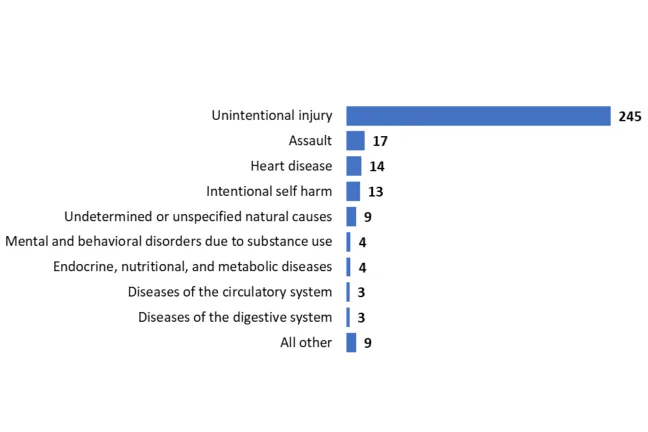
The largest proportion of deaths — 245 — was accidental or unintentional injuries. Of these, 87% were from drug overdoses. Overall overdose deaths in 2024 totaled 214 people, down from the peak of 282 overdose deaths reported in 2023.
Fentanyl was present in 86% of overdose cases and methamphetamine was present in 82%. Most people who overdosed had multiple drugs in their system, with 71% of all drug deaths involving both an opioid and a stimulant.
The numbers indicate just how quickly fentanyl’s impact spread. Fentanyl was first recorded as contributing to a death among people experiencing homelessness eight years ago. The drug contributed to one death in a person experiencing homelessness in 2017, then two each in both 2018 and 2019, followed by four in 2020, 36 in 2021, 91 in 2022, then jumping to 251 in 2023 before falling to 183 in 2024.
The multi-year increase — and then subsequent decrease in 2024 — in fentanyl-related deaths among people experiencing homelessness aligns with national trends, especially in the western United States.
The families of Benjamin “Ben” Donald Sizemore, Samantha “Sammy” Jo Meece and Tony Jamar Samuel shared their experience of losing a loved one experiencing homelessness to a drug overdose in this year’s report.
“Here’s someone who's so positive, and it came out of nowhere,” Sammy’s brother shared. “When we found out she had died, it was a surprise. We knew she was doing drugs, and we knew she had probably upped the drugs, but hearing that, wow, she overdosed — it came as a shock to us.”
Transportation-related fatalities
Transportation-related deaths made up the second-largest number of accidental deaths, with 19 people dying from crashes, or 7% of all unintentional deaths. Sixteen of the transportation-related fatalities involved pedestrians or cyclists. The trend among people experiencing homelessness aligns with overall traffic fatalities in the city of Portland. Since 2022, about 20% of transportation deaths each year in Portland have been community members experiencing homelessness.
A Multnomah County Health Department study of traffic crash deaths between 2012 and 2021 found that people experiencing homelessness face disproportionate risks, accounting for 24% of all traffic deaths in the county in 2020 and 2021. Researchers found the higher rate and risk of traffic deaths result from the combination of living in near-road environments and increased exposure by virtue of being outside much of the time.
Homicide and self-harm
Eighteen people were killed by someone else while experiencing homelessness in 2024, still down from a record 25 homicides in 2022, but up slightly from the 15 homicides counted in 2023. This mirrors the decrease in homicides overall as reported by Multnomah County and the cities of Portland and Gresham in 2024. An additional 13 people died by suicide, which was a decrease from the record 26 people reported in 2023.
Chronic and communicable diseases
While drug overdoses, traffic injuries and homicides were major factors, people experiencing homelessness also died of chronic disease, such as cancer and heart disease, and respiratory diseases, including chronic obstructive pulmonary disease, influenza and pneumonia. The report, however, tracked no COVID-19 deaths in 2024.
Housing and shelter — as well as the myriad other social, economic and environmental factors that underlie the causes of excess deaths among people experiencing homelessness — must continue to be considered when developing policies that can save lives and prevent premature death.
The community is invited to join a Homeless Day of Remembrance on the longest night of the year, this Sunday, Dec. 21, from 5 p.m. to 7 p.m.
The event, sponsored by community-based organizations and the Homeless Services Department, will be held at St. Andre Bessette (601 W. Burnside, Portland) to honor and remember those whose lives were cut short due to homelessness.