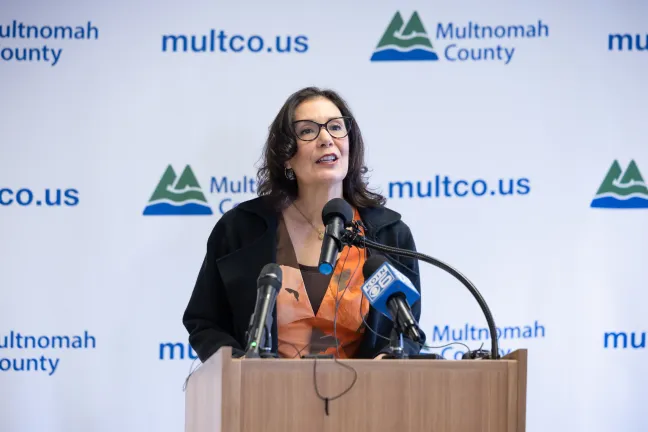
Multnomah County, Ore. (April 16, 2026) — Multnomah County Chair Jessica Vega Pederson today proposed a $3.9 billion balanced budget that makes difficult cuts to close a major funding gap for the second year in a row — while striving to preserve core safety net services and public safety programs that support hundreds of thousands of county residents.
In a 28-page letter released with the Chair’s Executive Budget, Chair Vega Pederson lays out her decisions to prioritize County programs and highlights key investments effectively serving vulnerable community members, with the goal of ensuring those programs can remain sustainable for years to come.
The Chair’s budget invests in helping people experiencing homelessness move through shelters and back into housing while helping others avoid eviction in the first place. It maintains jail capacity and fully funds the Behavioral Health Resource Center in downtown Portland. It preserves school-based mental health services and invests in programs that prevent overdoses, support sobering and recovery services, and provide basic healthcare.
The proposed budget also recognizes the ongoing threat to immigrant communities in Multnomah County, providing funding for rent, food and utilities to support families put at risk by federal policies and enforcement activities.
And this budget supports the infrastructure the County needs to accomplish its work, including stable staffing at the County’s animal shelter, ongoing investments in the Elections Division and increased capacity to speed up permitting.
“I made tough choices to prioritize vulnerable neighbors and improve how our government works,” the Chair says in her letter. “These are necessary to produce a sustainable budget, without over-reliance on one-time dollars. The tough tradeoffs underscore my commitment to fiscal integrity, effective governance, and most importantly – direct services.”
The same factors that helped drive last year’s budget deficit remain in place.
Downtown Portland’s struggling real estate market means the County is receiving lower-than-expected property tax revenues, one of the main sources of revenue for the County’s General Fund. And the County has seen federal and state funding for important health and human services programs clawed back. At the same time, the County’s expenses, including personnel costs, continue to grow faster than the County’s revenues.
Overall, the County’s total budget (including the General Fund, federal funds, and other state and local revenues) is down $93.2 million year over year.
This year’s shortfall in the County’s General Fund is $11.1 million. The $918 million General Fund is the largest pool of resources over which the Chair and Board have decision-making power.
The Chair’s budget would eliminate 166 full-time County positions.
Homeless Services
The Homeless Services Department is facing another year of major reductions — a $67 million gap this time — largely because of the expiration of one-time funding.
In light of those constraints, the Chair’s proposed investments seek to set a balanced and sustainable course for the future of homeless services, guided by a recently updated Homelessness Response Action Plan developed in partnership with the City of Portland.
The Chair’s budget ensures that none of the roughly 9,000 formerly homeless neighbors supported right now living in permanent housing will have to return to the streets. It also commits an additional $10 million in one-time General Funds to more efficiently move people from shelters to homes. This will allow preserved shelter sites to serve additional people by freeing up beds, moving an additional 770 people out of shelters and into housing.
To achieve that balance, the Chair has called for closing 605 adult shelter units and funding 90 fewer scattered-site shelter vouchers for families. Those reductions, affecting a mix of shelter types, would still leave 1,667 County-funded shelter units overall.
Community Safety
The County invests in every part of the community safety continuum, funding programs that hold people accountable, provide alternatives to incarceration, support victims and reduce recidivism — spanning the Sheriff’s Office, the District Attorney’s Office, Department of Community Justice and the Health Department’s Corrections Health Division. Altogether, budgets for these entities account for roughly 50% of the General Fund.
The Chair’s budget once again provides full funding to maintain current capacity in the County’s two jails. But this year, it also calls for a 0.25% reduction in the Sheriff’s administrative costs.
A year after the District Attorney’s Office saw its budget grow after amendments by the Board of County Commissioners, this year’s proposed budget asks the office to take a nearly 5% reduction that is commensurate with other Departments. The budget, however, would add $870,000 for a total of $1.3 million in ongoing funding to expand the office’s Digital Evidence Management Unit, which processes body camera footage and other digital evidence. That unit was identified by the District Attorney as his top priority for any new funding.
The Chair’s budget also shifts how pretrial services are managed in Multnomah County. A one-time allocation of $1 million creates a path for transitioning those services to the circuit court system and away from the Sheriff’s Office and Department of Community Justice. That move allows the County to focus on its core services and also aligns with how pretrial services are managed throughout most of the state.
Mental Health and Substance Use
The Executive Budget invests $9.3 million to continue funding for downtown Portland’s Behavioral Health Resource Center, which provides a day center, shelter beds and transitional housing serving people with mental health issues who are homeless or in transition.
The budget also preserves support for the County’s evolving deflection program and work to develop a permanent 24/7 sobering center, along with other programs that create a path away from jail to treatment.
It includes funding to prevent reductions to the County’s School-Based Mental Health Program, while still supporting work to improve services and access for students with the most needs.
In addition, the proposed budget seeks to streamline and stabilize the County’s harm reduction and communicable disease services by integrating this life-saving work within existing outreach teams.
Youth, Families and Seniors
Amid heightened federal immigration enforcement — which is separating families and creating housing instability for immigrants and refugees — the Chair’s budget dedicates funding to the County’s Immigrant Resilience Program, which provides direct assistance to families in need and helps stabilize their housing. The budget preserves a $3 million investment in the Bienestar de la Familia program, which ensures a variety of culturally sensitive, multilingual services for immigrant and refugee communities.
The budget also adds $3.5 million in ongoing funding to prevent evictions for an additional 500 families. And it allocates $200,000 in new one-time funding to support other families who faced eviction while waiting for federal Medicaid waivers to cover their rents.
The SUN Community Schools program — which serves roughly 18,000 students across six school districts — faces a $1.2 million reduction in the Chair’s budget. This difficult decision preserves 90% of current sites, bringing the remaining number of locations to 83, down from 92.
Learn more, get involved
The Chair’s budget is just the first step in several weeks of deliberations before the Board of County Commissioners adopts its official budget, with a vote scheduled for June 4.
Alongside dozens of public briefings and worksessions scheduled for the coming weeks, community members can also weigh in at three public hearings:
- Wednesday, April 29, in person and virtual: 6 - 8 p.m. at the Multnomah Building Boardroom, 501 S.E. Hawthorne Blvd., in Portland
- Wednesday, May 13, in person: 6 - 8 p.m. at Mt. Hood Community College’s Town and Gown Ballroom, Main Academic Center, 26000 S.E. Stark St., in Gresham
- Wednesday, May 20, virtual: 6 - 8 p.m.
The County continues to make its budget process more accessible than ever, with online dashboards allowing the public to follow the stages of the budget, potential reductions and new program requests, as well as real-time budget monitoring of the current FY 2026 budget.
Learn more about the budget process and how to offer testimony at the County Budget Office’s website.