Counties in Oregon are required to develop an Ambulance Service Plan that specifies the structure of their Emergency Medical Services (EMS) systems. Multnomah County’s current plan was last reviewed and adopted in 2016.
With the County’s current contract with its ambulance provider, American Medical Response (AMR), set to expire in 2028, Emergency Medical Services Administrator Aaron Monnig said the County needs to move away from a “fragile” funding model and rigid staffing requirements. Persistent issues with ambulance response times, shifts in the EMS landscape and pilot programs testing new service models have also elevated the need for changes to the plan.
“Our mission remains the delivery of the right care at the right time,” said Monnig. “A county as geographically and socioeconomically diverse as ours requires a system that is not only clinically excellent, but also structurally resilient.”
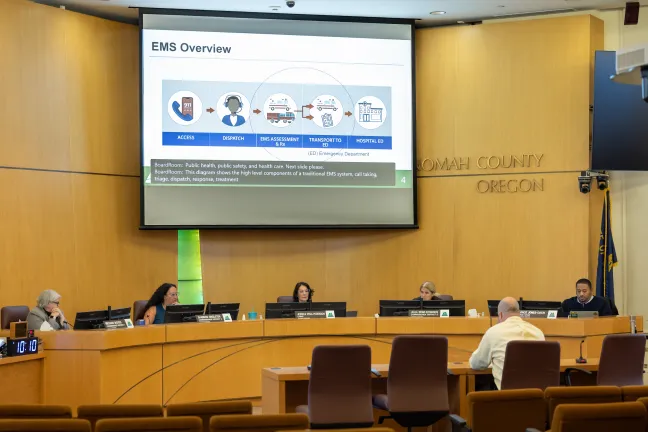
Following a comprehensive third-party assessment of the County’s Ambulance Service Plan and months of public feedback, the Multnomah County Board of Commissioners received a briefing Tuesday, April 14, regarding the proposed future of the County’s ambulance services.
Five foundational pillars of reform
Monnig outlined five functional pillars scrutinized during the assessment to determine the system’s future, each of which included key recommendations:
- Medical direction: Transition to a formalized Office of the EMS Medical Director within the Multnomah County Health Department. With over 2,000 active emergency medical care providers, there is a need to centralize clinical leadership to reduce errors and unify protocols.
- Interoperability: Modernize charting and dispatch technical systems to be interoperable, or make sure all first responders (police, fire, EMS) across the County can talk to each other and share crucial information instantly, even if they use different software or equipment.
- First response: Formalize the role of fire agencies, which respond to 64% of calls. This includes setting specific performance metrics for speed and quality.
- Ambulance transport: Determine the level of care inside the vehicle and ensure that Advanced Care Paramedics are reserved for high-acuity incidents.
- Funding: Move toward a public utility mindset to address a structural deficit that currently relies almost entirely on insurance reimbursement.
The “structural reality” of the paramedic shortage
Monnig spoke about the challenges facing the current system, calling the paramedic shortage “a structural reality.”
Monnig referred to the assessment’s recommendation to shift how ambulances are staffed as a way to combat the problem.
“We are questioning everything, even these foundations,” he said. “We want to focus on who we want on the call, not on how they get there.”
Instead of requiring two paramedics on every ambulance — a long-standing County standard that has contributed to recent response-time struggles — the assessment proposes a tiered, hybrid model:
- Basic Life Support and hybrid ambulances: For lower-acuity calls, staffed with emergency medical technicians and paramedics.
- Advanced Care Paramedics: Experienced “lead paramedics” who would be deployed on critical calls, potentially via “Quick Response Vehicles” rather than traditional ambulances.
Addressing the “fragile” funding model
The assessment’s most critical finding was the failure of the current financial structure. Currently, Multnomah County provides no direct subsidy to its ambulance provider, AMR. Monnig explained that 77% of ambulance patients are covered by Medicare or Medicaid — and their reimbursement rates do not actually cover the actual cost of service. That reality shifts the financial burden onto a shrinking pool of commercial payers.
“Simply raising rates is no longer a viable option,” Monnig said. “The report recommends addressing the structural deficit by acknowledging the failure of the user-fee model. We must move toward modernizing subsidies and funding the system at large as a public utility or a service district.”
A revised funding model could include an enhanced fee-for-service model that would charge higher rates for commercial insurance; a direct subsidy from the County or other public agencies; the creation of a dedicated EMS Service District; or other options.
Next steps: The road to 2028
Implementing a new Ambulance Service Plan will be a multi-year process. During the briefing, Commissioners asked about staffing, funding and how structural changes would translate into improved care quality and system stability.
The EMS team will now draft a revised Ambulance Service Plan, synthesizing the assessment recommendations, public input and feedback from the Board. The Board will receive a draft plan as soon as June 2026, with an approval vote expected later in 2026.
Following Board approval, the Plan will be submitted to the Oregon Health Authority. A procurement process is expected to be launched in 2027, with the new, final Ambulance Service Plan expected to be in place by late 2028.