
Tips to stay warm inside
It might be hard to balance staying warm with saving money on energy bills.
Your safety must come first.
- Don't risk your health by letting your house get dangerously cold. That can cause hypothermia.
- Don't use unsafe shortcuts for heat (like bringing a grill or propane space heater inside, or using a gas stove for heat). This can cause fires or carbon monoxide poisoning.
Many agencies, including Multnomah County, can help people who struggle to afford their winter heating bill. Contact 2-1-1 to find agencies that can help with heating bills. Multnomah County also offers a weatherization program for low-income families who want to make their homes more energy efficient or to have a furnace inspected.
Home heating
- Keep your thermostat set to at least 68 degrees Fahrenheit during the day. Infants or older adults may need to be warmer.
- If everyone in your home is healthy, try turning the thermostat down a few degrees while you sleep to save on energy bills. If you live with an infant, are over 65 or have a health condition, keep your home at 68 degrees at night.
- Close doors and partially close vents in rooms you are not using.
- Check and replace furnace filters if needed.
- Dress in layers inside, even while sleeping.
- Put up heavy curtains during the winter. Open them during the day and close them at night.
- If possible, make weatherization upgrades to your home like weather-stripping, storm windows or additional insulation. Learn more about County weatherization services here.
Space heater safety
- Place space heaters on a solid, flat surface at least three feet away from anything that can burn. Never cover your space heater.
- Plug the heater directly into the wall, not an extension cord or power strip.
- Turn off the heater when you leave the room.
Carbon monoxide
Carbon monoxide (CO) poisoning is a life-threatening emergency caused by inhaling carbon monoxide, a colorless, odorless, tasteless gas produced when fuels (wood, gas, oil, etc.) burn. Dangerous levels of carbon monoxide can build up when fuels are burned in areas that are enclosed or have poor ventilation.
Symptoms
Carbon monoxide poisoning can look like the flu. If you feel worse indoors, CO may be the issue. Symptoms include:
- Headache
- Dizziness
- Weakness
- Nausea or upset stomach
- Vomiting
- Chest pain
- Confusion
First aid
Carbon monoxide poisoning can quickly lead to loss of consciousness and death. If you suspect poisoning, immediately get fresh air and see a doctor. If someone is unconscious, call 911 right away.
Prevention
It is important to prevent carbon monoxide from entering your home in the first place:
- Never use a gas stove for heat. If left on for a long time, a gas stove can replace oxygen in a room with carbon monoxide.
- Never run a portable generator inside a basement, garage, tent or any enclosed space.
- Never leave a vehicle running while it is in a closed or partially closed garage.
- Make sure all devices that burn wood are properly vented to the outside
- Have a qualified professional inspect and service possible sources of carbon monoxide in your home every year. This includes your heating systems, chimney and gas appliances.
Carbon monoxide is invisible, so it is important to have a working carbon monoxide detector correctly installed:
- Install carbon monoxide detectors in every bedroom and on every level of your home, even if you don’t have any gas, oil or wood-burning appliances.
- Test alarms monthly and change batteries twice a year.
- Replace carbon monoxide and smoke alarms after 10 years.
- Smoke alarms and carbon monoxide detectors are different. Smoke alarms detect fire and smoke and will not tell you if there is carbon monoxide in the air. Combination detectors are safe to use and detect both smoke and carbon monoxide, but you must check the label to ensure your device specifically says "carbon monoxide" or "CO."
Safety outside the home
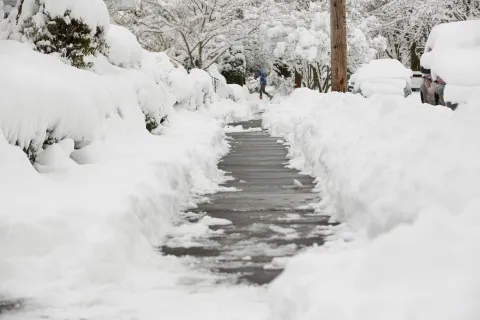
Falls due to ice and snow
Property owners or tenants are responsible for shoveling the snow and removing ice from in front of their homes and businesses. Check in with neighbors who might need a hand. Some elderly home owners or people with disabilities may have physical challenges or risk injury in the snow and ice.
Ice and snow can make slippery conditions that increase the risk of falls. If conditions are dangerous and you don’t need to travel, stay inside. If you need to go, be sure to:
- Wear shoes with good grip. If you have ice grips or boots, use them.
- Walk slowly and take short, small steps. Shuffle your feet to keep your balance.
- Use railings when going up and down stairs.
If you do slip, don’t reach out with your arms. Try to fall on your bottom. Wait for help before getting back up.
If you go out to clear snow or ice from your sidewalk or driveway, push the snow (instead of lifting it) to avoid falling. Be sure to take lots of breaks.
Downed trees
Keep trees trimmed away from your home. These could break during wind storms or under heavy snow or ice and could damage your home. Report downed trees to the city where you live. In Portland, dial 503-823-TREE (8733).
Ladder safety
Winter is the most dangerous season for those who would climb up a ladder to string Christmas lights or clean out gutters. Follow these easy tips to stay safe:
- There’s no substitute for a ladder. Don’t stand on a chair, railing, or upturned waste bin.
- Use ladders with slip-resistant feet
- Straight ladders should rest one foot away from the wall for every four feet of height
- Wear slip-resistant shoes
- Keep your hips between the side rails and do not lean too far.
- Stay below the top two rungs
When the lights go out
After a storm, avoid walking near downed or low-hanging power lines. And when the lights go out, here's who to call:
- PGE: Report an outage by calling 503-228-6322 or visiting the PGE outage map
- Pacific Power: Report an outage by texting OUT to 722797 or visiting the Pacific Power outage map
Learn about more ways to be prepared for a power outage here.