
On this page
- Report highlights
- Background
- Multnomah County Elections Division successfully implemented ranked choice voting in 2024
- Voter education and outreach was a core service of the Elections Division
- The Elections Division needs to better supports its staff
- The Elections Division has outgrown its current facility
- The Elections Division has reduced the risk of mapping-related ballot errors, but still needs GIS expertise
- Recommendations
- Objectives, scope, & methodology
- Audit staff
- Elections Division audit report pdf, including management's response
issued February 2026
Report highlights
| What we found | Why this is important |
|---|---|
| The Elections Division successfully implemented ranked choice voting for the City of Portland’s 2024 contests. | The division will conduct the first ranked choice election for Multnomah County races in 2026 and will continue running ranked choice elections for Portland. |
| The Voter Education and Outreach program at the Elections Division was a core service that reached historically disenfranchised voters and many new citizens. | The elimination of the Voter Education and Outreach program will negatively impact voters. |
| The Elections Division needs to better support its staff. | Inadequate training and staff turnover can increase the risk of election errors and in turn, erode public trust in elections. |
| The Elections Division has outgrown its main facility. | The location of the building limits access; the building is too small for large elections. |
| The Elections Division has created procedures to reduce risk of ballot errors but needs in-house expertise. | Relying on technical staff outside the department who don’t have expertise in elections increases the possibility of error. |
Acknowledgements
We would like to thank the Elections Division staff for their participation and responsiveness to our questions. We would also like to thank the former staff, community partners, and subject matter experts who participated in our surveys and interviews. During our audit, we observed the high level of commitment, dedication, and pride that the division’s employees brought to their work, and we are grateful for all they do to support the right to vote and uphold the integrity of our democracy.
Background
Why we did this audit
Before this audit, our office had not conducted a performance audit of Multnomah County Elections in the last 15 years. We also chose to audit the Elections Division because the division implemented ranked choice voting for the City of Portland’s November 2024 candidate elections, and will do so in 2026 for county candidate races. In addition, there were ballot errors in at least two recent elections, which the county corrected. As we began our audit, we heard about concerns around staffing and training. We also learned that the division has outgrown its current location.
Our audit looked at the recent implementation of ranked choice voting, staffing challenges, what the division has done to reduce the risk of future ballot errors, and limitations and safety concerns around Election Division facilities.
About the Elections Division
The Multnomah County Elections Division, part of the Department of Community Services, administers all local, city, county, state, and federal elections for all voting districts within Multnomah County. This includes administering elections for both candidates and measures for the six cities and 26 special districts within the county - such as school, fire, and water districts. Multnomah County had 578,620 registered voters as of November 2025.
The division’s work includes registering and updating voter records, accepting candidate and measure filings, producing voters’ pamphlets, issuing and mailing ballots, providing assistance to voters, processing and counting ballots, and releasing and certifying election results.
Staffing and budget
The Elections Division had 16 staff positions budgeted in fiscal year 2025 (July 1, 2024 through June 30, 2025) and funding to hire up to 300 on-call workers to help administer elections. The division’s permanent staff has grown in recent years, but there has also been staff turnover and the loss of several employees with decades of experience.
In FY 2025, the division had a total budget of $8,489,212 which included funds for implementing ranked choice voting and administering the November 2024 presidential election and any special elections, if needed. The division’s budget has increased 54% since the last presidential election year, which occurred during FY 2021. This increase includes four added staff positions since FY 2021 and $1,716,376 in one-time-only funding for FY 2025. One-time-only funding is requested for a single fiscal year.
Elections facilities
The Elections Division does the majority of its work at one main office, including voter assistance and ballot processing. This building is the Duniway-Lovejoy Elections Building, located in central southeast Portland. Since 2018, the division has also operated a satellite location, the Voting Center Express in Gresham, to provide services to voters.
Voter assistance
The Elections Division provides front counter service to voters at their main office and the Voting Center Express. We observed division staff serving the public on several different days leading up to the November 2024 election at both voter service locations. In these days leading up to the election, most voters did not need to wait to receive assistance. Staff were consistently available to answer questions and assist voters. On Election Day, there were people lined up outside the main building and voters experienced long waits, some for over an hour.
Independent oversight
Multnomah County elections are governed by local ordinances, Oregon Administrative Rules, Oregon statute, and federal regulations. The State of Oregon has a State of Oregon Vote By Mail Procedures Manual which outlines applicable laws and serves as a resource for county elections offices to administer lawful elections. Oregon law requires that an audit trail must be maintained throughout the election process for ballots.
Division staff used Clear Ballot software to count, tabulate, and design ballots. The software is federally tested and federally certified. Division staff then tested the software internally and applied for state certification based on the federal testing and internal Multnomah County testing. The software was then certified by the State of Oregon. According to Oregon’s Secretary of State, computers running the software are never connected to the internet and physical access to the machines is restricted. Oregon law requires random sampling hand counts or risk-limiting audits in all counties after primary, general, and special elections. Oregon has required post-election audits after each statewide election since 2008. In these audits, elections officials conduct a hand recount of a random sample of ballots to verify that the machine count is accurate.
Best practices
On its website, the Elections Division highlights the importance of public observation and transparency, and also encourages the public to participate as observers of its processes. The Elections Division also explains on its website the functions of the different ballot processing areas and “rooms” within their building.
During observations, Elections Division staff were also able to articulate and demonstrate the function of different safeguards for ballots when asked about different steps in ballot processing.
Another best practice we observed were bipartisan teams of election workers adjudicating votes. This is a process where two staff representing two different political parties follow set guidance to determine a voter’s intent when it could not be determined by the ballot tallying software.
Multnomah County Elections Division successfully implemented ranked choice voting in 2024
In November 2022, City of Portland voters approved amendments to the City Charter, including the use of ranked choice voting in city candidate contests beginning in the November 2024 election. Also in November 2022, Multnomah County voters approved an amendment to the County Charter to use ranked choice voting in county candidate contests no later than 2026.
In a ranked choice voting system, voters have the option to rank candidates in order of preference instead of selecting only one candidate. In the City of Portland, ranked choice voting lets voters rank candidates in order of preference — first, second, third, and so on — rather than choosing one. This way, people's second, third, fourth choices, and so on, may still count toward a winning candidate, meaning the winner is more broadly supported. In the single seat races for mayor and auditor, if no candidate gets 50%+1 vote after the first round, the candidate with the least votes is eliminated, and their supporters' votes are moved to their next choice. This process continues until one candidate has a majority. In multi-seat races, like the Portland city council races with three council members elected per district, the threshold is 25%+1 vote. The threshold is how many votes a candidate needs to be elected. After the initial round of counting the first ranked votes for each candidate, if one or more candidates reach 25%+1, they are declared elected. Tabulation continues in rounds until all seats to be filled are elected.
The City of Portland held its first ranked choice election in November 2024, for mayor, auditor, and city council. In 2026, Multnomah County will implement ranked choice voting for the county chair, auditor, sheriff, and District 2 county commissioner.
The Elections Division incorporated updated ballot processes and tabulation software in order to implement ranked choice voting. Multnomah County continues to also administer traditional single choice contests alongside ranked choice voting contests.
Multnomah County implemented ranked choice voting through a collaborative process involving experts and other jurisdictions
The Elections Division worked in partnership with the City of Portland as well as Washington and Clackamas Counties to implement ranked choice voting
The City and County signed a memorandum of understanding in August 2023 that described the roles and responsibilities of Multnomah County and the City of Portland for ranked choice voting voter education. Additionally, Multnomah County entered into an intergovernmental agreement with Clackamas and Washington Counties in October 2023. Small parts of the City of Portland cross over into Clackamas and Washington counties. This meant that the City of Portland’s ranked choice elections crossed county boundaries and required agreement and collaboration in administering ballots, processing ballots, and implementing reporting practices for ranked choice voting contests.
The intergovernmental agreement established that Multnomah County would process Clackamas and Washington County ranked choice voting ballots. This process consolidated all ranked choice voting ballots for the City of Portland within Multnomah County’s elections administration.
The Elections Division sought best practices on ranked choice voting implementation and administration
In preparation for the 2024 election, the Elections Division told us they sought best practices from the Ranked Choice Voting Resource Center, a nonprofit organization that provides technical support, information, research, and tools to jurisdictions and the public about ranked choice voting. The division also looked to other jurisdictions experienced in ranked choice voting, such as New York City, the City and County of San Francisco, California, Minneapolis, Minnesota, as well as Arlington County, Virginia.
Ranked choice voting meant increased complexity in election administration
Staff developed and updated processes including updated voting system software, ranked choice voting ballot creation, ballot instructions, voter pamphlet production, ballot adjudication, the tabulation of results, and results reporting. Each of these processes required increased staff time, according to the Elections Division Implementation Report.
Elections Division staff also tested and practiced a multi-winner ranked choice election hand recount in July 2024, as a precautionary measure to prepare for the potential of closely contested races. A contest decided by a margin of no more than one-fifth of a percentage point requires a hand recount by Oregon law.
Despite the increased workload, the Elections Division certified the election and operated within the same timeframe as previous non-ranked choice elections. The division certified the election, including ranked choice contests, on December 2, 2024, the certification deadline.
Voter participation in Portland’s ranked choice voting contests was similar to past Portland elections
According to Fair Vote, a nonpartisan, nonprofit elections research organization, the number of voters who voted for federal or state races at the top of the ticket in the 2024 election, but did not vote for municipal offices, was similar to 2012 and 2016, two of the last three presidential cycles. This suggested that voters adapted well to ranked choice voting.
The voter education campaign and collaboration between the City of Portland, Multnomah County Elections Division, and community partners helped inform voters in Portland about ranked choice voting. In a post-election Portland Auditor’s survey conducted by FM3 Research, 91% of voters reported they understood how to fill out their ranked choice ballot for the city’s elections.
The rates of undervotes, or voters choosing not to vote in certain races, were similar to past City of Portland contests
The undervote rate is the percentage of voters who skipped voting in a particular contest on their ballot. The undervote for Portland mayoral races reported by the division for 2024 and by Fair Vote for 2020 and 2012 were: 6.36% in 2024, 5.8% in 2020, and 13.8% in 2012. The 2016 mayoral race was decided in the primary election, and can’t be directly compared to general election contests.
The average undervote rate for all Portland city council (formerly known as city commissioner) races reported by the division for 2024 and by Fair Vote for 2020, 2016, and 2012 were: 15.37% in 2024, 12.5% in 2020, 22.2% in 2016, and 23.5% in 2012.
Overvotes were higher in Portland’s District 1 (East Portland)
An overvote occurs when a voter marks ovals for multiple candidates in the same rank column, such as selecting more than one candidate as their first choice. According to Multnomah County Elections’ 2024 Ranked Choice Voting Implementation Report, “overvotes were of the greatest concern as they make it impossible to count a person’s vote for the candidate(s) who were selected as a part of an overvote.” In this scenario, voters attempted to vote but by ranking multiple candidates in a single column, the votes for those candidates were not counted. Elections Division staff reported the overvotes for Portland’s 2024 city council races, by district, in percentage and number of votes:
District 1 in Portland had more overvotes than other city council districts for voters first-ranked choice
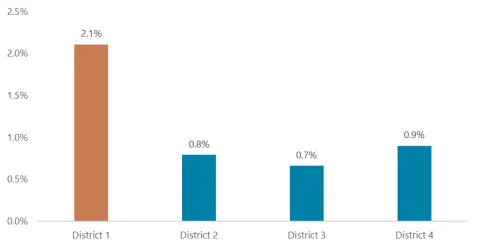
As noted in the Election Division’s 2024 Ranked Choice Voting Implementation Report, the City of Portland identified all residents of District 1, east Portland, as one of their priority populations and focused voter education and outreach in those communities in the lead up to the 2024 ranked choice voting election. Elections Division staff also noted the importance of targeted voter education efforts to address rates of overvotes and lower voter participation.
The 2024 ranked choice voter education campaign contributed to the majority of surveyed voters reporting they understood ranked choice voting
The City of Portland and Multnomah County collaborated on the ranked choice voting education campaign, with the city leading much of the ranked choice voting education work for its first ranked choice voting elections. The city’s voter education team was composed of the Charter Transition team, staff tasked with implementing the city’s new Charter requirements, and supported by city and county Elections staff.
According to a Voter Education Report published by the City of Portland’s Transition Team in March 2025, the city’s voter education team also collaborated with internal partners. Internal partners included:
- The City’s Government Transition Advisory Committee - a committee of community members
- The 311 Program - available to answer community questions
- Neighborhood Coalition Offices
- City of Portland Central Communications
- Portland City Council offices
The city’s voter education plan included broad education, hard-to-reach voter education, and a media campaign, as well as candidate education. Some components of the broad education campaign included six community town halls and 22 tabling events, and an educational mailer sent to every Portland household.
Some of Multnomah County’s focus included media education, a paid media campaign that included billboards, ads on busses, and television ads, as well as voter outreach events. The Elections Division also creates a voters’ pamphlet. The voters’ pamphlet goes out to each county residence. The voters’ pamphlet is not required by law but is a voter education tool the division and the county choose to create and fund because of its reach and impact.
A large majority of voters who responded to the post-election Portland Auditor’s survey conducted by FM3 Research reported they were aware of ranked choice voting before voting, with 73% of People of Color saying they were aware and 89% of White people saying they were aware. A majority of voters also reported hearing about ranked choice voting from the City of Portland mailer and local media, demonstrating the impact of the voter education campaign’s messaging through these media.
Voter education and outreach was a core service of the Elections Division
The Voter Education and Outreach program engaged underrepresented groups, including communities of color, unhoused voters, new citizens, and voters in custody. We found that the program met its objectives and reached many voters in historically underrepresented communities in the months leading up to the 2024 election. The voter education and outreach team attended 35 culturally specific events and reached over 5,000 voters. These staff also attended citizenship ceremonies and registered 1,106 new citizens. One community partner told us, “It was very useful for new citizens to learn about elections.”
The Voter Education and Outreach program also relied on other Elections Division staff with language and culturally specific skills to meet its objectives. Voter Education and Outreach program staff analyzed data from precincts, the smallest voting sub-division, to assess voter participation and demographics in order to shape voter engagement strategies.
The elimination of the Voter Education and Outreach program will negatively impact voters
Before FY2026 budget reductions, the Voter Education and Outreach program focused on removing barriers to voter participation through partnership-building and targeted outreach
The county has eliminated the Voter Education and Outreach program. Eliminating the program impacts the division's ability to implement equity initiatives and engage historically disenfranchised residents. The Department of Community Services’ requested budget for FY 2026 stated, “The Voter Education and Outreach program was established to identify and remove barriers to voter participation in underserved communities. The program is focused on building relationships, community engagement and targeted education and outreach opportunities. The elimination of this program will impact access to underserved communities.”
Multnomah County departments were required to submit reductions for consideration for the Chair’s proposed FY 2026 budget. The Department of Community Services, which includes the Elections Division, submitted the Voter Education and Outreach program as a potential reduction, and listed one full-time employee, contracted services, materials costs, and internal costs for a total of $256,000.
The division’s potential submitted reductions did not include the Voter Education and Outreach program technician position. This position was funded as a limited duration pilot position using one-time-only funds in fiscal years 2023 and 2024. While the Elections Division did request that the position be funded as a full-time position in its FY 2025 requested budget, it was funded again with one-time-only funds for $132,957, with $121,099 for personnel costs and $11,858 for materials and supplies.
This information was not included among the Department of Community Services’ submitted reductions for FY 2026; the division wasn’t required to include one-time-only dollars in its FY 2026 submitted reductions package, but without this information, the full scope and impact of what and who were being eliminated was incomplete. It is not standard across the county to include one-time-only costs in the reduction packages presented to the Board of County Commissioners, but at least one other department did include one-time-only costs that were part of a program listed as a potential reduction submitted to the Chair.
The Chair’s FY2026 proposed budget did not include the Voter Education and Outreach program. During budget deliberations, two County Commissioners put forth an amendment to include a $100,000 grant program in the division budget. The final FY2026 adopted budget included the $100,000 grant program, which will fund community organizations to conduct voter education for ranked choice voting focused on east Multnomah County residents, specifically those outside of Portland, many of whom will be voting in a ranked choice election for the first time in 2026.
Reliance on a new grant program for ranked choice voting education introduces risks related to reach, timing, and impact
There are risks associated with implementing a new grant program. Creating and distributing a grant to community organizations is new to the Elections Division. Staff will need to incorporate the grant program and grant management into their work without the addition of new staff. The division will need to create well-defined deliverables and metrics, as well as manage, monitor, and oversee those deliverables.
These were challenges the City of Portland faced leading up to its first ranked choice election. The city also created a grant program that supplemented the overall voter education campaign on ranked choice voting. The city awarded $210,000 to 11 organizations to support voter education activities. We heard from the city that it was difficult to measure the impact of the new grant. The Elections Division also shared with the Board of County Commissioners the results from the City of Portland’s Voter Education Report about some of the challenges including ill-defined program metrics and a swift timeline for partners to implement programming.
It is a difficult and unwelcome task for the Board to cut programming and positions. However, there may have been other ways to continue the Voter Education and Outreach program. If the program had been scaled down to perhaps the program technician role (previously funded with one-time-only funds), the county could have continued existing partnerships with culturally specific organizations, unhoused communities, and voters in custody.
The division has two staff positions that are knowledge, skill, and ability positions, one Spanish position and one Vietnamese position. The division staff members in these roles have provided subject matter expertise and facilitated language translation of elections materials, including at the state level, and are available to customers at Election Division buildings. The Voter Education and Outreach program also leveraged support from these staff members to deepen cultural and linguistic engagement out in the community beyond the Elections Division building and the Voting Center Express. The loss of the Voter Education and Outreach program means the Elections Division will not have staff to continue outreach to voters based on a precinct analysis of voter participation and will not be able to actively maintain many of the relationships built with community groups.
A community partner elaborated on the impact of the Elections Division Voter Education and Outreach program on their clients when they said, “Government and politics can at times feel very unreachable by our underserved communities. Having Mult. Co. Elections at our events to table and educate is critical in my opinion. They need to know their vote matters and is beneficial and learn how they get educated on the candidates and maybe even run themselves. It is a doorway to the political system for them.” We heard from community partners that the engagement reached clients from underserved communities. Several community partners also requested the Voter Education and Outreach program be continued or reinstated.
Without the voter education and outreach program and staffing, the county risks weakening equitable access to Elections Division resources and voter education
The Voter Education and Outreach program not only managed in-person outreach, but also facilitated social media for the Elections Division, specifically through the program technician position. The post-election survey that the Portland Auditor commissioned stated 38% of voters reported hearing about ranked choice voting through social media.
In the Election Division’s Ranked Choice Voting Implementation Report, the division identified one of the key takeaways from the 2024 ranked choice voting election as, “The primary challenge for the RCV elections in 2026 and beyond is achieving equitable access to educational information by performing targeted outreach to ensure all voters are reached. Specifically, additional and expanded outreach is needed with the following voter groups:
- City of Portland District 1 voters in general
- Voters in precincts with higher levels of overvote
- All voters of color
- Bilingual voters”
Portland’s District 1 borders East Multnomah County, comprised of Gresham, Fairview, Wood Village, Troutdale, and unincorporated areas. East Multnomah County shares some similar demographics to District 1, including within the voter groups identified for additional and expanded outreach, such as more people of color than in Portland in general. Wood Village, a city in Multnomah County bordering Fairview and Troutdale, for example is 50% Latine as of the 2023 U. S. Census Bureau’s American Community Survey. According to the East Multnomah County Inclusive Economic Development Roadmap, Gresham, Fairview, Wood Village, and Troutdale represent about 150,000 people who will be voting in Multnomah County’s first ranked choice election. Within these cities about 25% of the population speaks a language other than English.
Additionally, the county faces a challenge to fill the voter education role that the City of Portland performed in the last ranked choice voting election with voters outside of Portland. County voters outside of Portland, many of whom will be new to ranked choice voting in 2026, will not benefit from Portland’s past and current voter education and outreach. For example, the City of Portland held many in-person events as a part of its ranked choice voting voter education campaign, including events that allowed voters to practice filling out a ranked choice voting ballot. It is unclear if these kinds of events will take place in east county under the new grant program.
The Voter Education and Outreach program also contributed to division’s alignment with the county’s language, communication, and cultural access policy. The Voter Education and Outreach program engaged residents and provided in-person voter registration at many community events, including citizenship ceremonies. In 2025 the Department of Homeland Security issued a memo restricting non-governmental voter registration at citizenship ceremonies. The Elections Division partnered with other local jurisdictions, in late 2025, to continue registering new citizens following citizenship ceremonies. The work is being supported by the former Voter Education and Outreach program technician as an on-call worker.
Without dedicated voter education and outreach staff working outside of Elections buildings in community spaces, the Elections Division may struggle to provide the same level of equitable and cultural access it did through the Voter Education and Outreach program, a program that was focused on ongoing community outreach particularly with those in historically underrepresented in communities.
The Elections Division needs to better supports its staff
At the beginning of our audit, we conducted several interviews with permanent staff and heard various concerns about the work environment. We wanted to better understand the challenges that staff are experiencing and the impacts on the division’s ability to achieve its mission and vision. We found that many employees are experiencing challenges in their work and that the division needs to better support its staff.
In order to assess staffing challenges, we conducted an anonymous survey of current and former permanent and limited-duration employees. Twelve current and five former employees completed the survey. We also conducted a separate anonymous survey for on-call workers and received 167 responses out of 261 surveys sent, for a 64% response rate. We conducted interviews with almost every permanent or limited-duration employee and three on-call workers, and reviewed the results of the last three countywide employee surveys for the Elections Division. The Evaluation and Research Unit within the Department of County Management conducts the survey every two years to ask all county employees about their experience in the work environment, including job satisfaction, relationships with supervisors, communication, sense of belonging in the workplace, and equity.
The Elections Division is facing internal and external staffing challenges
The division relies on a small permanent staff and large pool of on-call workers to administer elections
In FY 2025, the Elections Division had 16 budgeted staff positions. This included a full-time limited duration employee to support the Voter Education & Outreach program. The division also received funding for a full-time limited duration position to oversee the implementation of ranked choice voting. Permanent staff work in highly specialized roles and staff describe their work as often siloed. The division also relies heavily on temporary on-call workers to administer elections. Over the course of FY 2025, the division administered the November 2024 presidential election and the May 2025 special election and employed 202 on-call and temporary workers. Some on-call workers take on lead roles during elections, including overseeing key functions of elections administration, training and supervising other on-call staff, and filling in for permanent staff during absences.
The permanent staff has grown while also experiencing significant staff turnover in recent years
In 2021, Elections Division staff conducted a strategic assessment of the division and determined that it was understaffed, posing potential risks to the accurate and reliable administration of elections. Elections are very complex and errors can occur at every step of the process, from ballot design to processing and tabulation.
The division proposed the addition of six positions and received three additional FTE (full-time equivalents) in the adopted FY 2023 budget, with another two FTE added in FY 2024. This assessment was conducted prior to the implementation of ranked choice voting in 2024, which increased the staff’s workload.
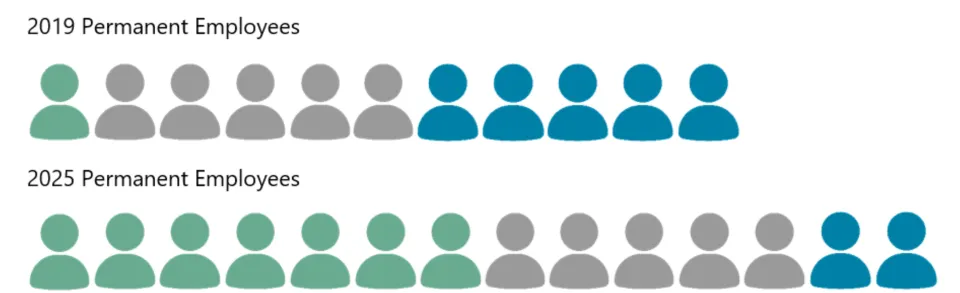
The division has experienced significant staff turnover in recent years, with several long-time employees departing and leaving gaps in institutional knowledge. Of 11 permanent employees on staff at the beginning of 2019, only three are still permanent employees with the Elections Division. The average years of employment for permanent employees has declined from 11 years in 2019 to 4.7 years in 2025. The addition of 12 new staff and the departure of 3 staff who each had over 20 years of experience contributed to this decline. Elections Division leadership told us that it takes four years for staff to work every type of election and therefore be fully trained. Only half of the permanent employees at the beginning of 2025 had over four years of experience with Multnomah County elections.
In the last six years, the number of employees with:
- Under four years of experience has increased (in green)
- 4-10 years of experience has remained the same (in gray)
- Over 10 years of experience has declined (in blue)
Elections workers are experiencing more stress nationally and locally
The national climate for election workers has also changed since 2016. Nationwide, election official turnover has increased over the past 20 years, and at a faster pace between 2018 and 2022. Between 2000 and 2004, approximately 28% of local election offices experienced turnover of their chief elections official. The turnover rate increased to 34% in 2020. This increased turnover is potentially due to increased threats and harassment and declining public trust.
A study of Oregon County election staffing by the Elections & Voting Information Center found that many elections officials are experiencing high stress due to the current political climate surrounding elections work, leading officials to consider leaving the profession of elections administration.
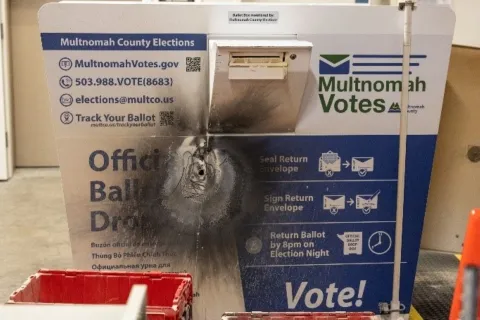
In Multnomah County, Elections Division staff also reported that their jobs are more stressful than they used to be. During the course of our audit, staff experienced two serious security incidents. In October 2024, an incendiary device damaged a ballot box on the sidewalk adjacent to the Duniway-Lovejoy Elections Building. In January 2025, the Elections Building was vandalized with graffiti and damage to windows and doors.
The Elections Division needs to minimize the risks of staff transitions and absences
We found that the division needs to improve its onboarding, cross-training, and maintenance of standard operating procedures in order to minimize the risks to elections administration. Because the permanent positions in the division are highly specialized, work can be significantly impacted by staff departures and unexpected absences. For example, one permanent employee oversees ballot counting and adjudication, while another oversees signature verification, and there are no other permanent employees assigned or cross-trained specifically to cover those responsibilities. Staff describe their work as often siloed.
“There’s been a huge loss of institutional memory in recent years, as experienced staff leave. Those who remain are often given workloads and assignments beyond their pay and job descriptions. (...) External pressures are growing, but the real threat is internal. There are good people there, but they won’t stay, and I worry that further turnover will precipitate a major system failure.” - Former Elections Division Employee
In interviews, several permanent staff and on-call workers shared the impact of staff turnover, noting that because staff often work in silos and rely on each individual staff member’s expertise, the division is at risk of having gaps in knowledge when experienced staff members leave. For example, in 2023, 550,000 ballots had to be reprinted because a District 3 county commission race was mistakenly included on all ballots countywide. Division leadership identified staffing changes and inadequate procedures as major factors in this error.
The Division does not sufficiently onboard and train staff to prepare them to fulfill their job responsibilities
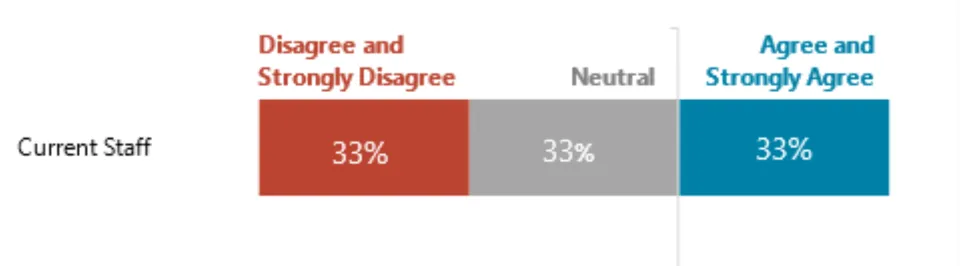
Effective onboarding is important for employee success, staff retention, and the successful administration of elections. In our survey of permanent and limited-duration staff, only 33% of current employees and 20% of former employees agreed that their onboarding fully prepared them to fulfill their job responsibilities.
Many current and former employees we surveyed felt they were not adequately onboarded
Responses to survey question: I received onboarding that fully prepared me to fulfill my position responsibilities.
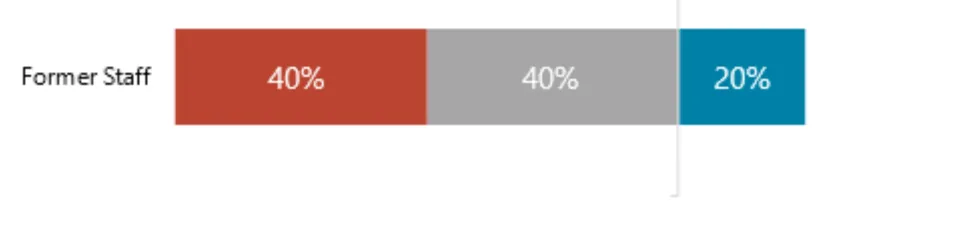
Results of the 2023 countywide employee survey also showed that a large portion of Elections Division employees did not feel they had received sufficient training. In reviewing documents provided by the Elections Division, we found that the division lacked position and employee-specific onboarding plans.
A majority of the current staff expressed in interviews that they received inadequate onboarding, or felt onboarding could be improved. In interviews, current employees expressed concerns and frustrations with their onboarding process, including:
- Not receiving an updated copy, or any copy, of their job description
- Not being fully informed of their job responsibilities
- Not receiving an orientation to the division and the responsibilities of other employees
- No documented procedures for key responsibilities
- Beginning their employment with no onboarding plan
The division often relies on staff who were previously in a position to onboard new staff. In interviews, staff who had access to the employee who previously held their position expressed that they found it helpful for learning their jobs. This approach to onboarding sometimes resulted in gaps, such as not learning tasks that are performed during a different time of the year than when onboarding took place and not gaining a full understanding of the division’s work. This approach also cannot be relied upon as an onboarding strategy, as outgoing employees will not always be available to train staff coming into their previous position. Because staff roles are highly specialized and key elections tasks require timely and accurate completion, effective onboarding of staff is critical.
The division does not consistently update standard operating procedures, and procedures may not exist for some important areas of elections administration
The Elections Division should have standard operating procedures for every function of the division to ensure the accuracy and integrity of elections. These procedures, along with clear job descriptions, can help the division avoid losing institutional memory when experienced staff members leave. According to elections administration best practices, elections administrators should have a regular revision schedule for standard operating procedures and designate responsible staff for conducting regular reviews. A staff person should also be designated to conduct regular reviews of all procedures to ensure they are accessible and up to date for the staff that use them for their work.
In our survey of permanent and limited duration employees, only 50% of current staff agreed that the division had written, updated operating procedures for critical functions of their role.
Only half of current employees that we surveyed agreed that there were written, updated operating procedures for their tasks
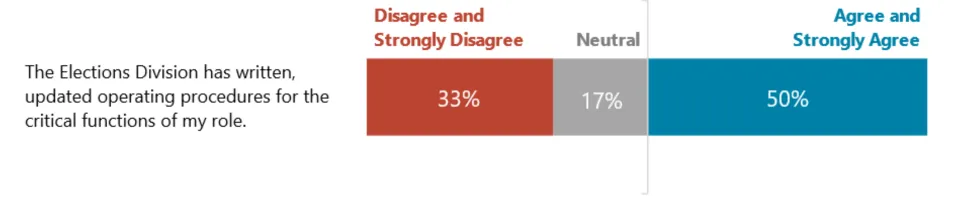
In interviews, several staff told us that written procedures did not exist for critical areas of their work. Some staff also identified other challenges to accessing or updating procedures, including not being told where to find procedures relevant to their role and not having the time to update procedures.
“There are useful procedures for the election results reporting functions. Not much else.”
- Current Elections Division Employee
In our review of elections procedures, we found that the division did not maintain a centralized list of procedures to track updates. The division updated many procedures in order to implement ranked choice voting in 2024. However, we found that the vast majority of existing procedures had not been reviewed recently, or that review was not documented. Out of 45 procedures, 41 were last reviewed over two years ago according to the dates listed on the procedures.
Nonexistent or out-of-date operating procedures can pose risks to elections administration. Procedures that are not updated regularly can quickly become outdated due to changing laws and regulations. Standard procedures are also particularly important for on-call workers, who may not remember how to complete a task or know how a process has changed from their last election.
The division lacks cross-training tracking and plans, resulting in potential gaps in coverage for key functions
According to the U.S. Elections Assistance Commission’s Election Management Guidelines, cross-training staff is critical to reducing the risk to elections if an experienced staff member is absent or departs from their position. Elections Division leadership acknowledged that while the division’s cross-training has improved over the years, staff turnover has impacted the division’s progress towards being adequately cross-trained for critical functions.
In our survey, only half of the current staff agreed that they had been cross-trained to cover for other positions, and only half agreed that other staff had been cross-trained to cover their areas of responsibility. We also heard from several staff in interviews that cross-training in the division is limited.
In our survey, many current staff responded that they had not received cross-training for other roles and that other staff were not trained to cover for them
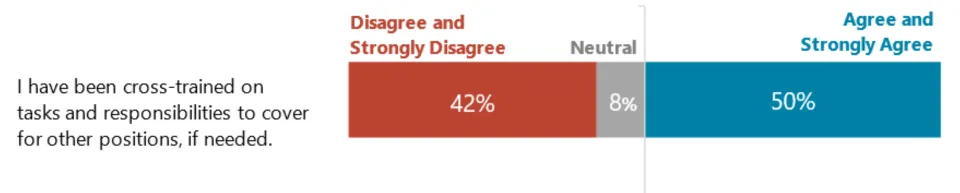

Due to limited cross-training, some staff are concerned about the coverage for critical tasks if the staff person primarily responsible were to be absent. In our survey, two-thirds of current employees agreed that there would be coverage for their responsibilities if they were unexpectedly absent during a critical time for an election. Eight percent of employees disagreed and a quarter were neutral.
While two-thirds of current employees agreed that there would be coverage for their responsibilities if needed, one-third disagreed or were neutral
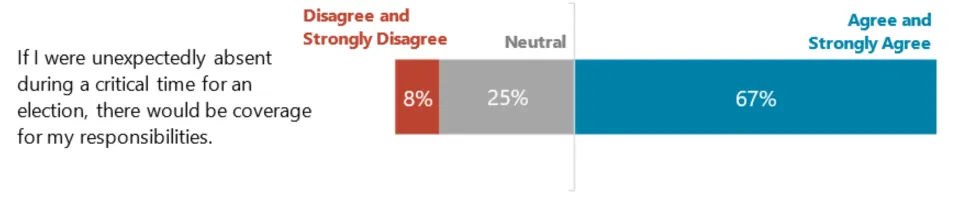
In interviews, several staff also expressed concerns about coverage for their responsibilities if they were absent and felt that the division needed to implement more cross-training to reduce the risks to elections.
Employees are experiencing challenges in the division’s work environment
A positive and supportive work environment for employees is a key value for Multnomah County. As stated in Multnomah County’s 2019 Workforce Equity Strategic Plan, “Safety and belonging are fundamental to the ability to thrive and foundational to what employees need.” A challenging work culture can result in more turnover and position vacancies, and this can have serious consequences for elections administration. Insufficient staffing can increase the risk of election errors and in turn, erode public trust in elections.
We reviewed the results of the last three employee surveys for the Elections Division, conducted in 2019, 2021, and 2023. For the vast majority of questions, division employees have reported a worsening experience of their work environment while results countywide have improved in most areas. For the most recent survey conducted in 2023, the Elections Division had worse results than the countywide average for 70% of questions.
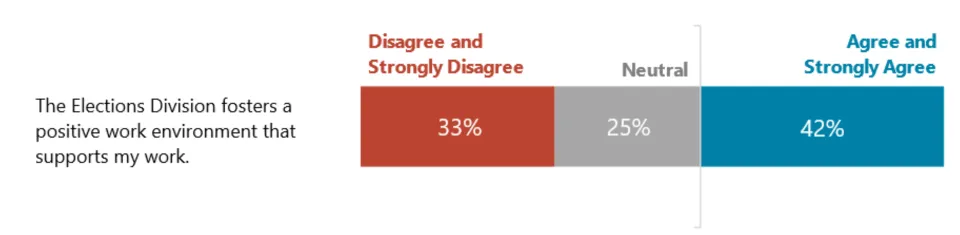
In our survey, only 42% of staff agreed that the division fosters a positive work environment, and we also heard about challenges with the division’s work culture in our interviews with staff.
Less than half of the current staff in our survey agreed that the division fosters a positive work environment
“[Leadership] has allowed a toxic work environment to fester. As a result, good people who know what they're doing and care about our mission are left unsupported and often end up pushed out. People who contribute little are never held to account for unprofessional and often toxic behavior. Good employees take on too much work while the [leadership] allows the bullies to run the organization.” - Former Elections Division Employee
While there are factors outside of the division’s control that are likely having a negative impact on staff morale, such as the political climate, security incidents, and harassment, we also found that poor management and communication practices are significantly impacting employee satisfaction.
Many staff described concerns about speaking up and a lack of transparency from management
Results from the 2023 countywide employee survey show that many employees do not feel comfortable speaking up about concerning behavior or feel valued for voicing their opinions.
“The work environment is very stifled. I get the sense that people do not feel comfortable speaking their minds.” - Current Elections Division Employee
In our interviews, many staff said that they felt uncomfortable speaking up or voicing new ideas. Some said they were willing to speak up, but often felt dismissed. Staff described a culture where concerns are not treated as valid, speaking up is poorly received, and disagreement is not tolerated.
Employees also felt that leadership should be more transparent and communicative, particularly about program changes and security and safety incidents. Several employees said that leadership did not address the emotional impacts of recent incidents, such as when an incendiary device damaged a ballot box, or provide adequate emotional support. A couple of on-call workers also felt that management was not being transparent about the scheduling process for on-call shifts, or the hiring process for limited-duration positions - which pay more than on-call positions.
Staff have experienced challenges with supervision and poor conflict management
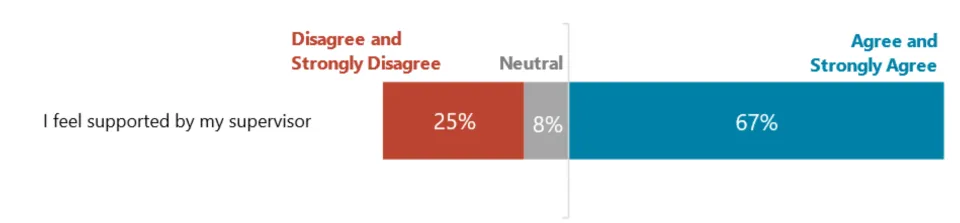
Working in elections administration can be extremely stressful and the work requires perfection to ensure the accuracy and integrity of elections. However, not all staff feel adequately supported to do their work. In our survey, a quarter of the current staff disagreed with the statement, “I feel supported by my supervisor.”
While most current staff in our survey reported feeling supported by their supervisor, a quarter do not feel supported
In our survey, some on-call workers also commented on the poor supervision and support they have received.
“The people who are in leadership positions seem to be newly hired into the position, and ill prepared for managing so many people and moving parts. I’ve helped out on multiple occasions and supervisors are very green.” - On-Call Elections Worker
In interviews, the permanent staff shared a wide range of experiences with supervision. While some staff described an overall positive experience with their supervisor, other staff described poor supervision, ranging from micromanaging to not receiving enough direction. Several staff also said the division does not have a culture of handling conflict in healthy and productive ways, and that division leadership does not support the staff in navigating disagreement.
Staff have low confidence in the division’s commitment to workforce equity
Results from the 2023 countywide employee survey show that many elections employees do not feel their department is taking concrete actions towards workforce equity.
“We are a small group of very dedicated staff who pull off miracles. It would be nice to see the county provide more support and hold leadership accountable for the lack of equity and inclusion within the division. We need more help, and concern over the well-being of staff who are routinely overworked each election cycle. We are not robots.” - Current Elections Division Employee
A couple of staff expressed in interviews that they were not receiving enough communication from Elections Division management about equity efforts. A few staff also expressed concerns about the number of employees of color who have left the division, and the lack of equity in pay and seniority between employees of color and White employees.
“Staff that work hard were routinely given more work to do, and pay was not equitable across the division. People of color and women were more likely to do more than in their job description and less likely to be adequately compensated for it.” - Former Elections Division Employee
Both permanent and on-call staff are not satisfied with their opportunities for professional development and feel undervalued
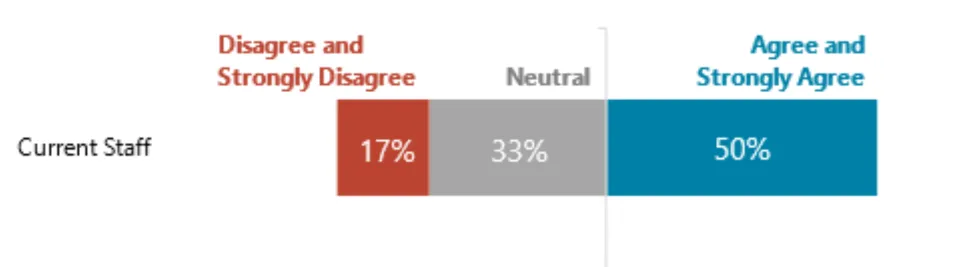
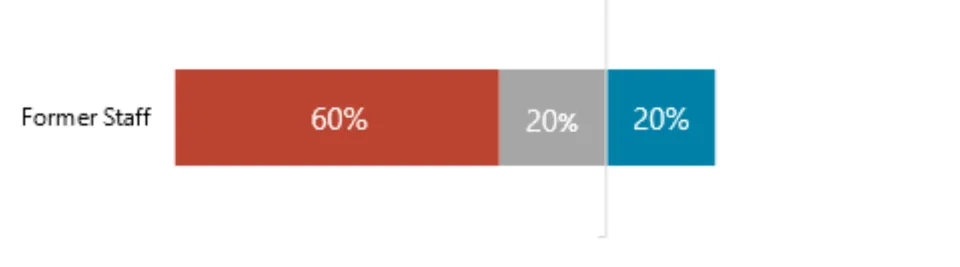
Professional development is an important strategy in advancing workforce equity, successful succession planning, and retaining employees. Only half of the current staff agreed that they are satisfied with their opportunities for professional development. Only 20% of the former staff agreed they were satisfied. The 2023 countywide employee survey results showed that a majority of Elections Division staff who responded did not feel fairly compensated for their work, or felt they had opportunities to advance their career.
Only half of the current staff in our survey agreed that they were satisfied with their professional development opportunities and the majority of former staff were not satisfied
Responses to survey question: I am or was satisfied with my opportunities for professional development.
In interviews, several staff expressed dissatisfaction with their opportunities for professional development. Some staff said they had experienced barriers, including a lack of support from their supervisor and challenges with balancing opportunities and their job responsibilities. A couple of staff said their supervisors never followed up on goals outlined in their annual Performance, Planning and Review (PPR) process, the county’s tool for work goals and professional development.
“My experience at Elections has been filled with frustration and disappointment at the lack of support and preparation. The opportunities for advancement seem to only exist for white staff, and my professional goals as outlined in the PPR process have gone ignored by management.” - Current Elections Division Employee
In our survey and interviews, several on-call workers commented on the low pay of on-calls given their importance to successfully administering elections.
“On Call workers perform duties that regularly equal those of full-time employees, especially during large elections. Many are reservoirs of experience and practical knowledge without which Elections could not function. The degree to which that fact is acknowledged in a meaningful way (as in when making decisions about how to change processes or make improvements) varies widely by which staff member they directly report to.” - On-Call Elections Worker
The Elections Division is understaffed to achieve its mission and vision
Multnomah County’s Elections Division is understaffed compared to the peer jurisdictions they look to for best practice
We compared the staff size of the Multnomah County Elections Division to elections offices in seven comparable or neighboring jurisdictions. Comparing elections offices across jurisdictions can be challenging, as elections offices vary widely in size and the functions they perform. All of the jurisdictions we selected for comparison are mid- and large-sized counties in states with Vote by Mail. Two of the counties, Salt Lake County, Utah, and Boulder County, Colorado, have administered ranked choice voting elections, and a third, King County, Washington, is preparing to implement ranked choice voting in 2027.
We found that the ratio of permanent FTE (full-time equivalent) staff to ballots processed varies across jurisdictions. However, Multnomah County has a smaller staff when compared to the two jurisdictions that the Elections Division looks to for best practices, Denver County and King County.
| County | Ballots Processed per FTE for November 2024 Election | Population | Total Permanent FTE |
|---|---|---|---|
| Denver County, CO | 12,315 | 715,522 | 30 |
| Boulder County, CO | 12,457 | 330,758 | 16 |
| King County, WA | 16,281 | 2,269,675 | 71 |
| Salt Lake County, UT | 28,988 | 1,185,238 | 18 |
| Multnomah County, OR | 29,924 | 815,428 | 14 |
| Washington County, OR | 30,111 | 600,372 | 10 |
| Pierce County, WA | 34,111 | 921,130 | 13 |
| Clackamas County, OR | 35,559 | 421,401 | 7 |
Source: Multnomah County Auditor’s Office analysis, based on 2020 US Census (Population), interviews with Elections staff in each jurisdiction (Permanent FTE), county elections websites (Ballots Processed).
King County and Denver County have multiple staff dedicated to voter education and outreach, while Multnomah County has none. The Multnomah County Elections Division’s vision statement includes a goal of having equity focused resources for communities that may experience barriers to participating in elections, but no longer has dedicated staff to support this work.
Staff have a high workload during general elections
The division’s vision statement includes the goal of a healthy and resilient team, including a staffing structure that reduces the risks to elections and supports the safety and mental health of employees. However, results from the countywide employee survey show that a majority of staff who responded do not feel the workload is properly distributed.
Many staff we interviewed said they don’t feel the Elections Division has enough staff, and several said they have experienced a high workload or felt the workload was unevenly distributed. Over a 40-day span to administer the November 2024 Presidential Election, 11 of the permanent, limited duration, and on-call lead staff worked over 10 consecutive days. Most staff worked at least one day over 10 hours, with over half of the staff working at least five days that exceeded eight hours. Four of the staff worked 20 or more days that exceeded eight hours. Fatigue can lead to mistakes, and high workload can also contribute to staff turnover.
The Elections Division has outgrown its current facility
As we conducted initial research for this audit, we heard concerns from Elections Division staff about the limitations of their current main facility. Concerns included that the building was not large enough to conduct elections with high turnout, and that the building and its location did not provide enough access to Multnomah County voters. We had similar concerns as we observed on Election Day for the November 5, 2024 election. We found that the Election Division’s main facility limits access to voters and staff and there isn’t enough space in the main facility to process ballots during large elections.
The Elections Division uses multiple spaces to administer elections. The division’s primary office is located in the Duniway-Lovejoy Elections Building at SE 10th and Morrison in Portland. It is open during the county’s regular business hours. It is where staff provide assistance to voters, including registering to vote, obtaining ballots, and dropping off ballots. This is also the primary location for processing and tabulating ballots.
Management has organized the Duniway-Lovejoy facility to support election integrity. For example, they segregate key elections activities in different rooms and ensure that critical systems do not have internet access. While steps have been taken to sustain the facility as a usable building, it is not an optimal building to meet the division’s needs because of issues around location, accessibility, and safety. The Duniway-Lovejoy Building is not a sustainable building for the Elections Division in the long term.
During recent elections cycles, the division has also operated a satellite location, the Voting Center Express located in Gresham, inside the East County Health Center. It is not open year-round but opens in the weeks before an election. Voters can register to vote, obtain ballots, vote, and receive assistance in a preferred language.
Election also rents a small section of a county-owned warehouse. During larger elections, such as when federal offices are on the ballot, the division sometimes uses this space to organize ballots and then move them to the Duniway-Lovejoy Building for processing. Processing ballots across two locations is not ideal because it increases the risk of misplacing a ballot. It also increases a security risk when ballots are transported. However, the Elections Division Director has indicated that they might not be able to afford this rental in the future because of rising facilities costs.
The Duniway-Lovejoy Building provides limited accessibility to voters and staff
The building is located in a busy area with no parking devoted to voters. There is street parking, but the neighborhood is centrally located and it can be challenging to find a parking space. This especially impacts voters and employees with mobility issues. Elections Division staff told us that some on-call staff are older, a group of people more likely to have mobility issues. To help address this, Elections Division staff told us that they obtained temporary permits to secure street parking spaces for Elections Division vehicles and for on-call employees with mobility issues during elections. They also have four disability parking spaces in front of the building.
Parking is limited
Limited parking spaces for people with mobility issues mean it’s harder for those people to access the building or obtain other services there. It also puts an undue burden on employees with mobility issues. The lobby can get overly crowded during busy elections. For example, we observed that the November 2024 election was busy with a line of voters going around the block. This creates a potential safety risk, especially for people in wheelchairs, as there is only one wheelchair-accessible exit in the lobby. Management told us that the lobby’s second public door can’t be made accessible due to existing architecture.
The building is old and not designed for elections
It can be difficult to move between floors in the Duniway-Lovejoy Building as well. The facility was built in 1925. The Elections Director told us that during elections, there is a lot of vehicle traffic in the building. There is not a lot of space for vehicles to move through as employees bring in ballots from ballot boxes. The path to exit the building is narrow for vehicles.
There is only one elevator in the building, and it has a history of breaking down. The Elections Director told us he had looked into installing a second elevator but there are structural issues with the building. Elections Division staff use the elevator to move ballots through the facility and not having access to it during an election would inhibit the division’s ability to process ballots.
In FY 2024, the Duniway-Lovejoy Building accounted for 2.5% of the county’s service task costs and 46% of the Department of Community Services’ service task costs. Service tasks in FY 2024 included installing a new sprinkler system and installing insulation to an exposed ceiling.
There isn’t enough space for ballot processing during busy elections
During busy elections, the division uses rented warehouse space to unload and prepare ballots. This is because there isn’t enough space in the Duniway-Lovejoy Building to safely accommodate the number of vehicles coming through to deliver ballots. The drive between the two buildings is 14 miles. Processing ballots in a single location is more efficient because it would eliminate the time needed to drive between locations. There is also an increased risk of misplacing ballots the more places the ballots go. Elections officials are required to keep a record of every time a ballot moves to a different location, but it is easier to track the movement of ballots when they go to fewer locations. All six jurisdictions we spoke to for this audit – the City and County of Denver, Colorado; Salt Lake County, Utah; King County and Pierce County, Washington; and Clackamas County and Washington County – all process ballots at a single location.
The Elections Division has reduced the risk of mapping-related ballot errors, but still needs GIS expertise
For the May 2024 primary, the Elections Division mistakenly mailed roughly 9,300 ballots that were missing a referendum that should have been included. While investigating the errors, Elections Division staff discovered 170 registered voters for whom district boundaries had not been updated from the last round of redistricting in 2022. (Redistricting is the process of updating boundaries for legislative districts.) Elections mailed replacement ballots to all affected voters before election day.
We wanted to learn what steps the division had taken to reduce the risk that errors like these would happen again. We found that the division has taken a number of steps to reduce the risk of error. However, there are additional ways the Elections Division could reduce risk.
Mapping districts in Multnomah County is complex
In order to send voters correct ballots, county staff plot voter addresses onto voting district maps. There are 15 voting districts in Multnomah County. The frequency and regularity of redistricting varies by district.
To maintain and update the data, the county uses a geographic information system (GIS), which is a computer system that captures, stores, and displays geographic data in interactive maps.
County GIS specialists use the data supplied by ArcGIS to put voter addresses in their correct geographic location to identify which voting precincts residents belong to. This placement is called geocoding. Geocoding voter addresses is how the Elections Division knows which ballots to send to which people.
County GIS staff update district boundaries as needed. At a minimum, this occurs every 10 years, after the U.S. Census. GIS staff take the redistricting map data from federal, state, local, and special jurisdictions and create an updated voter precinct map. Some districts update on a regular schedule, such as districts for county commissioners and congressional seats. Other districts update boundaries as needed.
Mapping district boundaries in Multnomah County is complex because it has many overlapping jurisdictions. A mistake in geocoding a voter’s address could place them in the wrong voting district. Precincts are sometimes split through district boundary lines or cut through property boundaries. Also, school districts and other special districts can have overlapping electoral boundaries. Precincts where this happens are called split precincts.
In a split precinct, not all voters will receive the same ballot. For example, voters on the west side or east side of a precinct might all be in the same congressional district, but they might not share the same school district. School districts and special districts sometimes have overlapping boundaries that require the Elections Division to split the precinct and can affect the number of districts or contests on the ballot. GIS staff need to identify areas where district boundary lines might cut through a precinct or property so that each voter gets the correct ballot. One of the county GIS specialists we spoke with, who works on elections mapping, described it as being like a spiderweb with different overlaying boundaries. Between the censuses, GIS specialists receive changes to layers or new jurisdictional boundaries, like an added urban flood safety water quality district.
The mapping process is complicated by the fact that the State of Oregon was supposed to roll out a new voter address system in 2024. This new system will have GIS embedded in it, but implementing that has been delayed.
Why errors occurred
After the ballot errors occurred in 2024, the County Chair called for a review of districting and ballot procedures. A consulting firm, the Elections Group, reanalyzed the district data. The firm specializes in elections administration. They found some key reasons why the errors occurred:
- Data sources had different naming standards
- Not enough documentation of the redistricting process
- GIS source data from Metro contained errors
- Unfamiliarity between GIS staff and Elections Division staff on the data and procedures of their counterparts
We found that the Elections Division has generally addressed these issues.
Data sources had different naming standards
Normalization is the process of standardizing data so that addresses will have a set format. This makes it easier to match data across different data sets. Normalization is an ongoing challenge for the Elections Division because it receives voter registration information from a variety of sources, including governmental agencies, hand-written voter registration cards, and digital registrations. It is also a time-consuming task. Also, while Elections Division address data generally uses postal standards to mail notification cards and ballots to voters, the GIS data used for the May 2024 ballots had come from Metro, a jurisdiction that focuses on property parcels.
The Elections Group found that while the Elections Division was successfully managing most address normalization issues, there were particular address types that had more errors than others. A significant portion of the errors from the May 2024 election were related to addresses that were descriptive, rather than specific. An example of a descriptive address would be “near the intersection of SE Hawthorne Blvd and SE 7th Ave.” A voter might provide their address in this way because they do not have a permanent address but spend a good deal of time in the location they describe.
Errors in GIS data
Until recently, the county had been using a GIS called the Regional Land Information System (RLIS). This system is operated through Metro, the regional government. This system is a compilation of more than 150 GIS data layers that serve as the spatial data infrastructure for the Portland Metropolitan area. However, a third-party review of the ballot errors by the Elections Group found errors in data supplied by Metro, and that these errors contributed to some of the ballot errors.
Loss of GIS expertise
This complex process requires GIS and elections expertise. The division previously had a long-time staff member who was a GIS specialist. The employee retired in 2022. The Elections Division now works with county GIS experts outside of the division. The division is located in the Department of Community Services, while county GIS staff are located in the Department of County Assets.
The Elections Division has taken steps to prevent similar errors in the future but could improve cross-training and collaborative opportunities
GIS staff created documentation procedures for redistricting for Elections Division staff
At the Elections Division’s request, the county GIS team created a document to help Elections Division staff understand the GIS team’s work in the redistricting process. This document lists all 15 districts the division is responsible for. As was recommended by the Elections Group, the GIS team created this documentation to help Elections Division staff understand the technical process behind redistricting. This work was needed because Elections Division did not have an in-house GIS expert.
The county now uses a more reliable source for GIS data
Because there were errors in Metro’s data, the GIS team told us they now use a commercial platform called ArcGIS. This is what the Elections Group used in their analysis, and county staff think it is more reliable because it leverages data from both government sources and commercial data. The GIS team told us this source uses a more robust algorithm and can handle a variety of inputs and accommodate for that variety, such as misspellings in names. However, the county GIS team also needs to rely on local jurisdictions to supply data. They sometimes still use Metro data as Metro updates most regional GIS data quarterly.
The Elections Division has improved quality control
In order to minimize the manual handling of address-district relationships, the Elections Division now has a process where if staff put a non-standard address into the address library, the address also has to go onto a separate spreadsheet. Two employees review the entry by checking the formatting and map location to ensure the precinct is correct.
The GIS team has created a map of boundaries with voter precincts that the Elections Division can use to search for addresses and see them on the map. According to the GIS team, this visualization wasn’t available to the division two years ago. The visualization is helpful for Elections Division staff to better understand the address data they are working with. It could also potentially help them see mistakes.
There could be more cross-training and collaboration between Elections and GIS staff
The Elections Group recommended that the Elections Division and GIS staff create an interdepartmental team that is cross-trained on each other’s tasks. The function of this team would be to promote collaboration and interdepartmental understanding. Two members of the Elections Division staff have done some cross-training to understand the work the GIS staff do. Activities such as creating the map of district boundaries provide opportunities for collaboration and learning. However, GIS staff have not done any cross-training on their counterparts in the Elections Division. If GIS work is going to be done by staff outside of the Elections Division, then division and GIS staff should provide more cross-training opportunities for each other. They should also find additional opportunities for collaboration, such as planning for redistricting after the next U.S. Census.
Having GIS expertise within the Elections Division would help reduce the risk that mapping-related errors could occur
There is still a risk that mapping-related errors could occur. This is because there isn’t an Elections Division staff person with substantive GIS expertise and dedicated time to do GIS work. Five out of the six jurisdictions we spoke with had internal GIS staff: The City and County of Denver, Salt Lake County, King County, Pierce County, and Clackamas County. While at least one Elections Division staff person has received a limited amount of GIS training, the lack of a dedicated GIS specialist within the division has left a hole in the division’s institutional GIS knowledge.
Additionally, GIS staff told us that for smaller districts, like school, water, and fire, the relationships that the former Elections Division staff person had with special districts were helpful in getting updated data.
While the county GIS staff who have been working with Elections Division are GIS experts, they are not elections experts. Voting-district mapping is a complex process specific to elections, and having GIS expertise within the Elections Division would reduce the risk of mapping errors. Multnomah County’s GIS team told us, and leadership agreed, that it would be good for the division to have someone on staff with GIS expertise. This would allow the Elections Division to update map boundaries and manage their own address file independently. GIS staff describe the current system as old, that it does not include GIS, and can be challenging to work with. Additionally, county GIS staff do not work with the data regularly the way the Elections Division staff do. It makes more sense to have the people who regularly work with the data map the data, especially given how crucial mapping is to ballot accuracy. Elections is an area where, realistically, there isn’t room for mistakes.
In order to reduce the risk for error, it will be important to have someone on the Elections Division staff with GIS expertise to create maintain data, keep up on changing technology, and develop relationships with jurisdictions. It would be most beneficial to the county and its hundreds of thousands of voters to have this person in place before redistricting takes place again in 2031 to help plan and prepare for the process. Ideally, this person would be on board at least a couple of years before the next census.
Recommendations
Ranked choice voting & Voter Education and Outreach
We recommend that the Elections Division, no later than May 2026:
- Advocate for and request the reinstatement of the Voter Education and Outreach Program for the FY 2027 budget.
One-time-only funds
We recommend that the Chair, COO, and Budget Office, no later than April 2026:
- Direct all county departments to include in all departmental budgets/reductions packages a description of and the function of any one-time-only funds that fund all or a part of a program and/or position(s) that could be cut or will not be re-requested.
Staffing
We recommend that the Elections Division, no later than January 2027:
- Develop an orientation curriculum for onboarding new employees to the division, including position-specific, individualized onboarding plans.
- Develop, implement, and maintain a cross-training plan to ensure that a sufficient number of permanent and on-call staff are cross-trained to cover critical areas of elections administration.
- Create training plans for all supervisors that include trainings on effective supervision, conflict resolution, trauma-informed practices, and equity.
- Create a transparent process for permanent and limited-duration employees to pursue professional development opportunities. This should include creating a decision-making framework for approval and allocation of any available training dollars and outlining an approach to supporting employees in balancing position responsibilities with opportunities.
- Communicate with on-call workers about the overall approach to scheduling shifts, use of limited-duration positions, and opportunities for career advancement.
- Create a centralized inventory of standard operating procedures that tracks when procedures were last reviewed, and develop a regular schedule for reviewing all procedures.
Building & safety
We recommend that the Elections Division, no later than June 2027:
- Develop a plan for a new Elections Division facility.
Ballot errors
We recommend that the Elections Division, no later than May 2026:
- Advocate for and request a staff position within the Elections Division that has GIS expertise for the FY 2027 budget.
- Create and implement a cross-training and collaboration plan for GIS staff and relevant Elections Division staff, including preparing for redistricting in 2031.
Objectives, scope, & methodology
The objectives of this audit were to:
- Determine the extent to which the division has remedied recent ballot errors and steps taken to prevent similar errors in the future.
- Describe the Elections Division’s implementation of ranked choice voting and assess impacts on voter participation, particularly for historically underserved populations, as well as identify improvements for the 2026 election.
- Assess the division’s current facility and safety plans and their impacts on the division’s ability to administer safe, accessible, and secure elections.
- Identify any structural staffing challenges that could contribute to inequities and impact the division’s ability to achieve its mission and vision.
To accomplish these objectives, we:
- Conducted 46 interviews, including with:
- Permanent and limited-duration employees
- Lead on-call workers
- Multnomah County GIS and IT security staff
- Subject matter experts on ranked choice voting
- Elections offices in similar jurisdictions
- City of Portland elections staff
- Conducted a survey of current and former permanent and limited-duration staff, and a separate survey of on-call workers
- Conducted a survey of community-based organizations that partnered with the Elections Division Voter Education and Outreach
- Reviewed results from the last three countywide employee surveys
- Reviewed documents provided by the Elections Division related to staffing and operations, including budget, procedures, and strategic assessment
- Reviewed analysis and recommendations about the 2024 ballot errors from the Elections Group, an election consulting firm
- Researched best practices and academic literature on elections administration, ranked choice voting, and voter education and outreach
- Reviewed staffing, voter turnout, and budget data, and reviewed analyses of City of Portland ranked choice voting election results and other ranked choice voting elections
For this audit, we analyzed human resources data from January 1, 2019 through July 1, 2025 from Workday, the county’s enterprise planning resource system. We also analyzed aggregated data from the countywide employee surveys from 2019, 2021, and 2023. This data was provided to us by the Department of County Management’s Evaluation and Research Unit, which administers the survey.
We assessed the reliability of the data by (1) performing electronic testing for obvious errors in accuracy and completeness, (2) interviewing county officials knowledgeable about the data, (3) reviewing related documentation, and (4) close collaboration with county officials to identify any data problems. Our office has determined that the data were sufficiently reliablefor the purposes of this report.
We also provided safety-related information to management, which was not included in this report to reduce the risk that the information could be misused to cause harm.
The scope for our audit was generally fiscal years 2019-2025 in looking at budgets and engaging employees. Because the 2020 presidential election was an outlier in some ways due to the pandemic, we also looked at elections data as far back as FY 2009 to include multiple presidential elections.
We conducted this performance audit in accordance with generally accepted government auditing standards. Those standards require that we plan and perform the audit to obtain sufficient, appropriate evidence to provide a reasonable basis for our findings and conclusions based on our audit objective. We believe that the evidence obtained provides a reasonable basis for our findings and conclusions based on our audit objectives.
Audit staff
Siniva Bennett, Performance Auditor
Dani Bernstein, Senior Auditor
Mandi Hood, Senior Auditor