When Baddy Birya’s son, Amir, was around 15 months old, his family began to notice subtle things about his development, even as he reached several milestones.
“The challenge was he was not speaking, not even a single word,” Birya remembers. “We started seeing the signs — flapping his hands, speeding and turning. We knew we needed an intervention to truly understand what was going on.”
Birya and his wife took Amir to their primary care physician, as well as early childhood specialists. They felt supported and reassured as they were guided through therapy and the stages of an autism diagnosis.
“My son, who is now seven, is on the autism spectrum, and it was something really new to us,” Birya says. “My view as a parent is that no single parent should feel isolated because of a challenge like autism, behavior or any other issue, for that matter.”
The family was connected to many services, including Multnomah County’s Intellectual and Developmental Disabilities (I/DD) Division, which works to support people with intellectual and developmental disabilities, along with their families, enrich their quality of life, and find greater inclusion in their community.
The division determines eligibility and provides comprehensive case management, linking clients to critical resources: Medicaid-funded residential and employment programs, in-home care, transportation, and rent assistance.
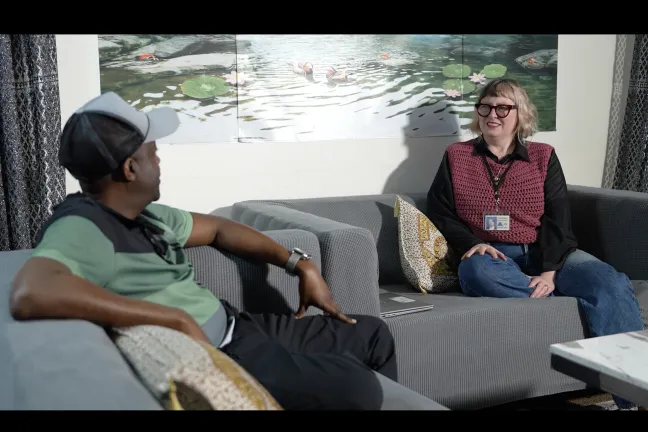
“When I first met this family, they did not know about the services that were available to them,” said Erica Borman, a service coordinator for the I/DD Division. “So the first step we went through was just educating them about what you could have.”
Borman helps create support plans for families, which can sometimes also mean unlocking critical in-home support services, such as sensory support tools, assistive devices and home modifications. This can also include in-home attendant care, relief services, chore support and more.
“It's me and my wife in this ballgame, and sometimes we have personal issues to attend to for the benefit of the family,” says Birya. “So we support him and we have someone who comes to support Amir — someone who supports us to support Amir.”
Borman has become an extension of the Birya family, helping them through critical times and processes.
While Borman loves her work, she is candid about its realities: navigating Medicaid and the bureaucracy is challenging.
“In order for us to maximize the program and provide the most help, we have to be able to actually access it. A lot of times, the process, the bureaucracy, gets in the way — makes it hard," Borman says.
“The Birya family is in a different spot, but for others having to reapply for Medicaid every year, it can be overwhelming, especially when you already have a child with a disability or if you yourself have a disability.”
March is Intellectual and Developmental Disabilities Awareness Month, a time to raise awareness and celebrate inclusion of people with intellectual and/or developmental disabilities in every facet of community life. More than 8 million people across the United States live with intellectual or developmental disabilities.
“Anybody can become disabled at any time,” says Borman. “These programs are not just for our disabled community members. They're potentially for us.”
For Birya, Borman’s transparency became his greatest resource.
“Information is power. Without information, you can do nothing,” he says. “We get the information we need from Erica about programs through the County and the avenues of assistance available. We feel that somebody cares about the challenges we are facing.
“We feel that we belong to a team. We're not isolated.”
To continue its mission of connection, Multnomah County’s Intellectual and Developmental Disabilities Division will host two events this spring:
The 2026 I/DD Information Fair: Thursday, May 21 from 12:30 p.m. to 4:30 p.m. at the DHS Center (11826 N.E. Glisan Street in Portland).
Documentidd-info-fair-flyer-2026.pdf (2.75 MB)The 16th annual Employee & Program Participant Art & Craft Show: Thursday, June 4 at the Caldera Art Gallery (1227 NW Davis Street, Portland). The event will feature a public art reception showcasing the creative talents of I/DD staff and participants. The event will open from 12:30 p.m. to 3:00 p.m. and 5:00 p.m. to 7:00 p.m.
Document_art-reception-poster-2026.pdf (172.08 KB)
Both events are free and open to the public.
“It's very important to me that the people we serve are seen as valued community members,” said ToiNae Gibson, Children and Young Adult Program Manager.
“That’s what drives me. I've seen this evolution of not only building and providing more support to people so they have this life and overcome challenges, but also educating them and letting them know they have rights.
“You have the ability to make choices, which was something that was not offered to people.”
Today, you can find Amir speaking — and not only in English. He has started teaching himself new languages, including Spanish, and is exploring alphabets from countries like Russia and Kazakhstan. You might even catch him singing.
“Every brain is beautiful. Every difference should be celebrated,” said Borman.
“I think it's really important that we are kind and patient with each other because every, every different way somebody thinks is a value-add.”