
Dear friends and neighbors,

This month, we concluded part of a years’ long project into the history of the Multnomah County Auditor’s Office with the publication of an article in our professional association’s regular publication, the Association of Local Government Auditors Quarterly. Performance Auditor Dani Bernstein and Sr. Auditor Mandi Hood wrote the article titled Learning from our past: A brief history of the Multnomah County Auditor’s Office.
I wanted to share the article with you in full because it provides a great overview of our office’s history, how performance auditing continues to evolve, and how we can draw on the past to keep moving toward accountability and justice. In this bleak time when access to SNAP benefits is being restricted, ICE acts with impunity, and so many other horrible federal actions seem to happen every day, I found this article hopeful about the role your local government auditors play in supporting government that works for the people. As the county’s budget forecast remains bleak, my office’s accountability work will continue to be important to providing you with information you can trust to help improve our county.
Thank you,
Jennifer
Learning from our past: A brief history of the Multnomah County Auditor’s Office
By Dani Bernstein and Mandi Hood
“If you don't know where you've come from, you don't know where you're going.” - Maya Angelou
“Know whence you came. If you know whence you came, there is really no limit to where you can go.” - James Baldwin
Introduction
Over the past eight years, the Multnomah County Auditor’s Office staff have done a lot of reflecting on how we can better serve our local community through our audits. We talked about the fact that many people in our community are not familiar with what our office does. This is a problem because we answer directly to voters. We believe that connecting with the public is a vital part of our office's work. We realized that if we want to build stronger relationships with communities in Multnomah County and produce impactful audits, it will be important for both the public and auditing staff to understand the history of our office's work. A look at the past may seem like a strange topic for an ALGA Quarterly about Emerging Issues, but as the quotes from Maya Angelou and James Baldwin note, to prepare for the future, we need to know where we’ve been.
To learn more about our office’s history, we reviewed archive materials related to the history of our office and the history of our region. We also conducted interviews with former elected Multnomah County auditors and staff auditors.
The Office’s Early Years
The original function of the Multnomah County Auditor was notably different than it is today. The Oregon State Legislature created Multnomah County in 1854 and appointed the county’s first auditor. The Auditor’s original function was to serve as the county’s accounting officer. Though there were some changes, this was generally the function of the Auditor during the early years of the office and for the first half of the 20th century.
The first notable shift in function occurred during the tenure of auditor John O’Donnell. Voters approved a Home Rule Charter in 1966 that created a Department of Finance, making some of the office’s work duplicative. An early version of the charter eliminated the Auditor’s Office but O’Donnell threatened to oppose the charter entirely. O’Donnell had the longest tenure as county Auditor, serving from 1951-1974. O’Donnell wasn’t considered the best of Auditors. A local paper called him “a political accident who has no real qualifications for the job and has just bumbled through.” A county commissioner once said that O’Donnell “didn’t know an audit from ham on rye.” After almost 25 years in the position, O’Donnell was persuaded not to run again in 1974.
The origins of performance auditing in Multnomah County
O’Donnell’s exit from the office occurred during a time of political and cultural transition for the United States. Former Multnomah County and City of Portland Auditor Jewel Lansing noted in an article about the origins of performance auditing in Oregon that the national public interest movement of the 1960s had reached the accounting profession in the early 1970s. Because of this, Lansing helped found the Oregon Accountants for Public Interest in 1972. She was a civic-minded accountant who became inspired to pursue performance auditing after a conversation she had while driving Lennis Knighton to a conference in Central Oregon in 1974. Lansing had a background in auditing nonprofit organizations that received government grants. She wrote that she realized early in her tenure as Multnomah County Auditor that she could make a major contribution as an elected official by conducting performance audits.
Lansing became the Multnomah County Auditor in 1975. She replaced internal auditors with analysts and began incorporating aspects of performance audits into the office’s work. A talk Lansing gave to the Portland City Club in 1975 illustrates how a performance audit broadens the potential scope of an audit to include the impact on service users. She noted that the General Accounting Office’s (the precursor to the Government Accountability Office) definition of “accountability” delineated three elements of government accountability: Financial and compliance, economy and efficiency audits (also called operational or management auditing), and performance auditing. In economy and efficiency audits, Lansing noted that auditors ask questions such as,
“Is the taxpayer’s dollar being efficiently spent?
Could this organization be making better use of its resources, its personnel, space, its equipment?
Is there duplication of effort that might be eliminated?
Are the administrative procedures adequate and organizational structures sound?”
She noted that the performance audit was the newest and most controversial type of auditing. This may be because performance auditing grew out of financial auditing, which was arguably less concerned with understanding larger constructs, such as social and racial equity and systemic root causes. And the idea of performance auditing was still fairly new in 1975.
In performance audits, Lansing said auditors could ask:
Are the purposes of this program being met?
Are the people for whom the program was intended being served?
These last two questions allowed auditors to center their work around residents and the impact programs have on them. This is a notable and substantive shift in the function of governmental auditors. Audit work now had the potential to go beyond finding ways to reduce errors and increase efficiency. Multnomah County auditors could now assess how well programs served the community and if they were changing people’s outcomes for the better.
Performance auditing allowed auditors to approach their work from a more community-centered place: it was now in their purview to assess both how efficiently people’s tax payer dollars were spent and how programs served the community to improve outcomes. Examining Lansing’s tenure showed us how performance auditors have the opportunity to consider the context in which our systems work, and in which we live, to assess program outcomes.
A New Vision for the Auditor’s Office
The late 1970s and early 1980s were tumultuous times in the United States. Americans experienced economic upheaval as the country moved through a recession that began in the late 1970s, which increased the need for county services. Voters approved an amendment to enshrine the audit function in the Multnomah County Charter in 1978. Anne Kelly Feeney, who was county Auditor from 1983-1988, told us she tried to balance audits across county operations. As in Lansing’s tenure, the office performed a combination of operational and performance audits. Feeney said that her delight and joy were operational audits, and that she was most proud of the juvenile court audit conducted during her tenure. She described the value of auditing as someone fresh coming in and asking big-picture questions. Feeney resigned in the middle of her second term after voters approved a County Charter amendment to limit the salaries of elected officials.
Dan Ivancie was elected Auditor in 1988. He did not have any prior auditing experience but came from a politically prominent family whose last name was well-known. It was during Ivancie’s tenure that a requirement was established in the County Charter starting in 1992 for the Auditor to be either CIA or CPA. Ivancie was neither. In his role as Auditor, he suggested that a property which had once been a nursing home and a “poor farm” be turned into a golf course.
Gary Blackmer, then a senior management auditor at the City of Portland, unseated Ivancie and was elected in 1990 and held the office for most of the 90s. It was during Gary’s tenure that the performance audit function was established in the County Charter. Blackmer was less than impressed with the reports issued during Ivancie’s tenure and fired most of the audit staff. When we spoke with him, Blackmer said that because the audit function had been weakened under Ivancie, hiring new staff and cranking out performance audits felt like plowing fresh land. As for the mission of the office during the 90s, Blackmer said he wanted to make a difference in people’s lives – not just employees and elected officials but also people receiving services. He valued going out and talking to employees and asking them what gets in the way of their work, in order to understand where they’re coming from and figuring out a solution.
Strengthening a Focus on Ethics
With performance auditing firmly established, the office expanded its work around ethics, along with efforts to educate the community about the office’s work. In the early 2000s, the Auditor’s Office focused on audits of the county’s social service programs, while also balancing audit topics with other areas of the county’s work. Auditor Suzanne Flynn, who served from 1999-2006, brought a social service background to her work as an auditor and wanted to raise community awareness about the office’s work. Flynn engaged with civic and neighborhood groups, and created the office’s Service Efforts & Accomplishments reports, a tool for increasing accountability in county government by annually reporting on the outcomes of county services. These reports ended after 2007. Flynn told us that auditing was an important public service, but sometimes found it challenging to have a tangible impact and make the community aware of performance audits.
Auditor LaVonne Griffin-Valade succeeded Flynn and served as Multnomah County Auditor from 2007-2009, until she ran for and was elected Portland City Auditor. While at Multnomah County, Griffin-Valade established the office’s Good Government Hotline for staff and community members to report suspected fraud, waste and abuse of position. The hotline was established in part because a county employee had embezzled an estimated $300,000. Auditor Steve March succeeded Griffin-Valade and served as county auditor from 2009-2018, expanding the office’s work to promote an ethical culture. He told us that during his tenure, the office focused on the basics: making sure county programs were running efficiently and effectively. March maintained the office’s emphasis on performance auditing, while also valuing the expertise of 1-2 CPAs on staff to conduct investigations into suspected fraud. Under March, the office also began conducting a county ethical culture survey; March said this was due to an ethics scandal in county leadership and frequent turnover at the top of the organization.
Embedding Equity into Practice
A significant shift towards embedding community engagement and equity into auditing practices began in 2019 under current auditor Jennifer McGuirk. The office updated its mission statement and values to emphasize accountability, equity and inclusion. The office has also adopted trauma-informed approaches and developed protocols for integrating equity and community voice into every step of the audit process. Audit topic selection now includes criteria that give particular weight to impacts on vulnerable populations and life/safety issues, and auditors are tasked with ensuring at least one recommendation in every audit supports equity. The office has also shifted its reporting style to be more accessible and persuasive to the public, rather than writing only with management in mind. Auditors strive to write in plain language and with an eye towards increasing public understanding and awareness of county government.
Conclusion
As a profession, we find ourselves in a period of significant challenges for local governments, with public trust on the decline and attacks on diversity, equity and inclusion initiatives by the federal government. This challenges us to continue to perform our vital public service in a time when transparency, accountability and equitable outcomes for all are desperately needed. We have an opportunity to better understand the potential of performance auditing to call out root causes of the problems our communities face. By reflecting on the origins of performance auditing in Multnomah County, we can see how the move towards performance auditing opened the door for us in Multnomah County to center those most impacted in our audits. We also recognize that it’s critical for our work to continue to evolve, especially when it comes to centering our work around the people who matter most - our communities. We hope this article has highlighted how our profession continues to transform to better serve the public and remind each of us of our capability to create meaningful change in this world.
Community engagement
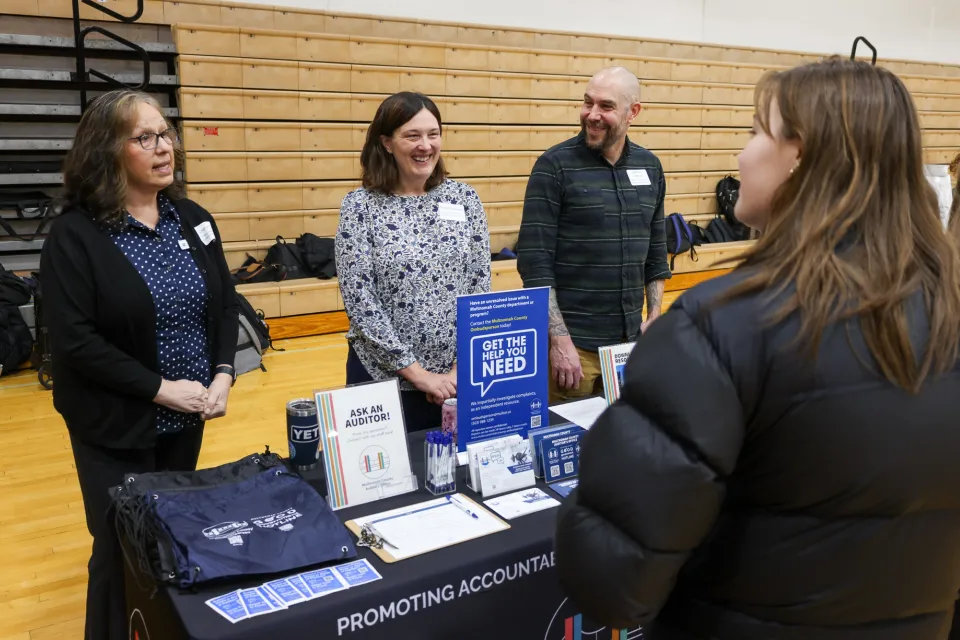
On December 5, Audit Director Nicole Dewees, County Ombudsperson Cheryl Taylor, Performance Auditor Jeremy Johnson, and Constituent Relations and DEI Engagement Specialist Raymond De Silva represented my office at the 15th annual Democracy in Action event. This annual event hosted by Central Catholic High School provided space for seniors to engage civically with local government offices and other related political organizations. We answered thoughtful questions about how we serve the community through our four pillars of audit reports, ombudsperson-work, good government hotline, and community engagement.

Invite Auditor McGuirk to attend an event or meeting
If you’d like me and or staff to attend or speak at a meeting with your community group, simply fill out this form.
Photo Credit: Marcus Morton '27, Central Catholic High School