May is Older Americans Month, a time to recognize, celebrate and support older adults. This year’s theme, “Champion Your Health,” underscores prevention and wellness as cornerstones of healthy aging.”
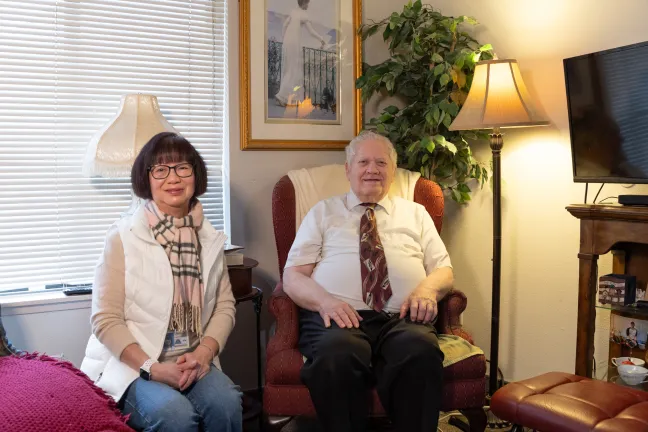
Sherry Braga has peace of mind knowing her 85-year-old father, Wendell Owens, is receiving the care he needs — a prospect that wasn’t assured several years ago.
“Life has unexpected twists and turns that you don't see coming, and so you have to navigate them,” said Braga. “We're very, very grateful for what this program has offered.”
Both Owens and his wife, Artis Jane, experienced serious health issues years ago. Adding to their challenges was the fact they lived in Idaho, which made it difficult for Braga to regularly help care for them.
“I knew my mom, especially her health, had declined. She had a stroke and I knew that she needed more assistance,” said Braga. “So I started making plans to find a facility where they could live near me, where I could give them the support they needed.”
Eventually, thanks to Multnomah County’s Long Term Services and Supports program funded by Medicaid, Braga’s parents were able to move to a two-bedroom apartment at an Assisted Living Facility in North Portland.
“I really feel like if we had not gotten them here and into a system that provided the support they needed, she probably wouldn't have lived as long as she did,” said Braga. “She lived almost three more years here.”
For people who need help meeting daily health or personal care needs, the County’s Medicaid Long Term Services and Supports program can be literally life saving.
Serving adults 65 and older, as well as people with disabilities, Multnomah County’s Aging, Disability and Veterans Services Division reviews a potential participant’s finances to determine their eligibility for the program.
To qualify, applicants must meet strict asset and resource limits and provide documentation of their income and savings. Then, case managers authorize, coordinate and monitor services.
Many people find themselves facing poverty, unable to pay for assisted living or long-term care on their own, even after a lifetime of work. And even when someone can initially afford long term care, it’s a challenge to sustain that ability over many years.
“It’s an unfortunate reality, and we see it everyday,” said Christine Manikowski, an Aging, Disability, and Veterans Services Division manager.
“People who worked their whole lives find themselves struggling in their golden years. The cost of care in an assisted living facility is already high — in some cases as much as $10,000 a month.”
Humble, hardworking, caring and civic-minded are just some of the words used to describe her parents, Braga says. Her father was a minister and counselor, and her mom worked as an interior designer. In their small Idaho town, they fostered children and helped reunite families when parents were struggling.
“They never thought about themselves,” said Braga. “They were always giving people rides. My mom even let people do laundry at their house if they didn't have their own laundry facilities.”
Owens, named after 1940 presidential candidate Wendell Wilkie, is still a self-described history buff, with a love of presidential history, regardless of background or party affiliation.
He grew up “very, very poor,” said Braga. “They didn't have a book in the house. I mean, they couldn't afford books or magazines or newspapers. So he really values anything in print.”
The couple built a life from very little, at one point living in the basement of the church where Owens served as pastor. He worked his way up to a supervisory position at a power company and counted on a pension — until the company went bankrupt.
“So then what do you do? You're in your golden years, counting on that pension, and it no longer exists,” Braga said. “That's where Multnomah County's Medicaid program was a lifesaver, stepping in to help provide healthcare, especially the assisted-living facility.”
Moving her parents closer while her mother faced health challenges was no easy task. Nor was navigating paperwork and other complications to enroll in Medicaid across state lines.
That’s where case manager Kim Tuyet Le came in, not only handling eligibility requirements, but also identifying the kind of care and services Braga’s parents needed.
“She's helped us figure out and navigate what we needed to do,” Braga said. “I had assumed you could just transfer services from one state to another. But the rules for each state are very different.”
The eligibility determination process alone is daunting and can take months. Case managers help manage the complexities and prioritize community-based care, offering in-home services, case management and support for daily living.
That support couldn’t come soon enough. When Braga’s parents moved to Portland, doctors found her mother’s kidneys were failing. She began dialysis soon after.
“We are grateful every day,” Braga said. “Kim, our case manager for several years, is just the loveliest person and just so kind. She kept me informed every step of the way and helped me through a process that was all a new experience to us.”
For Le, that level of support is deeply personal, “As a refugee myself, I have fallen deeply in love with the Pacific Northwest. “The community embraced me with open arms, offering a warm welcome and valuing my unique background. I feel compelled to share that sense of gratitude and have found a special passion for working with older adults, people with disabilities and veterans and I remain deeply committed to giving back and serving my community to the very best of my ability."
Medicaid is a federal program administered by states. New federal policy changes, however, have heightened concerns about Medicaid eligibility, which will soon have to be rechecked every six months — increasing administrative workload and potentially affecting access to benefits for aging populations and mixed-age households.
“They have a heavy caseload. They're managing so many people who need assistance,” said Braga. “In my parents’ case, I was able to help them. But some people don't have anyone to help manage or navigate all the paperwork. Much of it is online or requires technology, which older people don't have and they're not familiar with. They never grew up with computers.”
Today, Braga remains deeply grateful for a community that values seniors and older adults. The check-ins, along with the compassion they’ve been shown during one of the most difficult times in her and her parents’ lives, mean the world.
After Artis Jane passed away, Wendell moved into a home that perfectly fits his collection of historical memorabilia and books. He’s close to Braga, and his apartment still carries his wife’s designer touch.
“They felt loved, unconditional love,” Braga said. “They felt like someone really cared. And they had hope about a better life, for the future.
“That’s how we were all raised and so we try to pay it forward.”
For more information on long-term support options, programs and services, contact the Aging, Disability and Resource Connection Helpline at 503-988-3646 or link.multco.us/ADRC-helpline.