On this page
- HOPE Team, funded by Multnomah County Sheriff’s Office
- Homeless Services Department: Employment programs, Safety on the Streets
- Department of Community Justice’s Community Healing Initiative
- Youth and Family Services: SUN, Eviction prevention and Stability Initiative
- Health Department: Mental Health Residential Services and Corrections Health
- Next steps
The Multnomah County Board of Commissioners hosted its second community hearing on the County’s fiscal year 2027 budget Wednesday, May 13.
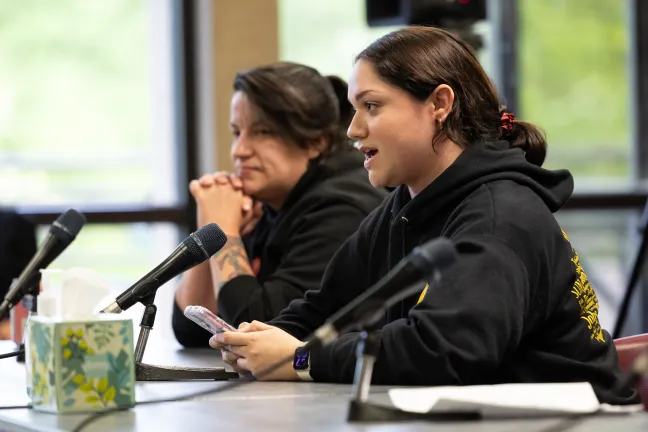
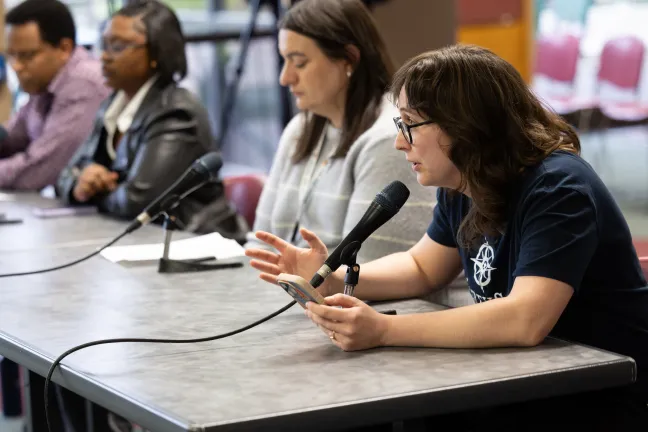
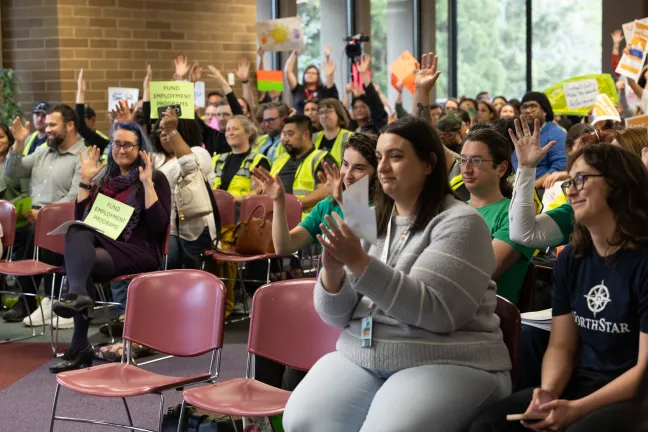
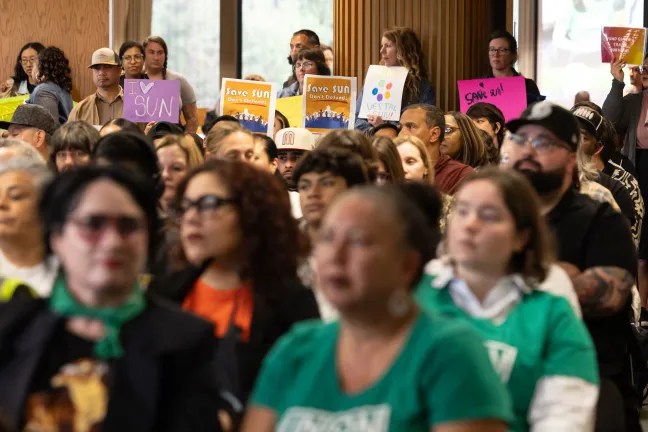
The in-person hearing was held at the Mt. Hood Community College campus in Gresham, with many local community members and government officials in attendance.
A total of 55 people testified in person, and an additional 89 submitted written testimony.
Next year’s County budget faces substantial constraints. The County is facing an $11 million General Fund spending gap along with a $67 million gap for homeless services. The reasons for the gap include slowing growth in commercial property taxes, ongoing inflation, personnel and operational costs outpacing revenue, and state and federal cuts.
Chair Jessica Vega Pederson’s $3.9 billion proposed budget makes difficult decisions that prioritize direct services to those who rely on the County most and serve the community’s essential needs. The Board of Commissioners is now discussing potential adjustments to the Chair’s proposal before voting to adopt a final budget June 4.
“Hearing from you about this year’s proposed budget priorities and how they represent Multnomah County’s values is an essential part of the budget process. Your feedback will inform our decisionmaking as we continue working towards an adopted County budget that is truly representative of the communities we partner with and serve,” said Chair Vega Pederson.
Community members advocated for a wide range of priorities, including funding for the Sheriff’s Office, legal services for people facing eviction, employment services for people experiencing homelessness, and support for corrections and behavioral health.
HOPE Team, funded by Multnomah County Sheriff’s Office
Fairview Mayor Keith Kudrna advocated for the continued funding of the Multnomah County Sheriff’s Office’s Homeless Outreach and Programs Engagement (HOPE) team. Kudrna shared a personal experience to show the importance of relationship-building in addressing homelessness.
In the early 1990s, Kudrna said, his wife ran a homeless shelter for teenage youth in the Seattle-area. That’s where Kudrna said he first learned “the importance of relationships.”
“Having that consistent face was very important,” Kudrna said.
“By losing the HOPE team, you are not only doing East County a disservice but you’re also doing a disservice to those experiencing homelessness,” Kudrna said. “You are making it harder for them to get into the programs and to get the help that they need.”
Homeless Services Department: Employment programs, Safety on the Streets
Several attendees advocated for community-based employment programs funded by the Homeless Services Department. Anthony Sweetman shared how employment-related services — including job training, rent assistance and food support — helped him overcome significant personal and medical barriers over a seven-month period.
“Without all these resources in conjunction with substantial rental support and assistance in future permanent housing placement, I would not have made it through this tough transitional period,” said Sweetman, who said his past involvement in the legal system and recovery from multiple medical procedures have posed barriers to employment.
Sweetman now has secure housing and is working towards full employment, an achievement Sweetman credits largely to the program.
“I implore you to continue the funding that makes all this possible,” Sweetman said.
LT Germaine, the finance director at the Marie Equi Center, a day shelter that serves unhoused Lesbian, Gay, Bisexual, Transgender, Queer, Intersex, Asexual, and Two-Spirit (LGBTQAI2S+) individuals, said proposed reductions in shelter beds would leave hundreds of people on the streets.
“During a time of historic and catastrophic cuts to our homeless services infrastructure, day shelters like the Marie Equi Center represent a low-cost lifeline,” Germaine said.
Germaine said cuts initially proposed for Marie Equi Center could end the program. County Board members this month have said they would find funding to restore the proposed cut.
Department of Community Justice’s Community Healing Initiative
Santiago Ruiz, speaking through a Spanish-language interpreter, advocated for the Community Healing Initiative (CHI) program. Ruiz said the program has provided support for his son, Edgar, and their entire family during a challenging time navigating the juvenile justice system.
“This program is important to me and my family because they have supported me from the very beginning in the preliminary hearings of the juvenile court that my son has had, receiving guidance on the juvenile process during the first hearing and throughout this entire probation process,” Ruiz said.
Ruiz said the program’s parenting classes have also helped. “Attending parenting classes… has taught me to be a better father and to have better communication with my son and my family,” Ruiz said.
Ruiz said the program has connected his family to rent assistance and information on immigration services, “with which I have learned to advocate for myself and my family.”
“We need you and the Department of Community Justice to continue supporting this program,” Ruiz said.
Youth and Family Services: SUN, Eviction prevention and Stability Initiative
Community members, school staff and students also advocated for full funding of SUN (Schools Uniting Neighborhoods) Community School sites. Claudia Cedeno Fornos, a youth and family program manager at Impact NW, said the program shaped her own life after she immigrated to the United States from Nicaragua as a child.
Cedeno Fornos said she was raised by a single mother working two jobs, and SUN provided their family with access to groceries, school supplies and vital after-school care, while giving her a safe place to learn English and eventually navigate the college application process. After earning both a bachelor’s and master’s degree, Cedeno Fornos now manages the very type of programming that supported her youth.
“For many families, including mine, SUN is not just an after school program, it is a lifeline, a support system and pathway to opportunity,” Cedeno Fornos said. “Cutting even one site means cutting off access and support and opportunity for families like mine.”
Lexi Slotterback, a staff attorney at Metropolitan Public Defender’s community law division, urged the county to fully fund eviction prevention support services to protect tenants.
Drawing from five years of experience working with hundreds of tenants, Slotterback said preventing an eviction from reaching a tenant’s record upfront is more effective and less costly than trying to undo the barriers afterwards.
“At this stage, removing an eviction is a lengthy process, usually resulting in an unnecessary period of homelessness and instability for our clients and is generally more expensive than resolving the eviction upfront during the process,” Slotterback said.
“These ramifications are avoidable by funding eviction defenses up front,” Slotterback said.
Mai Xiong advocated for the preservation of the Multnomah Stability Initiative (MSI), a program that provides services and support to help families achieve economic stability. As a family advocate, Xiong shared the impacts the proposed cuts would have on local households.
“MSI has been helping families avoid eviction while giving them hope to reach self-sufficiency,” Xiong said. Xiong said one of her clients went on to become a registered nurse and homeowner. Another family went from living in their car with two children to working full-time, becoming debt-free and building credit toward housing stability.
“If funding is reduced or eliminated many families will fall into homelessness and progress they have made will be disrupted,” Xiong said.
“We respectfully ask you not to take away funding from a program that has gratefully impacted these regions in Multnomah County,” Xiong said.
Health Department: Mental Health Residential Services and Corrections Health
Naomi Scott, director of Northstar Clubhouse, a mental health recovery program, advocated for funding within the Behavioral Health Division. Scott said Northstar Clubhouse fills “critical gaps in our behavioral health system” by providing structure, employment, education support, nutritious meals, prevention and recovery for people who experience mental illness, all available with no insurance required for membership.
“The proposed 12% budget cut… is just not absorbable for our program and we are already at beyond capacity with a rapidly growing need,” Scott said.
“Reducing behavioral health supports does not eliminate the need, it just shifts those costs into far more expensive costs down the road,” Scott said.
Kendra Birnley, the lead nurse for the Transitions Services Program (TSP) in the Health Department’s Corrections Health Division, advocated for funding their services, which helps people leaving the correctional system by creating discharge plans and coordinating reentry needs, including providing supplies like clothes fit for the current weather upon exiting jail.
Birnley said the program works with “some of our most vulnerable community members” dealing with opioid use disorders, severe mental illness and complex medical issues, relying on the transitional planners to safely coordinate care upon release. Those transitional planners secure services that clients request for safety and stability, coordinate with attorneys’ offices and provide critical release timelines.
“At a time when so many other social safety nets are being stripped away, it doesn’t seem prudent or ethical to cut those who are a direct link between our most marginalized community members and the wrap-around support that they need,” Birnley said.
Next steps
The form to submit written testimony remains open throughout the budget process. It is available in multiple languages and can be found at multco.us/budget-feedback. Alternatively, community members can email their comments to the Board Clerk at boardclerk@multco.us