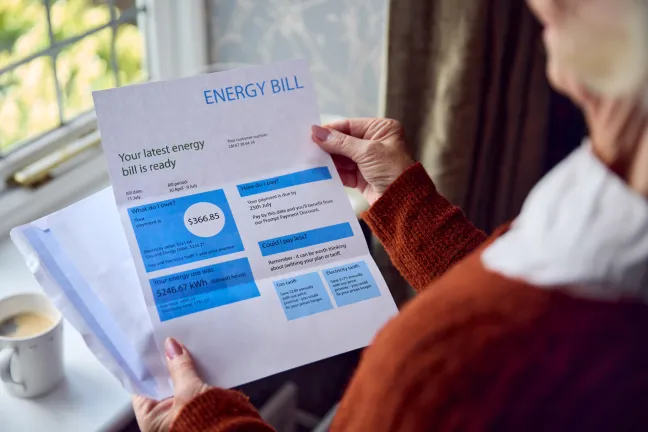
Energy costs have been in the news a lot lately, as electricity demand from data centers skyrockets both in Oregon and across the country, and the rates consumers pay for electricity and natural gas climb ever higher.
During the last year, Multnomah County’s Office of Sustainability team has been hard at work to support a more affordable energy future for our community while maintaining high quality service and strengthening the focus on the priorities of often-overlooked communities. Affordability, programs and protections that benefit low-income community members and a just energy transition have long been prioritized in the office’s advocacy to the Oregon Public Utility Commission (PUC), the state agency that regulates utilities.
To further strengthen their advocacy, the Office of Sustainability has been working with a coalition that includes the Oregon Citizens Utility Board and several environmental justice organizations like the Oregon Just Transition Alliance, Community Energy Project, and Verde. The coalition has also brought in environmental advocates like the NW Energy Coalition and the Green Energy Institute, and many others.
Consumer and energy justice advocates scored major wins in the 2025 Oregon legislative session, buoyed by the passage of the FAIR Energy Act (House Bill 3179) — a response to the drastic and consistent rise in energy bills that community members had begun experiencing in 2020. Among its many features, the law kickstarted a process to reform how rates are set for Oregon’s privately owned energy utilities, including the three energy utilities that serve Multnomah County: Pacific Power, Portland General Electric and NW Natural. The Office of Sustainability supported this critical law both in its development and throughout the legislative process.
Passage of Senate Bill 688 (SB 688) on Performance-Based Regulation was another hallmark success from the 2025 legislative session. SB 688 builds on PUC’s existing authority to regulate the six privately owned energy utilities in Oregon by supporting the establishment of a framework that rewards utilities for outcomes communities value — like reducing disconnections or investing in community-based energy projects — while disincentivizing outcomes they don’t want, such as lower system reliability or worse customer service.
Together, these two 2025 laws started a process to implement their vision of a system that motivates utilities to contain costs while maintaining service quality and prioritizing outcomes Oregonians want to see.
The ensuing work included multiple rule-making processes at the PUC. The Office of Sustainability staff have focused on Docket No. AR 676: the process of transitioning to a different way for the six privately owned energy utilities in the state to set rates, with more tools for cost-containment, along with more incentives for utilities to maintain high-quality service and prioritize outcomes valued by communities.
How rates were set before the FAIR Energy Act and Performance-Based Ratemaking
The Oregon Public Utility Commission regulates Oregon energy utilities with an eye toward safety, reliability and price fairness. The utility companies are subject to regulation because they are monopolies or the only provider of gas or electricity in their service territory.
Before the FAIR Energy Act and Performance-Based Ratemaking were passed, the process for rate setting started with the utilities submitting a request for a rate revision to the PUC. They typically requested an increase, often seeking to recover the costs of doing business (like the costs of business supplies or wages for their employees) and to begin recovering new investments in infrastructure like transmission, distribution or energy generation assets. These investments are important to utilities, not just because they are critical to their ability to provide service but because they are generally the only cost category for which the utility gets to make a profit, rather than simply recover costs.
The submitting utility’s filing included the percentage change they desired, as well as evidence for why the PUC should grant it. Their submission triggered a “General Rate Case,” or a process that functions like a court proceeding, complete with parties, witnesses, evidence, discovery, settlement conferences, legal briefs and hearings.
Other stakeholders, like the Citizens Utility Board, PUC staff, and environmental or environmental-justice advocacy intervenors, would review the utility’s filing line by line, making challenges to portions of the utility’s proposal, while also presenting their own evidence for a different outcome.
The PUC has three commissioners who are the decision-makers at the agency and are tasked with setting “just and reasonable” rates. They are appointed by the Governor and confirmed by the Oregon Senate. This three-commissioner panel decides how much the utility can increase rates, as well as whether to approve other utility requests, based on the record developed through the rate case process.
However, the PUC commissioners cannot unilaterally decide to deny a proposal to raise rates simply because rates are too high and they don’t want to raise them. When the utility can show that it spent money to serve customers in ways that meet the legal applicable standards, the PUC must allow the utility to recover reasonable costs and also make a reasonable profit.
How the FAIR Energy Act and Performance-Based Ratemaking change rate setting
The Office of Sustainability and coalition partners have been working to make sure the implementation of the FAIR Energy Act and Performance-Based Ratemaking delivers tangible benefits for community members.
One of the main tools the FAIR Energy Act provides to support cost containment is Multiyear Rate Plans (MRPs). Prior to the FAIR Energy Act, utilities could essentially ask for a rate increase whenever they wished. They also had access to many additional mechanisms that allowed them to pass their costs, dollar for dollar, onto community members’ utility bills. Now, in contrast, MRPs put the utilities on a five-year budget for most of their costs. This budget is indexed to inflation and adjusted for factors like growth and expected efficiency improvements.
While MRPs have great potential to help utilities contain their costs more effectively, that outcome is not a given — the devil is in the details. One example of the many factors that can either weaken or strengthen the cost-containment value of MRPs is the number of expenses that must be “under the budget.” The more utility cost categories (e.g., equipment, technology, labor, programs, etc.) are included in the budget, the stronger the MRP’s cost-containing effect can be. MRPs essentially ask the utility to manage costs of expenditures under those categories and stay under the budget. While some costs may rise faster than inflation, others won’t, so the utility will need to stay within its budget — perhaps by prioritizing certain investments — while avoiding the reduction or degradation of their service. Conversely, the MRP’s cost containment effect is weakened if the utility is allowed to recover more categories of spending outside of the budget.
Requiring utilities to stay within a budget may push them to deprioritize things we value as a community, such as high quality customer service. As a result, this process intends to establish incentives that help ensure utilities don’t sacrifice the quality or safety of their service when containing costs, and that utilities have a greater stake in reducing disconnections, using their existing infrastructure more efficiently, and prioritizing clean, community-based infrastructure.
The shared goal of the Office of Sustainability and its myriad collaborators throughout this process has been to make sure the design details of the MRP mechanism support cost containment, high-quality and affordable service, and the incentive for utilities to better prioritize important goals like reducing disconnections and emissions.
Oregonians are fortunate to have excellent staff in the PUC who have genuinely and thoughtfully organized a process grounded in principles that include mitigating the impacts of rate changes on customers, and goals like affordable and high-value service, efficient clean energy development and emissions reductions, distributional equity, and resilience. As a result, the Office of Sustainability is optimistic about the chances this implementation process will deliver on the combined vision of the two 2025 laws that set this journey in motion. We are similarly fortunate that the PUC commissioners have supported their staff’s vision and are genuinely interested in delivering the vision of the two laws.
Conclusion
We have learned a ton and dedicated a lot of time to this process over the last year, filing more than a dozen letters with the PUC and participating in hours of workshops and meetings. Yet there is a significant amount of work ahead to make sure that Oregon’s FAIR Energy Act and Performance-Based Ratemaking laws deliver on their promise. For the Office of Sustainability, our focus has, and will continue to be, energy justice and making sure that we transition to a clean energy system in which everyone in our state can afford to use the clean energy that they need to live and thrive.