
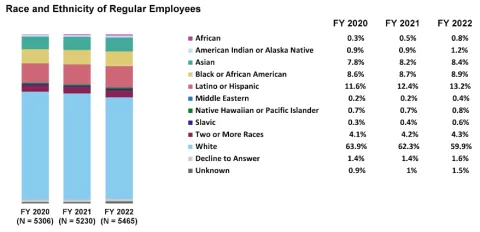
A stacked bar chart with fiscal year 2020 (N = 5306), 2021 (N = 5230), and 2022 (N = 5465) on the x-axis, and race and ethnicity of regular employees on the y-axis.
In fiscal year 2020: African (0.3%), American Indian or Alaska Native (0.9%), Asian (7.8%), Black or African American (8.6%), Latino or Hispanic (11.6%), Middle Eastern (0.2%), Native Hawaiian or Pacific Islander (0.7%), Slavic (0.3%), Two or More Races (4.1%), White (63.9%), Decline to Answer (1.4%) and Unknown (0.9%).
In fiscal year 2021: African (0.5%), American Indian or Alaska Native (0.9%), Asian (8.2%), Black or African American (8.7%), Latino or Hispanic (12.4%), Middle Eastern (0.2%), Native Hawaiian or Pacific Islander (0.7%), Slavic (0.4%), Two or More Races (4.2%), White (62.3%), Decline to Answer (1.4%) and Unknown (1%).
In fiscal year 2022: African (0.8%), American Indian or Alaska Native (1.2%), Asian (8.4%), Black or African American (8.9%), Latino or Hispanic (13.2%), Middle Eastern (0.4%), Native Hawaiian or Pacific Islander (0.8%), Slavic (0.6%), Two or More Races (4.3%), White (59.9%), Decline to Answer (1.6%) and Unknown (1.5%).