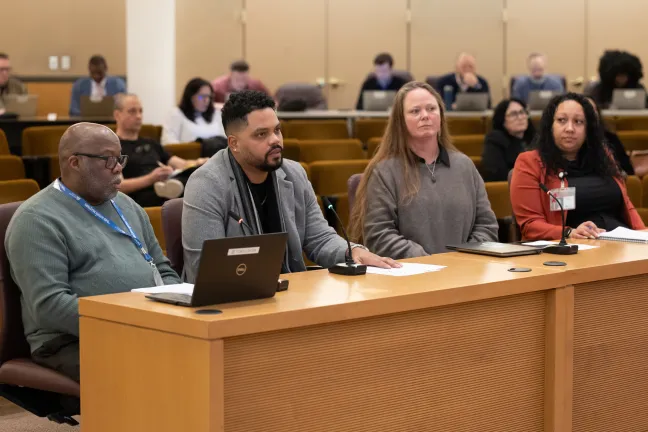
On Thursday, Dec. 11, the Board of County Commissioners unanimously approved a $2.4 million budget adjustment to fill part of a $4.6 million gap in behavioral health services. The one-time funding follows a decision by coordinated care organization CareOregon, the state’s largest Medicaid provider, to end funding that allowed Multnomah County to provide intensive care coordination to its members.
Without this intervention, the Health Department faced eliminating more than 38 positions on Jan. 1, 2026. Instead, the Board was able to preserve roughly 17 positions through June 2026, allowing some crucial services to continue even as others will still be reduced.
The remaining reductions will primarily affect the Behavioral Health Division’s youth, adult and jail care coordination teams. These staff members provide high-touch, in-person support for clients with the most complex needs, often working with individuals for anywhere from three weeks to over a year.
“That intensive outreach and support is going away,” said interim Behavioral Health Deputy Director Jessica Jacobsen. “Folks will still have access to care coordination through their health plan, but it will not be in-person, and it won't be long-term.
“The loss of service we're seeing is this ability to assign a dedicated care coordinator for any Health Share of Oregon member who has complex behavioral health needs — someone who acts as that extra layer of outreach and pulls together the entire care team to work on a person’s goals.”
Among the positions the County will retain, half belong to the Choice Model program, which serves adults with severe and persistent mental illness. Another program that was not impacted is wraparound services for youth and families, a care coordination model that is mandated by the state.
Interim Behavioral Health Director Anthony Jordan praised the dedication of the staff facing layoffs, saying the Health Department is working closely with Human Resources to find other positions for them within the County.
“These individuals worked every day with dedication and professionalism to serve our most vulnerable residents,” said Jordan. “Their expertise and daily efforts are vital to the health and wellbeing of our community. Our commitment is to manage this transition with the utmost compassion and responsibility.”
The funding crisis is the result of several years of mounting financial pressure. Since 2019, the Behavioral Health Division has relied on agreements with CareOregon to fund critical infrastructure and intensive care coordination.
However, in 2024, the Oregon Health Authority removed requirements that mandated coordinated care organizations provide intensive care coordination, making the service discretionary. This regulatory shift, combined with three years of operating deficits where Medicaid reimbursement rates failed to keep pace with the rising costs of care, led Health Share of Oregon to direct CareOregon to end its intensive care coordination agreements with Multnomah, Washington and Clackamas counties in September 2025.
The Behavioral Health Division is developing a long-term strategy to continue funding the nearly 17 positions it’s retained into Fiscal Year 2026-27. While the County continues to seek new funding opportunities to restore intensive outreach, leadership also acknowledged there is currently no direct replacement for the lost CareOregon revenue.
“We are continuing to look for opportunities to provide intensive care coordination wherever we can, whenever we can find funding,” said Jacobsen. “But we must also recognize that, right now, there is no direct replacement for this funding.”
Board comments
“You all were really thoughtful about how to approach this, thinking about minimizing negative impact, knowing that this is the situation that we’re in,” said Commissioner Shannon Singleton. “We don't see this as a one year reduction. We see this as a multiple year problem, and so let's see what we can do to get ahead of dealing with the same problem again in a year.
“I know this is hard, and you all and your teams do really great work, so I'm disappointed to lose the funding and programs. I have to only assume our outcomes have been better when there are in-person services versus telephonic services. And I just hope that we can get back to a place where this type of service can be provided again.”
“To be honest I'm not OK with that. It's a huge concern as far as losing those services, especially for folks that are transitioning back into our community,” said Commissioner Vince Jones-Dixon. “What are our options? Let me know if there's an option or a way that we could retain those positions for the next six months and come up with a better plan cause we're going to have trouble in our streets to put it bluntly.”
“I think it is so profoundly unwise,” said Commissioner Meghan Moyer. “I think it will end up costing them in the long term. But there is no question that this is exactly the wrong thing to be doing for this population right now and that it makes it significantly harder for us to try to build a more comprehensive community-based behavioral health system.
“I really feel like the Oregon Legislature ... [does] not understand the degree to which our health system is failing right now. And that is actually not a result of the Big Beautiful Bill. That will be the nail in the coffin. But when we cannot provide what is clearly the most evidence-based approach to keeping people as well as possible in community, which saves so much money, let alone is clearly better for individuals, we are broken. And I don't know what it’s going to take for the State of Oregon to get how broken it all is.”
“I wanted to express my appreciation for all of the work of the Health Department during this really challenging time as we figure out how to address the impact on services we know are critical to so many people in our county,” said Chair Jessica Vega Pederson. “These are not easy decisions, and I appreciate their engagement with partners and with staff who are going to be affected by these changes.”