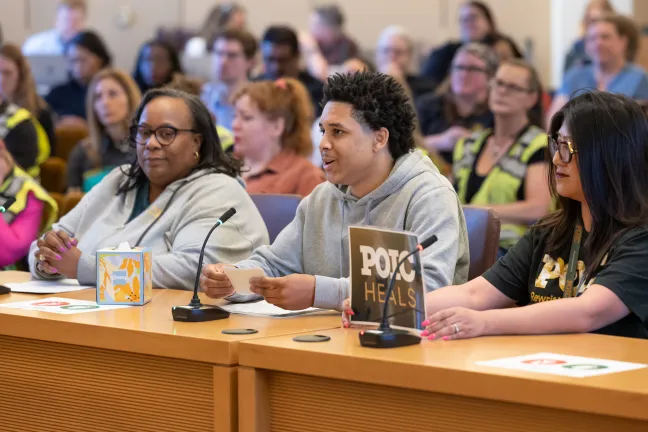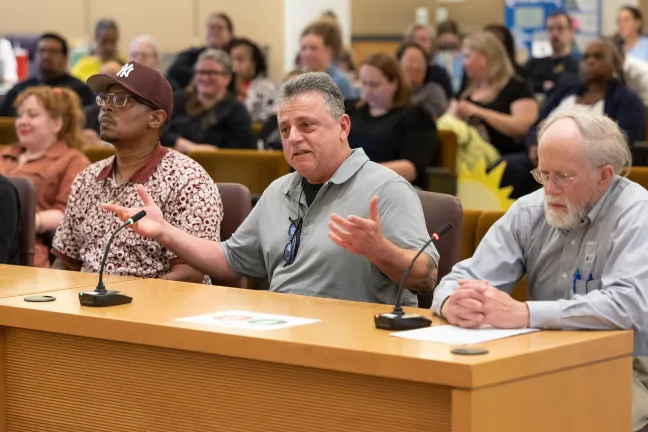
The Multnomah County Board of Commissioners hosted its first public hearing on the County’s fiscal year 2027 budget Wednesday, April 30.
The event drew enough community members to fill the boardroom of the Multnomah Building to its capacity, with additional people waiting in the lobby as others testified. The hearing was also livestreamed.
Over the hearing’s two hours, 50 people testified in person and three people testified virtually. An additional 39 people submitted written testimony.
Next year’s County budget faces substantial constraints. The total budget overall (including the General Fund, federal funds, and other state and local revenues) is down $93.2 million year over year. That includes an $11 million General Fund deficit and a $67 million funding gap for homeless services. The reasons for the gap include falling property taxes, ongoing inflation, personnel and operational costs outpacing the revenue and federal unpredictability of cuts.
Chair Jessica Vega Pederson’s $3.9 billion proposed budget makes difficult decisions that prioritize direct services to those who rely on the County most and serve the community’s essential needs
“Multnomah County’s budget and priorities are not built in a silo. They’re built alongside many partners and the community itself,” said Vega Pederson. “Hearing from all of you is part of that commitment, so I’m glad you’re here tonight to share your voice.”
Community members advocated for a wide range of investments, including legal services, employment services for people experiencing homelessness, animal services and support for youth.
Animal Services
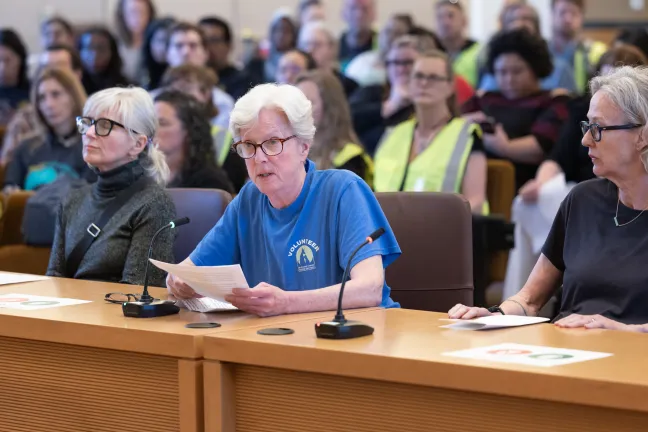
Several community members testified against proposed reductions to Multnomah County Animal Services (MCAS), which include cuts to the animal enrichment program that helps pets with transitions for more successful adoptions from the shelter to permanent homes.
Community member Polly Wheeler advocated for fully restoring and expanding funding for the animal enrichment program.
“When enrichment program staff are unavailable, essential activities including play groups [and] fear, anxiety and stress level monitoring are suspended, leaving animals without mental and physical stimulation. This contributes to behavior deterioration, increased euthanasia risk and fewer successful adoptions,” she said.
Nancy Yuill, a volunteer for the animal shelter, spoke about the difference the enrichment program makes.
“At MCAS, walk through the kennels in the morning and you’ll hear loud barking and see stress-induced jumping. Walk through the mid afternoon, after dogs have had some enrichment and engagement, you’ll feel the peace and quiet as many dogs are resting calmly on their beds,” she said.
Employment programs funded by the Homeless Services Department
A number of attendees advocated for funding for the Homeless Service Department’s community-based employment programs. Among them was Kimberly Torres-Jimenez, who shared their personal journey.
“I was a single mom stuck in the streets doing things I was not proud of… things I should have never been doing. I felt trapped, like there was no way out,” said Torres-Jimenez, who is currently working with a Homeless Service Department-funded employment program that connected her with a coach who has helped her obtain rental assistance, finding a home, and resources for covering her bills.
Torres-Jimenez shared that because of the support she has received from her coach, her children “have a stable mom who is working forward to a career in early childhood education on a scholarship” and will be working as a preschool teacher.
“I ask that you continue to fund employment programs so single mothers like me have a chance to change our lives.”
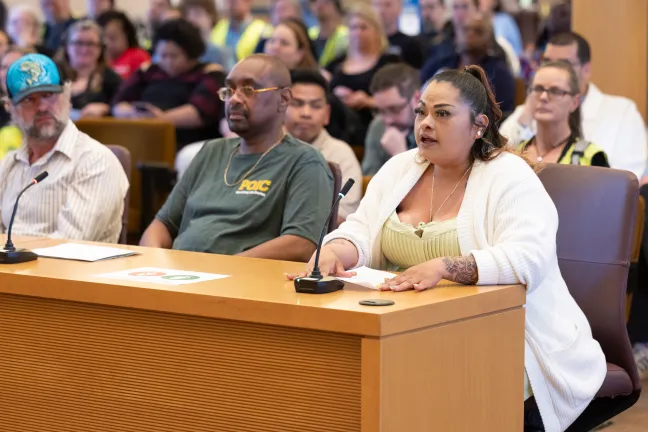
Troy Ramsey with the Portland Opportunities Industrialization Center (POIC) shared about how an employment program has impacted their life.
“I spent 24 years in prison,” Ramsey said, noting that the felony on their record made finding employment difficult, which made the rental assistance he received all the more crucial. The Equal Opportunity peer program he found through POIC “always picked their phone up, they always opened the door for me” and helped him find the belief, and the skills, to find employment.
Ramsey, who has earned their forklifting certification and is currently working toward their commercial driver license, warned that losing these services would have a direct impact on the community.
“This is helping reduce the recidivism rate… Without programs like this, the only option is going back to what we know,” said Ramsey. “We’ve harmed the community, but we want to give back to the community we’ve harmed and the only way to do that is by having program like this that can say, ‘Hey, we see you.’”
Youth and Family Services: SUN Schools and eviction prevention
People also spoke about the proposed $1.2 million reduction that would eliminate nine SUN (Schools Uniting Neighborhoods) Community School sites.
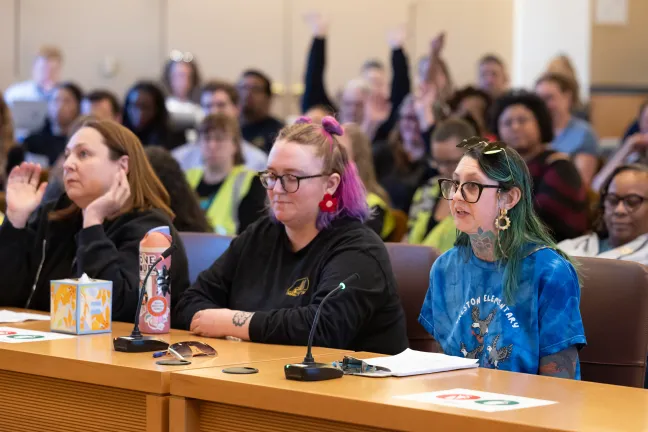
Bridgitte Lynch, the manager of the SUN site at Creston School, opposed the cuts to the SUN Community Schools, noting that the program provides safe, supervised after-school care, academic enrichment and mentoring, and basic needs, including access to food, resource navigation and mental health resources.
“When I see schools, after-school programs and shelters on the chopping block, our most at-risk do not feel like a priority, but feel expendable. If you share the same priorities as I do, please put your money where your mouth is and show us by protecting our children,” said Lynch.
Others advocated for Multnomah County’s Youth and Family Services Division eviction prevention support program that offers legal consultation, negotiation and defense services to tenants with eviction notices or court cases filed against them.
Numerous attendees also spoke to fund the eviction prevention support at a similar level as last year’s budget. Ethan Ackerman, a legal assistant at Metropolitan Public Defender’s Community Law Division, told a story about the impact of this program.
“One client came to us after receiving an eviction notice they couldn’t read. Her landlord had misapplied her rental assistance payment for another tenant,” said Ackerman. “With legal representation, she and many others can continue living in the same space and focus on their future here in Portland.”
Lone Fir Cemetery
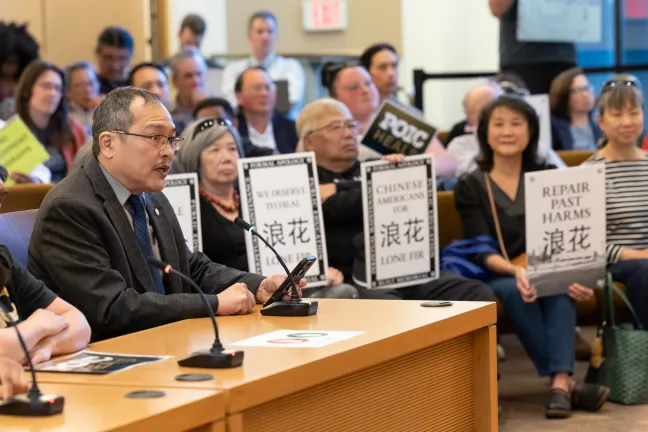
In the 1920s, Multnomah County ordered members of the Chinese community to remove buried loved ones from Block 14 of Lone Fir Cemetery, then-owned by the County, to make room for a maintenance building. Multnomah County has since apologized for the historic harms and committed to providing further funding for a memorial at the site honoring the community members affected by that decision. Neil Lee, vice president for the Oregon Chinese Consolidated Benevolent Association, advocated for the project’s full funding.
“What happened at Block 14 was an erasure,” said Lee. “Last May, in this very room, Multnomah County took an important step forward. The formal apology along with the initial $1 million investment in the Lone Fir Chinese Memorial marked the beginning of healing.”
Lee said the remaining $1.5 million for the project has not been included in the current budget to complete the project. “The Chinese community has waited for generations; this is the moment to see it through.”
Department of Community Justice Community Healing Initiative
Jack Fluker is a participant in the Community Healing Initiative (CHI), a voluntary program that provides early intervention and prevention services for youth who have lower-level offenses. He testified to advocate for the funding of the program.
“I made a mistake over a year ago where I took something that wasn’t mine and it got me on probation,” said Flucker. Through CHI, he connected with a mentor and participated in sports activities and field trips.
“The CHI program has taught me to be responsible and, most of all, love myself,” he said. The support from CHI has helped Flucker understand the importance of being a role model for his younger siblings and maintain a 3.7 grade point average.
Behavior Health Division Office of Consumer Engagement
The Office of Consumer Engagement works with the County’s Behavioral Health Division to provide feedback from its consumers and helps elevate the voice of those with lived experience that bring different perspectives. This helps ensure the division’s services are informed and supported by consumers.
Mario Cardenas, Latino/e/x engagement coordinator for the County’s Office of Consumer Engagement, reminded the Board of the effectiveness of that office and its culturally specific services. Cardenas, who shared that he is celebrating 14 years in recovery, described his role as a bridge between the Latino community and County leadership.
“We’re your voice, we’re the voice of people with lived experiences,” said Cardenas.
He urged the Board to continue supporting the culturally specific roles. “We connect people to services, we advocate, we bring community together, we unite community partners, we facilitate training, we break down barriers for people to get into treatment and we hold people accountable.”
Next steps
Chair Vega Pederson reminded community members that the form to submit written testimony or sign up to speak at an upcoming budget hearing remains open throughout the budget process. It is available in multiple languages and can be found at multco.us/budget-feedback. Alternatively, community members can email their comments to the Board Clerk at boardclerk@multco.us.
The next budget hearing will be an in-person event Wednesday, May 13, from 6 to 8 p.m. at Mt. Hood Community College. The final hearing will take place virtually on Wednesday, May 20, from 6 to 8 p.m. The Board will also continue to hold detailed public work sessions with County departments and offices.