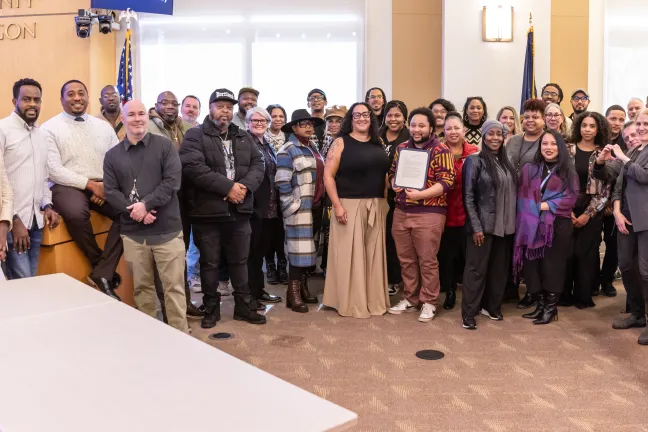
The Multnomah County Board of Commissioners hosted its monthly proclamation ceremony on Feb. 4, featuring three proclamations that honor and reflect on Black and African American history.
The event created space for three important proclamations: Pioneer Black First Responders Month, the 100-Year Centennial of Black History Commemorations, and Black History and Futures Month, explained Commissioner Vince Jones-Dixon, who co-sponsored the proclamations alongside Commissioner Shannon Singleton.
Jones-Dixon, who presided over the meeting in his role as vice-chair of the Board of County Commissioners, began by sharing the intentions behind some of the language used in public remarks and the proclamations themselves.
“When we say ‘African American,’ we are speaking specifically about Black people who are descendants of enslaved people here in the United States of America,” he said. “When we say ‘Black Americans,’ we are referring to a broader category of Black folks, descendants of enslaved people here in Americas — including Black Caribbeans, African Americans, Black Latine folks and beyond. And lastly when we say ‘Black people,’ we are referring to the full diaspora.
“It’s important to note these distinctions to uphold the depth of histories, perspectives and identities.”
Pioneer Black First Responders Month
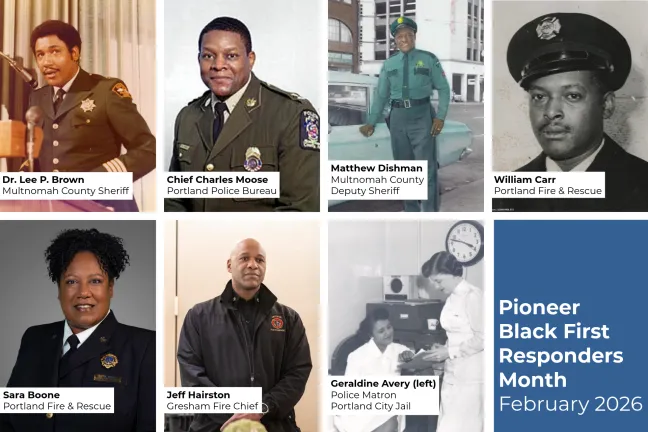
The Board proclaimed February 2026 as Pioneer Black First Responders Month, marking a historic first in Multnomah County.
The proclamation, co-sponsored by Commissioners Jones-Dixon and Singleton, said in part, “Even when Black people were excluded from serving in an official capacity, or first responders did not respond to crimes or cries for help within Black communities, Black community members stood up to keep their communities safe.”
“Our Black first responders sacrifice themselves every day, yet are met with the same inequities Black people have faced in general when compared to their peers,” said Commissioner Singleton as she introduced the proclamation. “We cannot talk about this commemoration without talking about the Freedom House Ambulance Service.”
The Freedom House Ambulance Service — founded in 1967 to serve Pittsburgh’s predominantly Black Hill District — was the first emergency medical service in the United States to be staffed by highly trained paramedics and operated entirely by African Americans. It was established against the backdrop of intense institutional racism, segregation and neglect by the police that provided emergency services at the time. Many Black neighborhoods were forced to rely on people from within their own communities to patrol, fight fires, and provide care to each other.
Guest speakers included Lakayana Drury, executive director of Word is Bond; Andrew Campbell, Word is Bond’s board chair and an employee of the Multnomah County Sheriff’s Office; and David Barron, founder of F.R.I.E.N.D Firefighting International and a youth ambassador for Word is Bond.
Barron and Drury read the proclamation, honoring key Black and African American first responders in Oregon history, including:
- Dr. Lee P. Brown, who served as the first Black sheriff of Multnomah County in 1975.
- Charles Moose, the first African American to serve as Portland’s police chief (1993-99).
- Matthew Dishman, Jr., the first African American deputy sheriff in Multnomah County, whose legacy of service and community leadership lives on through the Matt Dishman Community Center, operated by Portland Parks & Recreation.
- Black firefighters, including William Carr and Augustus “Gus” Waterford.
- Sara Boone, who became the first Black woman to serve as a Portland firefighter and later as the city’s first Black fire chief in 2019.
- Gresham Fire Chief Jeff Hairston, who became Gresham’s first Black firefighter in 2006 and who made history this year as the first Black man to serve as a fire chief in Multnomah County and Oregon.
Another first responder is Geraldine Avery. Avery was the first Black woman to be appointed police matron at Portland’s city jail. She was hired in November 1954.
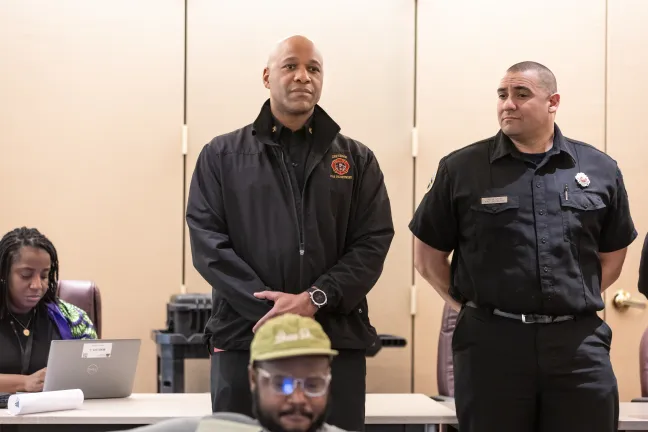
Commissioner Jones-Dixon shared a story about his daughter, who met then-Lieutenant Hairston when she was just 10 years old.
“She asked, ‘What is a firefighter; What is a firefighter?’” Commissioner Jones-Dixon recalled. “And the lieutenant at the time said, ‘Firefighters are doctor superheroes.’ That opened her mind, not just to the role of firefighters, but also leadership.”
“You were the first African-American firefighter to be hired in Gresham,” Commissioner Jones-Dixon said, addressing Hairston. “And you walked us through just the level of adversity and why leadership matters.”
100-Year Centennial of Black History Commemorations
The Board of County Commissioners observed the 100-year anniversary of Black History commemorations, part of a series of national events marking the milestone for community members celebrating Black history and recognizing the remembrances’ “historical origins, evolution and enduring significance.”
Heather Coleman-Cox, Juneteenth Oregon’s public relations director, read the proclamation and walked listeners through the origins of Black History Month:
A century ago, on Feb. 7, 1926, Harvard University-trained historian Carter G. Woodson established the first formal observance dedicated to the study and recognition of African American history.
The recognition was developed in response to the widespread exclusion and misrepresentation of African American contributions within American historical scholarship, Coleman-Cox explained.
“Dr. Woodson intentionally designated the second week of February for this observance to coincide with the birthdays of President Abraham Lincoln and renowned abolitionist and orator Frederick Douglass.
The observance was celebrated for 50 years as a focused week of study and reflection, emphasizing education, scholarly rigor, and historical correction, consistent with Dr. Woodson’s original vision of elevating truth, accuracy, and intellectual integrity in the telling of American history.
President Gerald Ford extended this observance from a week to a month in 1976, during America’s bicentennial year. Ford called upon Americans to honor the contributions of African Americans throughout the full span of American history and affirmed the observance as a matter of national importance.”
Read the full proclamation here.
“This proclamation today really just fills my cup,” said Commissioner Singleton. “I'm so honored to be in this room with folks that I've gotten to work with in various fashions, but just to celebrate us and the history that we have, both the challenging pieces and the joy and the celebrations that we can bring.”
Black History and Black Future Month in Multnomah County, Oregon
The Board of County Commissioners concluded the ceremony by proclaiming February 2026 as Black History and Black Future Month in Multnomah County.
The proclamation was co-sponsored by Commissioners Singleton and Jones-Dixon, along with the Multnomah County Employees of Color Employee Resource Group.
Commissioners Singleton and Commissioner Jones-Dixon took turns reading the proclamation.
“Black History did not start in the United States," Singleton said. “For Black Americans and people from the African Diaspora, Black history begins in Africa. Millions of unknown and known stolen African men, women and children came from the place where life, civilization and knowledge began. All people from the African Diaspora come from generations of people who were farmers, healers, philosophers, scholars, ironsmiths, mathematicians, scientists, historians, leaders, warriors, healers, sailors, strategists, and creatives.”
“Multnomah County recognizes that Black women are disproportionately affected by poverty and violence, but they are also more likely to volunteer their time and resources to help others,” read Commissioner Jones-Dixon.
“Black women and Black femmes have historically played a crucial role in the Black community, providing emotional support, guidance, and strength to their families and communities. Their contributions have often been unseen and unpaid, but they are essential to the well-being of Black people.”
The Commissioner teared up and paused, sharing that he was thinking of his mother during this passage of the proclamation.
Read the full proclamation here.
The Board closed the ceremony by encouraging “all residents to participate in Black History Month events and activities, to reflect on the significance of this historic day, and to continue working towards racial equity and social justice.”