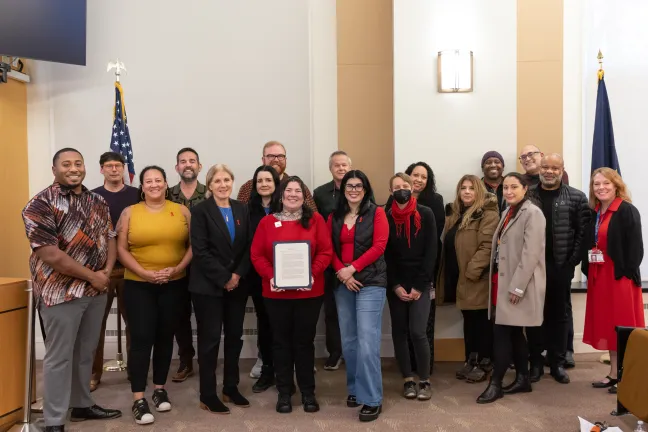
The Multnomah County Board of Commissioners on Wednesday, Dec. 3, celebrated its monthly Proclamation Day by approving three proclamations. Commissioner Julia Brim-Edwards presided over the meeting, as Chair Jessica Vega Pederson and Commissioner Meghan Moyer were excused.
“These proclamations affirm Multnomah County’s commitment to those in our community living with HIV and AIDS, remember the transgender and nonbinary community members that we’ve lost to violence, and recognize the victims and survivors of genocide,” said Commissioner Brim-Edwards.
The celebration also included the presentation of the Kathleen Saadat Community Advocate Award.
World AIDS Day
The board proclaimed Dec. 1, 2025, as World AIDS Day in Multnomah County. The proclamation, sponsored by the Health Department, increases awareness of HIV, stands against stigma, and honors those lost to AIDS or who continue to fight for equitable care. This year’s theme, “Overcoming Disruption, Transforming the AIDS Response,” reflects the origins of the community-led response to the epidemic.
Derek Smith, an HIV grant administration and planning manager with the Health Department, presented the proclamation.
“This community was born out of ‘disruption,’” according to the proclamation. Advocacy groups rose up in response to federal government indifference that led to the loss of nearly 450,000 lives to HIV/AIDS by the 1990s. This year marks 35 years of federal funding for comprehensive HIV/AIDS care through programs like the Ryan White HIV/AIDS Program, which supports the regional mission of the Portland Area HIV Services Planning Council.
Scott Strickland, also an HIV grant administration and planning manager, said, “Unfortunately, the language and behavior of some leaders now sounds very similar to what we heard in the 1980s.”
“It is more critical than ever that we speak out about this public health issue and renew our efforts to control it,” he continued. “New infections continue to occur, people who would benefit from treatment are being denied and unnecessary deaths are recurring.”
Today, people living with HIV who reach viral suppression can live long, healthy lives with no risk of HIV transmission. Nationally, 91% of clients receiving HIV medical care reached viral suppression in 2023. The regional rate is even higher, at 93%.
Despite this progress, persistent inequity and an uptick in new cases in Oregon and the region still require a transformative AIDS response. The proclamation notes that people of color, youth and transgender women account for a disproportionate share of new HIV and AIDS cases, with one-third of all new cases in Oregon affecting people 25 to 34 years old. People who use drugs and people with prior diagnoses of sexually transmitted infections are also at increased risk.
Community advocate Bee Velasquez shared the importance of local programs.
“Without programs like the Ryan White [HIV/AIDS Program] services, the Health Services Center, case management and culturally grounded support, many of us would fall through the cracks,” she said. “These services do more than treat HIV. They keep people housed, connected, supported and alive.”
Multnomah County remains committed to the “End HIV in Oregon Strategy” that makes testing easy, ensures prevention works and affirms that treatment saves lives, and is supported by the Health Services Center, a medical provider for people living with HIV or AIDS in the region, and the Behavioral Health Division’s Promoting Access to Hope program, which supports substance use treatment for vulnerable residents with co-occurring conditions.
The County continues to honor all those affected by HIV through the ongoing display of a historic National AIDS Quilt panel in the lobby of the Gladys McCoy Building, where the Health Department is based.
“Its ongoing presence in this public space serves as a daily reminder of collective remembrance, honoring, and learning from these powerful ancestors, so we too can take courageous action for a future that serves us all,” the proclamation reads.
Transgender Day of Remembrance and Presentation of the Kathleen Saadat Community Advocate Award
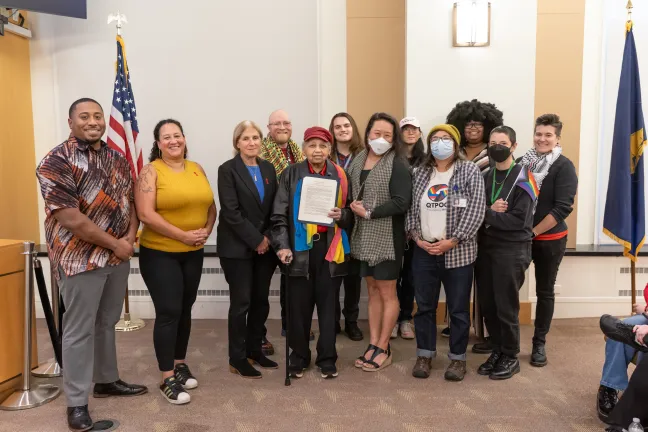
The Board proclaimed Nov. 20, 2025, as Transgender Day of Remembrance in Multnomah County, cosponsored by Commissioner Moyer and Commissioner Shannon Singleton.
“This is a day when we honor trans people who have passed,” said Commissioner Singleton. “Too often trans lives are taken in violence and prematurely. This year we have seen an onslaught of anti-trans policies and rhetoric aimed at erasing trans lives, history and contributions.”
Transgender Day of Remembrance began in 1999 as a vigil to honor Rita Hester, a transgender woman murdered in 1998. The day honors the lives and memories of trangender people lost to senseless violence, transphobia, self-harm and structural inequities.
The American Medical Association has declared anti-transgender violence a state of emergency. This violence disproportionately impacts trans femmes of color, specifically Black, Indigenous and Latine community members. The proclamation notes that “these incidents are underreported due to our region, state and nation’s history of systemic racism and transphobia.”
Since November 2024, at least 27 trans and nonbinary people have been killed in acts of violence across the United States.
The 2025 observance also included the presentation of the Kathleen Saadat Community Advocate Award, which recognizes a leading community member who bravely challenges and advocates for policies to address anti-trans bias and by living openly as their full selves.
Kathleen Saadat, whom the award is named after, first thanked the Board for the public acknowledgement of the trans community, particularly “at a time when it's critical that we continue to be public about embracing all communities that have been marginalized.”
Saadat praised this year’s recipient, Joelle Kim (she/her), Q Center executive director.
“Her commitment when we talked to the Q Center was to use the center as a place for healing, as a place for coming together, as a place for providing comfort and joy,” Saadat said. “This is a place where she can use her creativity, her compassion, her skills and commitment to continue the work of bringing us together. And in that bringing of us together and bringing our community together, we also, in that, contribute to the larger community.”
“It’s through people like Joelle that this continues to go on.”
Kim thanked Saadat, saying, “Your advocacy, your work really paved the way for younger generations to carry on.”
Kim also thanked the County’s Queer and Trans People of Color (QTPOC) and Prism Employee Resource Groups for their leadership and “for being a voice and support to County employees who identify as queer, trans and people of color.”
The proclamation was read by QTPOC Chair Andy Cho (she/her) and Prism Co-chair Daisy Pullman (it/they).
“We will commemorate their lives by protecting, advocating, and uplifting those who are still with us, while honoring those we carry in our hearts,” the proclamation read.
International Day of Commemoration and Dignity of the Victims of the Crime of Genocide and of the Prevention of this Crime
Multnomah County proclaimed Dec. 9, 2025, as the International Day of Commemoration and Dignity of the Victims of the Crimes of Genocide and of the Prevention of this Crime. The proclamation was co-sponsored by Chair Vega Pederson, Commissioner Vince Jones-Dixon, Commissioner Moyer, and the County's Immigrant and Refugee Employee Resource Group.
Dec. 9 marks the 77th anniversary of the 1948 Convention on the Prevention and Prevention of the Crime of Genocide (the “Genocide Convention”), the first human rights treaty adopted by the United Nations General Assembly. The Convention placed a legal and moral duty on governments not only to condemn genocide, but also to prevent it and protect people from it.
Commissioner Jones-Dixon shared that he had worked in Rwanda, where he learned about the nation’s unity and reconciliation efforts following Rwanda’s 1994 genocide. He emphasized the need for intentionality and action.“That’s been an action call to me, and I believe to the Board as well — like, how are we creating systems where we’re acknowledging, addressing and ensuring where that doesn’t happen here in Oregon, let alone in Multnomah County,” he said.
An Bui, who works in the Chair’s Office as a public engagement coordinator, read a message from the Chair in her absence.
“There is no perfect or right time to stand up for human rights and speak out against state violence,” Bui read. “It's only important that we do so.”
The County, in the proclamation, invoked the solemn promise, “never again.”
“The genocide of Native Americans in this country, along with past genocides in Namibia, Armenia, in Europe during the Holocaust, in Cambodia, Bosnia, Rwanda and Congo, and the present-day genocides in Myanmar, Palestine and Sudan, serve as stark reminders of the need for vigilance and action to uphold the treaty’s principles and ensure an end to impunity,” reads the proclamation.
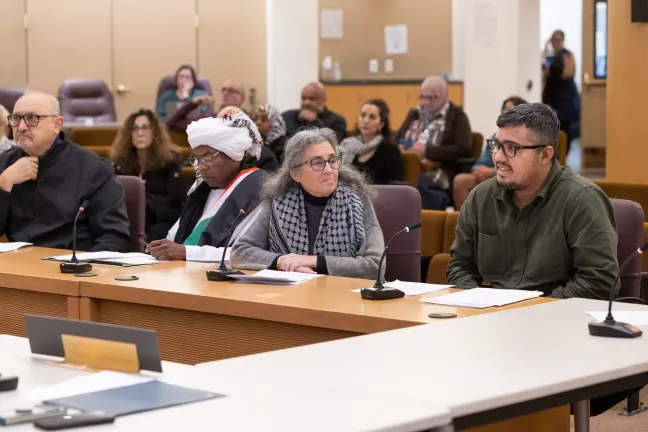
Nurul Haque, representing the Bangladesh Rohingya Student Association, spoke as a Rohingya genocide survivor who spent 32 years in a refugee camp. “Every day in the camp was a lesson in resilience, learning without books, dreaming with rights and hoping without promise.”
Haque, who now works for the State of Oregon, added, “I am one of the million, but I speak today because silence has never protected us. I speak because the world must hear what it means to be born into exile and raised in the shadow of genocide.”
Maxine Fookson, a member of Jewish Voice for Peace and retired Multnomah County Health Department pediatric nurse practitioner, shared, “I have a deep commitment to our practice oath which states: Do no harm.”
She connected her work to her Jewish heritage and faith, describing the history of pogroms, displacement, the Holocaust the Jewish people have endured as “historical events which are foundational to our beliefs that such atrocities must never again happen to anyone.
“I’ve been horrified over the past 26 months as Israel commits genocide in Gaza. As a Jew, I know that our freedom is extrably linked to freedom and justice for the Palestinian people.”
Nazier Abuzied, president of the Sudanese Development Community in Oregon, shared his personal connection as a survivor from Sudan.
“Like many in my community, I came to the United States seeking safety, opportunity and a chance to rebuild a life for myself and my family,” he said. “Here in Multnomah County, the Sudanese community is part of a large global family of survivors — people who carry painful memories, but also incredible resilience.”
Lastly, Nael Saker of the American Council for Palestine shared a personal tragedy, detailing the deaths of his sister, who recently died from hunger and lack of medical care, and his 81-year-old brother-in-law, who was shot inside his own home
“I share their stories today not only to honor their memories, but to demand that the world see Palestinian people with clear eyes and refuse to accept a reality where civilians are starved, bombarded, displaced and killed without protection or justice.”
The proclamation concluded with a call to action.
“The best way to honor the victims and survivors of genocide is to take action. Together, we call for an end to the suffering, an end to impunity and an end to the atrocities.”