

Dear friends and neighbors,
As your staff focused on countywide accountability, my team and I sustain expertise in how to conduct audits and investigations according to exacting standards. And, we develop and maintain deep knowledge about how county programs function. One of the things that can be most challenging about our work, and also the most rewarding, is that we are constantly learning.
This ongoing education is a requirement. For example, all auditors in my office must earn 80 continuing professional education credits every two fiscal years to maintain compliance with generally accepted government auditing standards. We take training on behavioral ethics, organizational risk, and other topics specific to evaluation and to Multnomah County programs.
This year, some staff in my office and I earned a few of these required credits by taking training on the United Nations Standard Minimum Rules for the Treatment of Prisoners, also known as the Nelson Mandela Rules. The training is relevant for organizations - like my office - that monitor and evaluate carceral systems.

We completed our training this month, just before Nelson Mandela Day on July 18. On that day, we shared a social media carousel about Nelson Mandela Day and noted the following:
- The Mandela Rules emphasize rehabilitation. Our 2025 DCJ adult probation and parole audit echoed this, urging Multnomah County to address sanction disparities and prioritize housing and mental health supports.
- The Mandela Rules ban solitary confinement for those with mental health conditions. Our 2022 Jail Condition audit urged Multnomah County to end this practice.
The United Nations General Assembly adopted these updated standards in 2015 by the consensus of all member states, including the United States. News reports at the time noted that the U.S. was instrumental in getting the standards adopted and in naming them to honor Mandela, the late president of South Africa who was imprisoned for 27 years due to his struggle for justice and human rights. Despite the U.S.’s work to support the standards, our nation has not come into full compliance with them through laws or practices.
When my office finds through an audit or investigation that the county isn’t meeting minimum standards, or there is a gap between county practice and best practices, we speak up. It’s an honor to speak truth to power on your behalf, and I hope you will join my staff and I as we call for county leaders to implement recommendations that will make the county better for all of us.
Thank you,
Jennifer
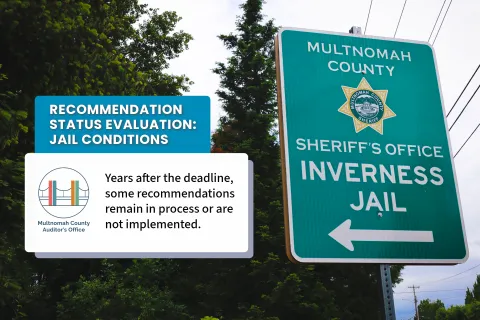
Status of recommendations evaluation: Jail conditions
This month we published our second assessment of recommendations from our 2022 audit of jail conditions. Audit Director Nicole Dewees, one of the staff on the 2022 audit, conducted the assessment.
We found that the Sheriff’s Office had implemented five recommendations and was in the process of implementing one. Additionally, we found that the Sheriff’s Office had not implemented four recommendations.
Among the recommendations that have not been implemented, the most concerning was that the county jails continue to widely use solitary confinement, particularly for those with mental health conditions. For example, misconduct citations resulted in solitary confinement 91% of the time. This kind of isolation is when an adult in custody is confined to their cell for 22 or more hours per day. There are strong correlations between solitary confinement and worsened general mental health, anxiety, depression, self-harm, and mortality—particularly suicide.
Additionally, the Sheriff’s Office and Board of County Commissioners have not implemented the recommendation to explore an independent review function for jail operations, such as discipline and use of force incidents. These particular matters must be dealt with quickly and cannot be easily addressed by outside agencies that generally do annual reviews. For example, discipline hearings are run by hearings officers who are Sheriff’s employees, which could be perceived as an inherent conflict of interest. An independent review function could help ensure the process is perceived as being fair – even when individuals disagree about specific incidents.
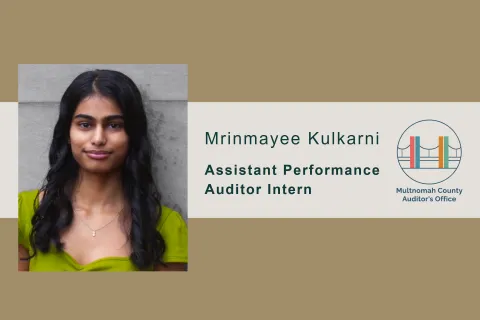
Welcome College-to-County (C2C) Intern
Mrinmayee Kulkarni is a senior at Willamette University pursuing a Bachelors of Arts in Politics. Raised in Beaverton, she's lived in Oregon her whole life. Mrinmayee has past experience working in government for the Senate at both the Oregon Legislature and the federal government. She enjoys writing fiction, playing piano, and traveling. Her professional interests include international law and diplomacy.
Community Engagement
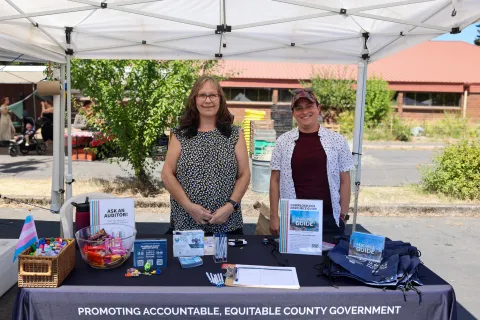
King Farmers Market
On July 19, my office continued our summer farmers market tour by tabling King Farmers Market, held in thein NE Portland's historic King neighborhood. Those who represented my office included Ombudsperson Cheryl Taylor, Senior Performance Auditor Dani Bernstein, and Constituent Relations & Equity Director Raymond De Silva, who provided community members with ombudsperson education and performance audit resources too.
Partners in Diversity Joint PRG Summer Gathering
On July 9, Partners in Diversity hosted their annual Joint Professional Resource Group (PRG) Summer Gathering. The event included Asian Pacific Islander, Black, Latino, and Native American PRG networks. Constituent Relations & Equity Director Raymond De Silva represented our office by attending the event at Lan Su Chinese Garden.
Invite Auditor McGuirk to attend an event or meeting
If you’d like me and or staff to attend or speak at a meeting with your community group, simply fill out this form.