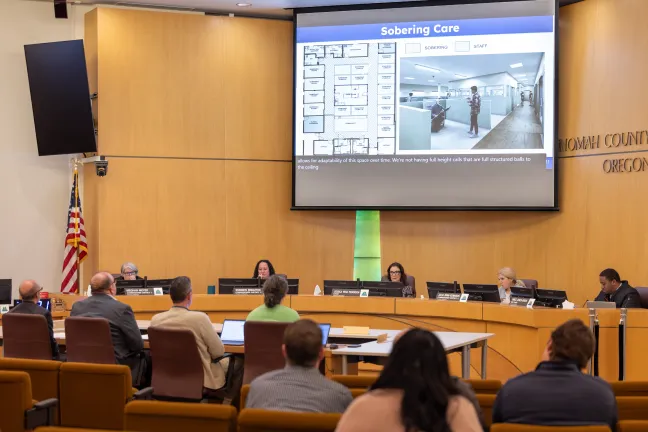
In a major milestone for Multnomah County’s behavioral health system, the Board of County Commissioners on Thursday, March 12, approved the project plan for construction of its new 24/7 Sobering and Crisis Stabilization Center. The Board’s action puts the facility on track to open its doors in late 2027.
Once opened, the center — located in the Central Eastside Industrial District — will offer 47 stations and beds across over 26,000 square feet, providing sobering, withdrawal management, and medication-assisted treatment 24 hours a day, 7 days a week. In April 2025, the County opened 13 sobering stations at its temporary Coordinated Care Pathway Center.
The Health Department’s Behavioral Health Division (BHD) is leading ongoing community engagement, working closely with key partners including the Central Eastside Industrial Council (CEIC) and the Hosford-Abernethy Neighborhood District (HAND).
“We’ve heard from law enforcement and first responders consistently about the need for a permanent 24/7 Sobering & Crisis Stabilization Center, which reflects a community safety approach to mental health crisis care,” Chair Jessica Vega Pederson said. “This center will be a focal point in providing an alternative to emergency departments and jails for individuals needing sobering and crisis stabilization. This is big, exciting work that will make a difference in the community."
A facility years in the making
The community’s previous sobering station, which had been operated by Central City Concern since 1985, closed in December 2019 amid safety and other operating challenges. In the years since, first responders have had few options for people experiencing acute substance use crises other than emergency rooms, jail, or leaving individuals on the street.
In April 2024, Commissioner Julia Brim-Edwards brought a detailed proposal to the Board for a permanent 24/7 dropoff center. In 2024, the Oregon State Legislature allocated $25 million to fund the project. This funding was used for a two-phased approach:
- Temporary facility: Approximately $9.4 million of the state allocation was utilized to stand up and operate the temporary Coordinated Care Pathway Center, which opened in April 2025 to provide immediate deflection and sobering capacity .
- Permanent center: The remaining $15.6 million in state funds will be applied toward the construction of the permanent S.E. Stephens St. facility
With the state’s remaining contribution accounted for, the total cost for the permanent $29.8 million project will be completed using $14.2 million from the County’s General Fund, proposed over the next two fiscal years
“Since my first day on the Commission, I’ve consistently pushed to expeditiously stand up more mental health health and addiction treatment services. I have heard from first responders and providers the urgent need for more options for people who are in crisis and intoxicated, beyond taking people to the emergency room, to jail or leaving them on the street,” Commissioner Brim-Edwards said. “We have an urgent need to better support individuals in crisis on our streets.”
The County acquired the property at 440 S.E. Stephens St. in April 2025, and the Board approved proceeding with formal design the same month. Scott Edwards Architecture completed the design in December 2025, and the County hired Fortis Construction as the construction manager/general contractor through a competitive procurement process.
The project team is also collaborating with the Regional Arts and Culture Council on exterior mural and interior artwork, featuring work from artists with lived experience related to substance use, addiction, and recovery.
What the center will do
The 26,053-square-foot facility will operate 24 hours as a trauma-informed resource for law enforcement, first responders and community partners. It will offer sobering services, withdrawal management, medication assisted treatment (MAT), deflection programming, and sheltering.
The center will include 47 stations and beds — 18 sobering stations for stays of up to 24 hours, and 29 withdrawal management beds for people who require a higher level of care over a longer period. Intake staff will triage, assess, and connect people to the most appropriate level of care, including referrals, transportation, and case management services.
Community Bridges, Inc., a provider with more than four decades of experience in behavioral health services, was selected through a competitive process to operate the facility.
Commissioner Meghan Moyer highlighted the center’s role as a "front door" for recovery services that has long been missing in the community. At the same time, she said she wants to ensure the center's programming and design are appropriate for the actual community need.
“I am a big believer in crisis stabilization,” Commissioner Moyer said. “I think our community desperately needs that, as well as sobering.”
Commissioner Shannon Singleton emphasized the need for continuity, ensuring that the County is "looking at all the opportunities to actually do warm handoffs and not just referrals.” She pointed out that the center needs to fit well with existing programming and prioritize access to the behavioral health shelter.
Commissioner Vince Jones-Dixon expressed his support for the project, saying, “I appreciate the progress and supportive of where we are so far. It's a much-needed resource in the community, which we all know.”
Construction scope and timeline
The comprehensive renovation will include a full seismic upgrade; new mechanical, electrical, plumbing, and sprinkler systems; new restrooms, showers and a commercial kitchen; and other work to comply with Oregon’s 2025 energy code. The building will feature an enclosed outdoor patio, accessible parking, and separate entrances for staff, law enforcement and the public.
Substantial completion is expected in September 2027, with furniture and equipment installation to follow. The behavioral health move-in is targeted for October 1, 2027.
A Good Neighbor Advisory Council will maintain ongoing community communication throughout construction and then once the building opens.
The public can find current information about the project and sign up for community updates on the Sobering Center website.