Watch the full board briefing.
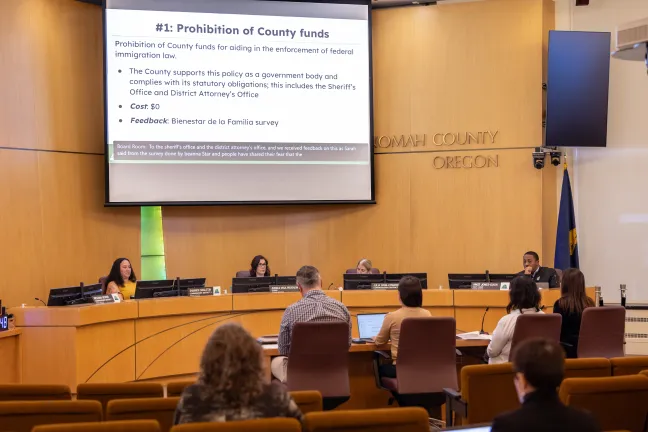
The Multnomah County Board of Commissioners on Tuesday, March 3, took time to hear updates from the Department of County Management on departments’ ongoing work to strengthen the County's status as a sanctuary county and response to immigration changes and enforcement.
The briefing highlighted two reports delivered by the Office of the Chief Operating Officer, reflecting months of work. One focused on specific actions the County can and has taken regarding client-facing services, with the other raising policy options to address employee accommodations and community needs.
County employees have worked diligently to adapt how services are delivered when needed, the reports make clear.
That includes offering home visits from case workers and food deliveries, encouraging virtual appointments for patients at County clinics, advocating for utility relief, creating a new website with resources for community members, and launching social media campaigns to combat misinformation.
County leaders also approved $175,000 for currently contracted providers to support rent assistance and legal services for families affected by recent federal enforcement actions. Those funds are already helping families and tenants find stability. An additional $75,000 in community grants will soon be awarded to organizations who don’t have existing contracts with the County. The County also received $226,000 in additional Supportive Housing Services (SHS) funding from Metro to support rent assistance for families affected by immigration enforcement, which was allocated to Bienestar de La Familia.
The information presented in the two reports will help the Board further develop the County’s federal response. A work session is planned for this Thursday, March 12, ultimately leading to a County ordinance.
“I deeply appreciate my team and all County staff who continue to show up every day in the light of constant fear — fear of being pulled over, of having kids and/or parents taken in front of schools,” said Commissioner Shannon Singleton, whose office led the work with Chair Jessica Vega Pederson’s staff.
“If people are being asked to find the courage to come into County offices or programs to get services from the County — and immigrant and refugee County employees are being asked to do this job or the labor of working through traumatic times to deliver services — I really think the least we can do is show up for them and show up for the community every way we can.”
“This conversation will give us a chance to work through the reports that were developed, understand what is currently happening, and lean into further replies,” Chair Vega Pederson said.
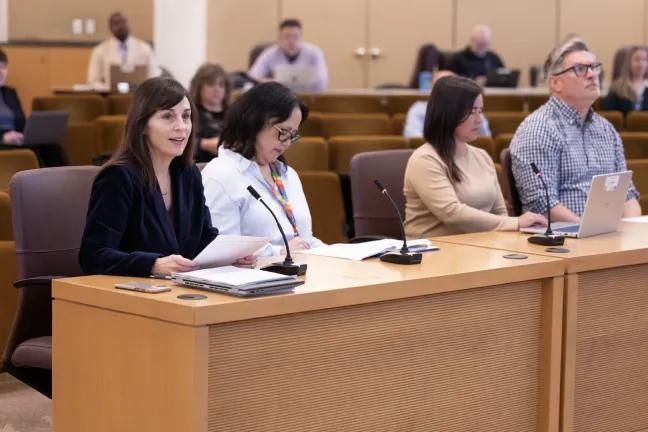
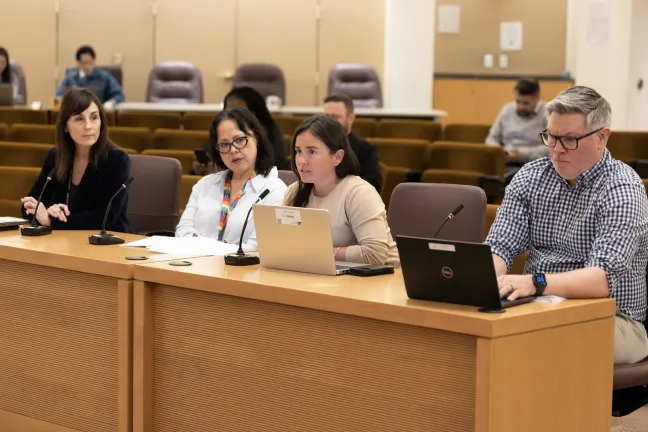
Many programs have been responding to direct community needs, Deputy Chief Operating Officer Sara Morrissey told the Board.
For example, the County has delivered between 15% and 20% of its food boxes to families’ homes because many are too anxious to leave. And the Health Department has been prioritizing efforts to ensure clients know that telehealth can be a preferred option, she said.
The County has also been maintaining and building trust with the community through regular communications and outreach, ensuring community members are aware of their options.
But Morrissey also noted some challenges, including:
- continued financial strain on departments as they work to support virtual and community services while also maintaining in-person capacity
- deepening financial burdens for people, individuals, families and businesses, which in turn increases the need for the County’s safety net services
County protections for immigration-related information
The reports also reviewed protections for County employees and potential policy and ordinance actions.
Presenters reviewed policy topics ranging from a ban on using County funds to help enforce federal immigration law to clarifications on restricted areas with signs and training for employees.
The County is complying with all current statutory obligations as a sanctuary community, Interim Deputy Chief Operating Officer Tracey Massey noted. But the County still must comply with any judicial warrant authorized by a judge, per the Oregon Sanctuary Promise Act.
Chief Information Officer Sim Ogle said the County is working to clarify all steps taken regarding detainment and custody when interacting with federal immigration law enforcement, as well as the notification process for impacted individuals and their families.
The Multnomah County Sheriff’s Office and Department of Community Justice (DCJ) do not accept administrative detainers or holds from the federal Immigrant and Customs Enforcement agency (ICE). The Sheriff’s Office and DCJ also decline all related requests for information unless disclosure is specifically authorized under state law.
The Sheriff’s Office maintains a publicly accessible website that provides limited information about adults in custody, but that information does not include information about someone’s country of birth or citizenship status. The Department of Community Justice’s disclosure policy also complies with the limitations set forth in Oregon’s Sanctuary Promise Act.
The County’s practice is to decline administrative subpoenas as required by Oregon law, said Ogle. But in response to those refusals, federal agencies can petition the federal district court to compel compliance. If the court issues an order, the County must comply.
“Advocates want the County to help families and caseworkers navigate the system so that dependents are not evicted or abruptly exited from social services while a family member is detained," Ogle said.
Massey also noted requests for signage to help make clear which areas in County buildings are not publicly accessible, which make them off-limits to federal officials and agents without a warrant. Law enforcement are still able to enter any parts of County buildings open to the general public, Massey said.
The cost to do this would be approximately $290 per sign and would require a team to identify buildings and determine where signage could be placed.
Ogle clarified how immigration-related data is stored and processed.
If this information is captured, he said, it is stored in a secure internal system. Disclosure to federal immigration officials is declined unless it’s required by a judge’s order or warrant. Administrative subpoenas alone do not qualify, Ogle said.
Immigration-related data for County employees — something required to determine or verify employment eligibility — is also stored in secured County systems separate from any law enforcement data systems.
Even so, the situation has created fear and reluctance among community members to share information with the County or with service providers, said Ogle.
Employee training and other supports
Multnomah County Emergency Management is actively developing a Countywide online training module to help prepare staff for potential interactions with federal agents. State training is also available, but the new module will be tailored specifically to the County.
The County is also evaluating other specific actions to protect and support employees affected by federal immigration enforcement. This includes the possibility of providing access to Workday, the County’s Enterprise Resources system for time entry and employment information, internationally — though not for the purpose of teleworking from an international location, said Interim Chief Human Resources Officer Cessa Diaz. International telework is not allowable due to significant technical, financial and operational costs, as well as information security risks, she explained.
Leave banks for immigration-related absences are allowed, and the County could explore options such as forward leave or allowing employees to carry a negative leave balance.
“Any new policies or rules would be negotiated with our unions,” said Diaz.
Commissioner comments
Listen to full commissioner remarks.
Commissioners commended the work to date and raised issues and questions that will be addressed during the March 12 work session.
“We have seen examples both here in Oregon and around the country of people being detained or deported for extensive periods of time, to then, through the judicial process, be released because it was unlawful,” said Commissioner Meghan Moyer.
“To what degree do we protect an employee's job if they are detained but are legally present and able to work in the United States?”
“We have contract rules and policy rules that protect our employees who may be detained for immigration reasons,” Diaz said. “Those include the ability to use protected leave or sick leave, as well as requesting leave from our catastrophic leave banks.”
Commissioner Singleton asked how clients or service recipients would know if they qualify for, or can ask for, virtual access. She also asked whether safety planning developed by Department of County Human Services case managers is being implemented across the County.
“That is something we’ll bring up with our deputy chief operating officers to make sure that it’s a practice that is being distributed countywide, " said Morrissey.
Commissioner Julia Brim-Edwards asked whether the County has considered scenarios involving requests by federal authorities for use of County buildings, or buildings in an unincorporated area of Multnomah County, where the County may have permitting or regulatory authority.
She also asked for clarification on ICE detainers and federal criminal proceedings, noting confusion about people being held in custody by the Multnomah County Sheriff’s Office.
“I was just going to reiterate that we do not hold individuals in custody on immigration detainers — full stop,” said Katie Bugard, chief of staff for Sheriff Nicole Morrisey O’Donnell.
“Our facilities are used for criminal proceedings only, whether that’s state or federal. It is based on criminal charges and a criminal adjudication that follows. There are no individuals being held in our facilities for an immigration detainer only.”
Commissioner Vince Jones-Dixon inquired about next steps and the potential ordinance. The Chair replied that the reports presented at the briefing would help guide and inform the County’s work in the coming weeks.
Closing out the briefing, Chair Vega Pederson detailed a story that was shared with the Board and staff members. A community member living in the metro area was facing a difficult immigration hearing on the East Coast, and with limited financial resources, was not able to fly to New Jersey. If the client failed to appear for their hearing, the judge would have closed his case and ordered him deported.
Attorneys with Metropolitan Public Defenders, with funding allocated to them from the Department of County Human Services Sanctuary Fund, were able to take the case and filed a flurry of motions, including some mailed overnight, and were ultimately able to reschedule the client’s hearing.
The client and their family will now have time to prepare for a hearing that’s now scheduled for 2029.
“This is why investing in legal support,” the Chair said, “is so important.”
“So often we see the scope of the problems and know that we don't have enough resources to address it in the way that it's needed, especially when we are trying to push back against actions of the federal government which has so many dollars and so many resources," the Chair said.
"But the work that we do, the steps that we take, the dollars that we invest do make a difference in people's lives."
#####