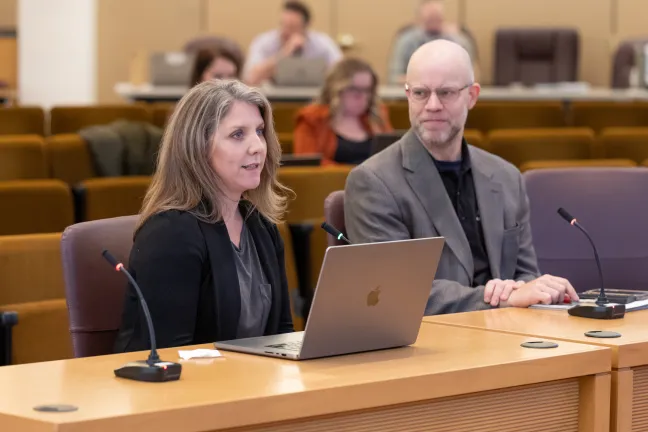
The Board of County Commissioners on Jan. 15 received a briefing about the County’s winter preparedness and severe weather shelter plans. County leaders highlighted a shift toward deeper collaboration with the City of Portland and more flexible response thresholds designed to save lives as weather patterns become increasingly unpredictable.
The evolution of the County’s severe weather response into a “more robust” program was prompted by a rise in weather-related fatalities several years ago, shared Emergency Management Director Chris Voss. He also noted that the County saw a decrease in fatalities in 2025.
Chair Jessica Vega Pederson prefaced the briefing by emphasizing the strong cross-jurisdictional partnership between the County and the City of Portland during severe weather events.
“The City of Portland is one of our most critical partners in ensuring that we are prepared to support this community during severe weather,” she said.
Staffing severe winter weather shelters, especially during 24-hour operations, can be a challenge because it requires mobilizing trained volunteers to handle high-stress, complex human needs at the exact moment when hazardous conditions make travel dangerous.
Voss explained that under an soon-to-be finalized agreement with the City of Portland, the County will compensate the City for additional costs they incur to keep city-run overnight shelters open 24 hours during severe winter weather activations.
“It’s a good deal for the County,” he said. “This allows us to leverage contractors and facilities. This will save us dollars in the long run, and it puts us in a position where we are less likely to fail in our ultimate mission: not turning away people during severe weather.”
The County maintains ongoing partnerships with 10 locations that can be converted into severe weather shelters, and also can use city-owned community centers, as well as spaces owned or leased by the State of Oregon, if needed. The County also has ready to use or activate:
- Five shelters trailers on standby, each containing sufficient supplies for an 80- to 150-person site (for daytime, overnight or 24/7 use)
- Food and water packages staged for various site capacities
- Security, transportation and other program support
- A resource request team, along with communications and staffing units
Activation thresholds
The County monitors weather conditions and other factors, including severe temperature fluctuations, wind chill and emergency department visits for hypothermia, when determining whether to open severe weather shelters.
County and City of Portland officials meet daily during potential events to discuss conditions — consulting with experts from the Emergency Management Office, Health Department, Department of County Human Services and Homeless Services Department — and then jointly decide on shelter plans.
Severe weather shelters open when any of the following thresholds are met for any one of the conditions below that are forecasted to persist for four hours or more between 8 p.m. and 7 a.m.:
- Forecasted temperature of 25° F (-4° C) or below
- Forecasted snow accumulation of 1.0 inch or more
- Forecasted temperature at or below 32° F (0° C) with driving rain of 1.0 inch or more overnight
The County’s Chief Operating Officer or their designee may also consider other conditions or circumstances during a severe weather event that could increase the risk to the community to activate a response.
The Homeless Services Department also activates an enhanced outreach program when conditions approach, but do not yet meet, shelter thresholds. This includes coordinated work to find vulnerable people living outside and distribute cold-weather gear and resource information. Thresholds for activating enhanced outreach include:
- Forecasted temperatures of 32° F (0° C) or below, without precipitation
- Forecasted windchills of 25° F (-4° C) or below, without precipitation
- Forecasted temperatures of 34° F (1° C) or below, alongside precipitation of more than one-tenth of an inch
The County also directly provides transportation to shelters during severe winter weather for people it has identified as “higher-risk” and those who may not be best served by the 211info ride system, which primarily facilitates sending cabs and other rideshare providers to the person in need.
“What happens during a lot of severe events, especially in these overnight hours, is that… sometimes [the individual is] not always easy to find. Sometimes Uber and Lyft will come upon some and maybe that person has a lot of stuff or is not someone that they want to let in their car, and they drive off,” Voss said.
During a five-day severe weather event in February 2025, the County provided 480 total rides.
Volunteer recruitment efforts
Multnomah County has seen a year-over-year increase in the number of people using its emergency weather shelters during their peak use.
“In 2024, we had our worst event and had to shelter 1,356 individuals,” said Rachel Pearl, interim director of the Department of County Human Services. “We now plan for 1,300, but remain able to adjust if something happens at a particular site.”
As the County navigates increasingly longer activations, its focus has shifted toward establishing a more sustainable staffing model. Multi-day 24/7 operational cycles during the last several years placed an immense strain on the County’s capacity to staff shelters sufficiently, underscoring the need for a larger pool of people to take shifts working in severe weather shelters.
“Remaining prepared is an ongoing effort,” said Pearl. “We’re working to expand the number of people who are ready and willing to do this work — including County staff and City employees, NET (Neighborhood Emergency Team) volunteers, and community members.”
By providing comprehensive training and removing barriers to entry, the County is building a larger reserve of volunteers capable of maintaining operational continuity during extended emergencies.
The “blue sky” phase of the emergency management cycle has become a critical period for proactive volunteer outreach. The Department of County Human Services has increased its public presence, participating in 25 tabling events over the past two fiscal years — including public health fairs and National Night Out gatherings — to promote household preparedness and recruit community volunteers.
To learn about upcoming severe weather shelter training and info session opportunities, as well as community volunteer needs during a severe weather event, visit multco.us/volunteer-emergency-shelter. The latest information on emergency shelters, enhanced street outreach and winter safety tips can be found at the County’s Care for When It’s Cold website (multco.us/cold).
Board comments
“I appreciate the level of intentionality as far as working with the City of Portland and just thinking about how we can use their 24-hour shelters,” said Commissioner Vince Jones-Dixon.
“I want to acknowledge and thank the improved partnership between the County and the City,” said Commissioner Julia Brim-Edwards. “This alignment — along with the collaboration with community partners — is leading to real improvements to our emergency response system in two specific ways: the robustness of the partnership with the City of Portland, and the flexible temperature thresholds, which allows the County to better serve vulnerable individuals in severe weather and be nimble under changing conditions.”
“Just a short ten years ago, it used to be the city’s responsibility to do this work. I’m glad they are back at the table to partner,” said Commissioner Shannon Singleton. She also asked if threshold flexibility still incorporates frontline voices. “When I was here, we had a situation where the snow was exceptionally wet and heavy and tents had collapsed and people didn’t have gear, so we were able to stay open an extra day for that ability to get people into safer conditions. Does that communication conduit still exist?”
Pearl confirmed that the County now prioritizes flexibility, often delaying morning closing times to re-evaluate shifting forecasts. “With climate change, forecasts become less reliable, so our flexibility around pushing out closing times has been a helpful strategy,” Pearl said.
Commissioner Meghan Moyer asked “what is the policy for the City’s overnight shelters for people who have previously been excluded from shelters, in an emergency weather situation?”
“It’s been a high priority for our team to ensure it’s understood that this is a life-saving measure,” Pearl replied. “We are opening because it becomes life-threatening for folks to remain outdoors, which means that we need to have very low-barrier thresholds for people being able to come into those spaces.”
“Whether it’s winter or summer, County employees really step up to fill the rolls we need,” said Chair Vega Pederson. “Our compassionate response that ensures no one is turned away during these weather events makes the difference between life and death for our most vulnerable community members.”