
Report issued May 2026
Why we did this audit
This report provides a useful look back at historical trends, which include the impact from the COVID-19 pandemic. This data can help inform future decision-making.
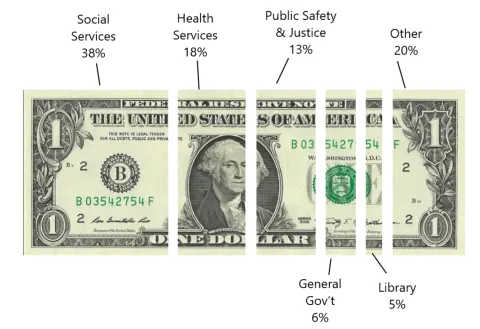
| FY 2025 Highlights | |
|---|---|
Metro Supportive Housing Services Intergovernmental revenues Increased ~ $10 million over FY2024 | State Behavioral Health Deflection Program Received ~ $15 million in revenues |
Use our interactive dashboards to learn about key aspects of the county's financial health
See how Multnomah County compares with neighboring counties
Examine county revenues vs. expenditures
Learn about where the county's money comes from
Learn about where the county's money goes
Explore indicators of the county's financial health
Learn about the county's economy - unemployment, property taxes, and other measures
Learn about county demographics
Yearly fiscal highlights
This report is a look back at historical trends. Below are some significant fiscal highlights that have impacted the county since 2016.
FY2025
- Supportive Housing Services (SHS) intergovernmental revenues for housing services increased by more than $10 million over the prior year.
- The Federal/State Program Fund included an increase of almost $40 million in the Health Department, of which over $15 million was for the State Behavioral Health Deflection Program.
- The Roads, Willamette River Bridges, and Burnside Bridge funds increased almost $23 million, primarily due to a lottery bond grant through HB5030 from the State of Oregon Department of Transportation for the Earthquake Ready Burnside Bridge Project.
- The Federally Qualified Health Centers (FQHC) Fund's expenditures increased almost $29 million compared to the prior fiscal year. The largest increase related to personnel expenses.
- The Preschool for All Program fund increased over $39 million in community services program type expenditures.
- The Supportive Housing Fund expenditures increased over $71 million. This fund accounts for revenues and expenditures for supportive housing for those people experiencing homelessness. Funds are used to support services and programs for people experiencing homelessness, or who are at risk of becoming homeless, and services and programs addressing community livability and safety concerns associated with homelessness.
FY2024
- The continuation of the Multnomah County Library Capital Construction Fund for planning, renovation, and construction of certain library facilities had an increase in capital outlay expenditures of over $49 million.
- The Burnside Bridge Fund for rehabilitating or replacing the Burnside Bridge had an increase in capital outlay expenditures of over $12 million.
- The Federally Qualified Health Centers (FQHC) Fund's expenditures increased almost $24 million compared to the prior fiscal year. The majority of the increase related to personnel expenses.
- The Supportive Housing Fund expenditures increased almost $60 million.
FY2023
- Revenues increased over $12 million and expenditures increased over $6.5 million related to the Preschool for All Program fund.
- Supportive Housing Services (SHS) intergovernmental revenues for housing services increased by more than $45.8 million over the prior year. There was also an increase of over $47 million in the Supportive Housing Fund which accounts for expenditures for supportive housing for those people experiencing or at risk of homelessness.
- The increases above are off-set by a decrease in the COVID-19 special revenue fund for intergovernmental revenues of almost $33 million from the prior year.
FY2022
- The new Supportive Housing Services (SHS) business and personal income tax was approved by voters in 2020 and became effective January 1, 2021. In FY2022, Metro passed through over $97.8 million in SHS intergovernmental revenues to the county for housing services.
- The Preschool for All Program fund was new in FY2022. The new Multnomah County Preschool for All (PFA) tax was approved by the voters in 2020 and became effective January 1, 2021. The voter-approved ballot measure established a new and permanent personal income tax within Multnomah County to fund universal, tuition-free, voluntary, and high-quality preschool education for every three- and four-year-old residing within Multnomah County. Tax collections totaled $187 million in FY2022.
- Construction costs related to the Behavioral Health Resource Center (BHRC) project increased almost $16 million. The BHRC facility has been programmed to provide peer support services, offer transitional housing for homeless people with behavioral health issues, and assist people with finding housing and treatment services.
- The Multnomah County Library Capital Construction Project for planning, renovation, and construction of certain library facilities as approved by Multnomah County voters on November 3, 2020, as Ballot Measure 26-211.
- Business Income Tax (BIT) increased by over $33 million. BIT collections had one of the largest year-over-year increases in the last three decades. The increase is due to a record level of corporate profits as the economy rebounded from the pandemic.
- Motor vehicle rental tax & the Special Excise Tax increases from FY2021 to FY2022 are also a reflection of the economic recovery after the effects the COVID-19 pandemic had on travel and tourism.
- Newly created Health Department FQHC Fund. The fund was created to separate the activities for Federally Qualified Health Centers (FQHC) from other funds. Balances for the activities that were previously reported in the General Fund and the Federal/State Program Fund were transferred into this new fund in order to capture all activities related to FQHC within this fund.
FY2021
- The new downtown courthouse opened in October 2020.
- Over $156.8 million in intergovernmental revenues recognized related to the COVID-19 pandemic.
- A $32 million (31%) increase in the business income tax (BIT) due to a couple of factors:
- The Board of County Commissioners approved a tax rate increase from 1.45% to 2.0% beginning with tax year 2020.
- The federal aid provided over the last two years to help address the impact of the pandemic increased overall incomes, boosting increased spending and aggregate demand. This resulted in some of the largest payers of the County’s BIT having stronger than expected profits coming out of the pandemic.
- General Obligation bonds issued to finance capital costs to expand, modernize, rebuild, and acquire land for library facilities.
FY2020
- An emergency declaration for the COVID-19 pandemic was declared in March 2020.
- The Behavioral Health Managed Care Fund program transitioned to Health Share Oregon (HSO). Beginning January 1, 2020, the Health Department was no longer operating as the Multnomah Mental Health (MMH) Risk-Accepting Entity as part of HSO.
FY2019
- The new Health Department headquarters opened.
- The county went live with a new suite of enterprise resource planning (ERP) systems in January 2019.
- Significant projects under construction included the central courthouse.
FY2018
- The county’s new ERP system replacement project was under way in FY2018.
- Wapato facility was sold in FY2018.
- Significant projects under construction included the downtown courthouse and the Health Department headquarters.
FY2017
- In 2016, Multnomah County and the City of Portland created the Joint Office of Homeless Services (JOHS), thereby consolidating homeless services under the county. Beginning in FY2017 the county began recognizing funding related to the JOHS program.
- $25 million lump sum annual payment (at the discretion of the county's CFO) to PERS starting with FY2017 per Resolution 2016-1.7.
- Significant projects under construction included the downtown courthouse and the Health Department headquarters.
FY2016
- At the beginning of FY2016 the Department of County Human Services (Social Services) transferred Mental Health and Addictions Services (MHAS) to the Health Department (Health Services).
- The Sellwood Bridge project was completed and the new bridge opened in the spring of 2016.
- The downtown courthouse construction project began the design and construction phase.
Objectives, scope, & methodology
The objective of this audit was to evaluate the financial condition of Multnomah County using the Financial Trend Monitoring System developed by the International City/County Management Association (ICMA) and the indicators suggested by the Government Accounting Standards Board (GASB).
Many of the charts show figures in inflation-adjusted dollars relative to 2025 (fiscal year ending June 30, 2025 or calendar year ending December 31, 2025, where applicable). The option to view the numbers in unadjusted numbers is also available. We use the CPI-W West – Size A, Consumer Price Index (fiscal year average = second half to first half) to reflect consistent purchasing power across different years.
Throughout this report, we have included the state payments to intellectual and developmental disabilities (I/DD) service providers. In FY2008, the state began paying community service providers directly, while in prior years these funds passed through the county. While the county no longer receives these funds directly, they are reported in the county’s financial statements as intergovernmental revenues and social services expenditures. In FY2025, this amounted to $433.896 million paid directly to I/DD service providers.
To provide context to some of the financial and economic indicators, we have presented the recession that occurred at the onset of the COVID-19 pandemic (2020). Per the National Bureau of Economic Research (NBER): “Contractions (recessions) start at the peak of a business cycle and end at the trough […] A recession is a significant decline in economic activity spread across the economy, normally visible in production, employment, and other indicators. A recession begins when the economy reaches a peak of economic activity and ends when the economy reaches its trough…a month is designated as a trough when economic activity reaches a low point and begins to rise again for a sustained period.”
- Per the NBER, the recession at the onset of the COVID-19 pandemic had a peak in February 2020 and a trough in April 2020. Similarly, the NBER determined “that a trough occurred in April 2020, [NBER] did not conclude that the economy has returned to operating at normal capacity […] The [NBER] decided that any future downturn of the economy would be a new recession and not a continuation of the recession associated with the February 2020 peak. The basis for this decision was the length and strength of the recovery to date.”
For more information
The prior reports cover FY2007 through FY2023 and are available on the County Auditor's website. Earlier reports are available upon request.
The county's financial policy is adopted and published annually in its adopted budget. The county's budget can be accessed at the county Budget Office’s website. The county’s financial statements can be accessed at the county Finance Division’s website.
For information on the Consumer Price Index used to show the inflation-adjusted dollars in the report, see the U.S. Bureau of Labor Statistics website.
Additional economic information can be obtained through the State of Oregon for the State Employment Department or the Office of Economic Analysis.
For information about the county's property tax structure and limitations, see the Tax Supervising & Conservation Commission website and the County Assessor’s Office website.
For more information about economic recessions, see the National Bureau of Economic Research’s website.
For more information on population and demographic data, see the U.S. Census Bureau website and Portland State University Population Research Center website.
Data reliability
For this audit, we used data from Workday, the county’s enterprise resource planning system. We assessed the reliability of Workday’s data by (1) performing electronic testing for obvious errors in accuracy and completeness, (2) reviewing existing information about the data and the system that produced them, (3) reviewing related documentation, and (4) working closely with county officials to identify any data problems. We determined that the data were sufficiently reliable for the purposes of this report.
Statement of compliance with government auditing standards
We conducted this performance audit in accordance with generally accepted government auditing standards. Those standards require that we plan and perform the audit to obtain sufficient, appropriate evidence to provide a reasonable basis for our findings and conclusions based on our audit objectives. We believe that the evidence obtained provides a reasonable basis for our findings and conclusions based on our audit objectives.
Audit staff
Annamarie McNiel, CPA, Operations and Audit Director