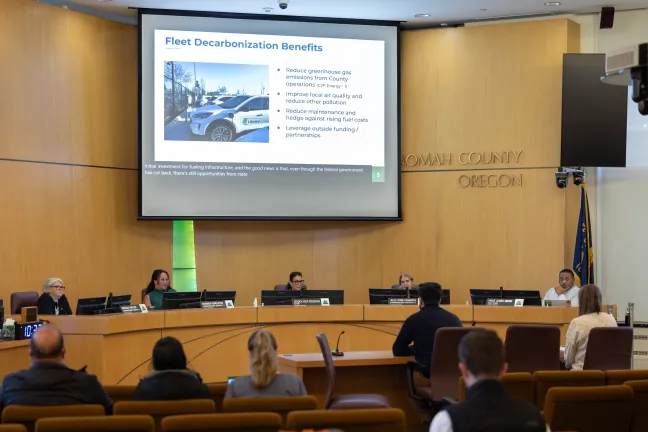
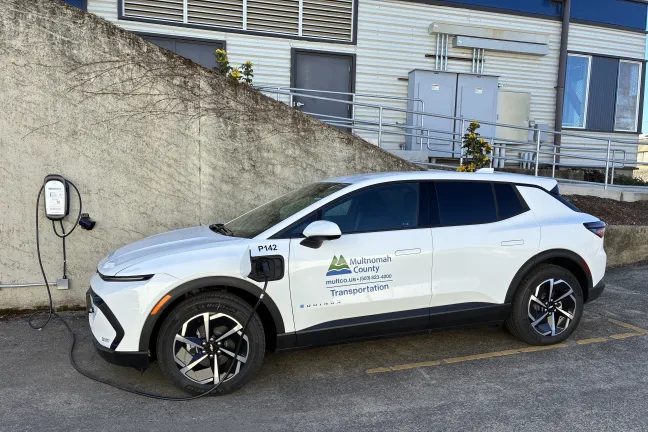
The Multnomah County Board of Commissioners on Thursday, Oct. 29, unanimously passed a resolution to adopt the Fleet Decarbonization Strategy, which establishes the framework for fully transitioning the organization’s fleet from gasoline and diesel to electric vehicles by 2050. The resolution, along with an Oct. 15 briefing on the matter, were advanced in response to a Fiscal Year 2027 budget note.
“Electric vehicles cost significantly less to fuel and maintain, and those savings add up for taxpayers. With difficult budget decisions ahead, this is an action we can take to reduce our long-term operating costs,” said Commissioner Julia Brim-Edwards, who co-sponsored the resolution with Commissioner Shannon Singleton, after the meeting. “This resolution moves us forward with a clear strategy and accountability for delivering results.”
“I know this might still be a controversial statement, but climate change is real… We see the impacts daily — the headlines continue to grow in the number and severity of incidents, and we're experiencing our driest October in 35 years,” said Commissioner Singleton. “So we have to take this issue seriously as a County.”
Multnomah County’s current fleet of more than 650 vehicles is used for a wide variety of purposes, including client visits, infrastructure maintenance, emergency management, law enforcement, health services and other needs. Transitioning to an electric fleet will benefit both the organization and the community.
“Moving from internal combustion engines to battery electric vehicles reduces County emissions. It will also reduce air pollution locally,” said John Wasiutynski, the director of Multnomah County’s Office of Sustainability. “We're seeing evidence that even the small increase in registered electric vehicles helps to improve local air quality.”
The initial costs of transitioning can be mitigated by partnerships with the state and utilities, and with other outside funding, Wasiutynski said, also noting that an electric County fleet will reduce longer-term maintenance costs and hedge against rising fuel prices.
The resolution represents the latest step in the County’s commitment to reducing the environmental impacts of its operations, particularly decreasing enterprise greenhouse gas emissions generated through County work — 35% of which is driven by County fleet vehicles.
In 2017, the Board adopted a resolution to put Multnomah County on track to meet 100% of community-wide energy needs with renewable energy — including the full decarbonization of the organization’s fleet — by 2050. Four years later, the Board passed a resolution that solidified the County’s commitment to fossil fuel-free buildings and fleet electrification.
Most recently, the Board adopted the 2026 Climate Justice Plan, a strategic 10-year roadmap for protecting residents from severe climate impacts and aggressively lowering carbon emissions. One of the strategies for reaching the plan’s “Clean Energy” goal is decarbonizing Multnomah County operations, including the County’s fleet.
The fleet decarbonization strategy, drafted by the Office of Sustainability, carries four main recommendations:
- Establishing an "EV First" administrative rule that requires County departments to prioritize battery electric vehicles (BEVs) during procurement when possible
- Establishing an interdepartmental BEV Task Force to make recommendations and work through implementation challenges
- Establishing emissions reduction targets for 2035 and 2040 to track progress toward the 2050 goal.
- Centralizing the funding for EV charging infrastructure, rather than making individual departments bear the cost
Commissioner Singleton introduced an amendment, approved unanimously, that adds interim fleet greenhouse gas reduction targets to the resolution — a 50% reduction from 2007 levels by 2035, and a 75% reduction by 2040 — rather than deferring the task of creating targets to a BEV Task Force that has yet to be formed.
“I don't think we need additional and long analysis on goals. (The Board) already has the role of setting ambitious but achievable goals, and that's what these goals will do — they're benchmarks that we can judge our progress by,” Commissioner Singleton said, pointing out that by 2024, the County’s 10-year cycle for replacing fleet vehicles will have turned over one and a half times. “We should be able to see substantial progress in this time frame.”
The amendment also added a commitment to “support the use of a skilled and trained local workforce,” along with contractors participating in apprenticeship programs and other employers that pay prevailing wages and benefits, through the County’s procurement choices regarding BEV charging infrastructure installation and maintenance.
With the resolution adopted, the County will take immediate steps to charter the Fleet Decarbonization Task Force and advance the “EV First” rule through the administrative procedure process, Wasiutynski said.
“This work is so important as we continue to advance climate action, energy efficiency, resource conservation and sustainability internally in our own operations,” said Chair Jessica Vega Pederson.