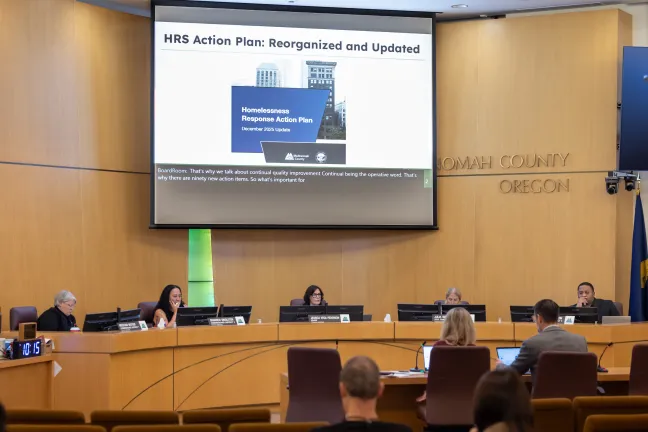
On Thursday, Dec. 11, the Board of County Commissioners approved updates to a strategic plan for addressing homelessness in Portland and Multnomah County. The Homelessness Response Action Plan, originally developed and approved in 2024, is the unified plan guiding the Portland area’s response to homelessness.
“This update builds on the lessons learned in the original HRAP, which continues the practice of being data, systems, and people driven to help us be accountable and transparent with the community on the work that’s happening,” said Chair Jessica Vega Pederson. “I’m extremely proud of the plan, the work that’s gone into it and the impact that it’s going to have.”
The original version of the plan was approved by both the Portland City Council and Multnomah County Board of Commissioners in 2024 as part of an updated City-County intergovernmental agreement.
The plan was always intended to be a living document that responds to the evolving realities of homelessness. “This is the first time it’s received a refresh, but it won’t be the last,” said Jillian Schoene, director of the Homelessness Response System.
Following the Board’s approval, the same updates were voted on by the Portland City Council on Dec. 17, where it passed 9-3.
The updated version of the plan includes five goal areas, 16 overarching strategies and 90 action items. It was developed through significant stakeholder engagement and was first approved by the Steering and Oversight Committee of the Homelessness Response System.
The plan carries over some of the work already underway as part of the first version of the Homelessness Response Action Plan, but it also brings on new action items.
“It’s a mix of existing items being carried forward, some with some refinements, and 90 new action items that represent the additional work we need to tackle,” Schoene said. “What this plan gives us is a guide keeping us on track, on task, and — with the overarching governance structure — accountable to each other.”
In addition to approving the updated plan, the Board also approved new Key Performance Indicators related to homelessness.
Significant data improvements accomplished by the Homeless Services Department in the past year have made it possible to track metrics that weren’t available when the first Homelessness Response Action Plan was developed. That includes inflow and outflow, which measure how many people are entering and exiting homelessness services in a given month.
The original intergovernmental agreement included only four key performance indicators. Now, there will be 12. Some are associated with a specific goal, while others are only tracked as indicators of the current state of homelessness.
The new indicators are:
- Reduction of net homelessness over two years.
- Percentage of people who returned to homelessness from a permanent housing location (indicator only).
- Increased availability of housing units that are affordable to households with extremely low income (defined as 0-30% of the Area Median Income) — tracked as the number of available deeply affordable units for every 100 households who are extremely low income.
- Reduction of exits from permanent housing to homelessness among people with high-acuity behavioral health challenges.
- Over two years, net reduction of those new to By Name List.
- Number of people living without a lease agreement in extremely low income households, defined as 0-30% of the Area Median Income (indicator only).
- Number of eviction judgments (indicator only).
- Within two years, reduction of the share of people who are known to be unsheltered.
- Over two years, reduction of net chronic homelessness, defined as Population A.
- Over two years, increase in the number of people exiting the homeless services system.
- Over two years, increase in the number of people exiting homelessness to housing.
- Net reduction of average time spent homeless before returning to housing.
These indicators will be tracked by the Homelessness Response System and reported out quarterly.
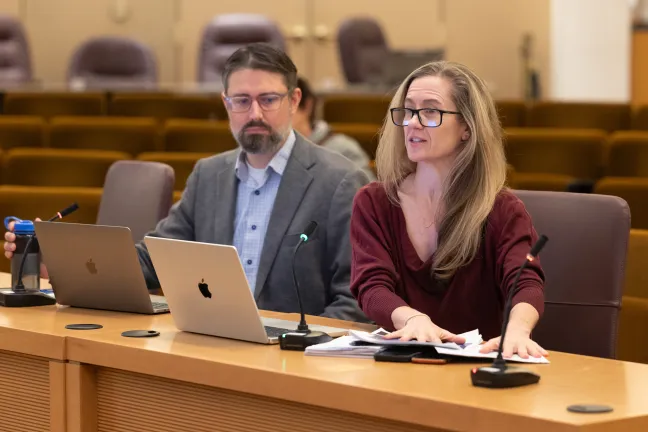
“Across all these KPIs, they are meant to help you ask and answer some key questions about our full system performance,” said Ryan Deibert, deputy director of the Homelessness Response System.
Some of the indicators will be defined with more specificity in June 2026 by the Steering and Oversight Committee, whose members include Chair Vega Pederson, Commissioner Shannon Singleton, Portland Mayor Keith Wilson, Portland Councilor Eric Zimmerman, Gresham Mayor Travis Stovall, Home Forward Director Ivory Mathews, and other representatives from the healthcare and business sectors.
The Steering and Oversight Committee will decide those details after the release of the first quarterly report using the 12 new key performance indicators, which will be published in May 2026. It will also follow the Board of County Commissioners’ and Portland City Council’s budget and policy decisions for the 2026-27 fiscal year, which starts July 1.
Board comments and vote
The updated plan was approved 4-1, with Commissioner Julia Brim-Edwards voting against it.
Commissioner Brim-Edwards expressed support of the updates to the plan, especially the new data-driven key performance indicators measuring progress. However, she called to question the specifics underpinning the key performance indicators that will be decided by the Steering and Oversight Committee rather than the full Board of County Commissioners and City Council.
“We set the key performance indicators, but the actual goals are being set by another body. I believe it’s part of my commission responsibility to be setting goals that demonstrate real progress and measurable improvement ” she said in a statement. “Our community expects better outcomes for the investments we're making, and we need to significantly improve the connections and pathways from homelessness to long term, stable housing.”
Commissioner Meghan Moyer said she supported the updates, especially the plan’s strengthened approach to behavioral health. However, she also expressed concern about its commitment to reducing homelessness over two years when the County isn’t able to control the number of people becoming newly homeless each month.
“I have trepidation about committing to outcomes in which we can’t control one of the major variables — which is the inflow,” she said. “I’m very nervous that many of the fiscal policies of our federal government are going to be causing tremendous harm to our neighbors. And so it makes it hard to commit to a reduction in homelessness, even though everyone’s committed to wanting to reduce it.”
Commissioner Shannon Singleton also shared her support of the updates, but said more work is needed to make the system more efficient and effective.
“This is a good next step. Moving forward, when discussing the partnership on homelessness with the City of Portland, I believe we have the opportunity to build a true system of services where homelessness is rare, brief and non-recurring. This will require us to lean on each jurisdiction's expertise,” said Singleton in a statement. “An intergovernmental agreement should focus on our points of collaboration including outreach coordination, linking the City’s public space management system into the County's homeless services system, and linking our homelessness services system into the City’s affordable housing portfolio — specifically to meet ending homelessness needs at the 0-30% Average Median Income level.”
Commissioner Vince Jones-Dixon also approved the updated plan, saying it will help the Board make decisions in the coming months. “I’ve appreciated the focused framework and timeline. It’s going to be extremely helpful as we facilitate the conversations with the cities in District Four,” he said, referring to his work convening East County city managers. “It will be helpful for us as we’ll bring forward recommendations in the coming months, and I’m supportive of the work that you’ve done thus far.”