
How Single-Winner RCV Contests Are Counted
Single-winner ranked choice voting is used to elect all Multnomah County offices, and Portland’s Mayor and Auditor. One candidate must receive more than 50% of the votes to be elected.
- To begin, only voters’ 1st choices are counted.
- If no candidate receives enough votes to be elected, candidates with the fewest votes are defeated and votes are transferred to their supporters’ next choices.
- This process continues until a candidate gains over 50% of the vote.
- Election officials will only use your 2nd-6th choices if your 1st choice has already been defeated
For Multnomah County candidate contests only: A process called batch elimination is used in the tabulation process. Batch elimination is the simultaneous defeat of multiple candidates whose vote totals combined is less than the vote total of any other candidate – making their election impossible. Batch elimination simplifies results reporting, but does not affect the voting experience or the final results of an election.
Watch a video that explains how single-winner RCV contests are counted
View results from the November 2024 RCV contests
Example of how votes are counted with single-winner RCV
Ranked choice voting contests are counted in rounds. In each round, a candidate is either defeated or passes the election threshold and is elected.
Round 1
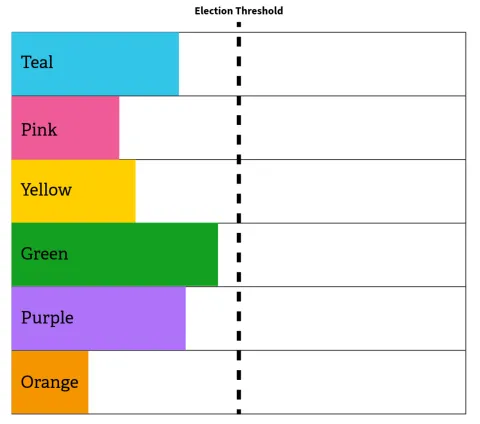
In round 1 of counting, only voters Rank 1 choices are counted. After looking at all voters’ 1st choices, Green takes the lead, but does not yet have over 50% of the votes.
Round 2
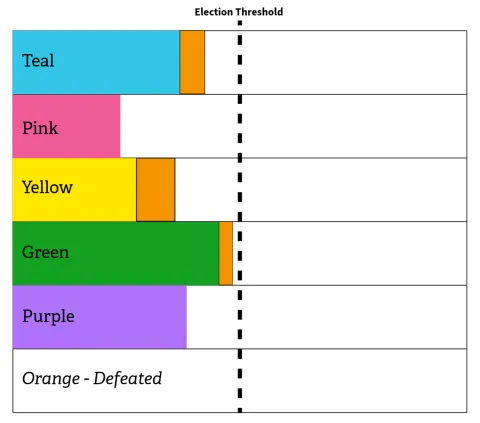
In the second round of counting, Orange has the fewest votes of all the candidates and so they are defeated. Their votes are then transferred to each of their voters’ next highest ranked choices.
Green continues to be in the lead and gains votes, but still does not have over 50% of the votes, so we continue counting…
Round 3
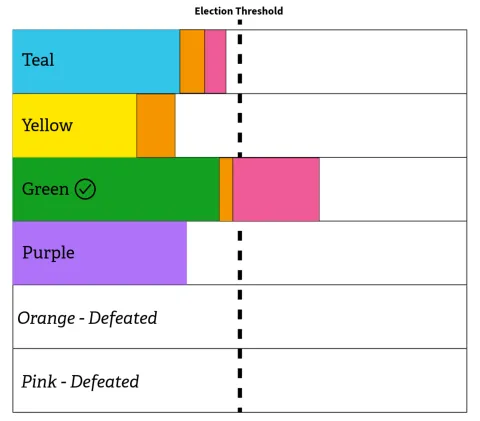
In Round 3 of counting, Pink has the least votes and is defeated. When Pink’s votes are transferred to their voters’ next choices, Green gains enough votes to cross the threshold and is elected!
How Multi-Winner RCV Contests Are Counted
Multi-Winner ranked choice voting is only used to elect Portland City Council, when three candidates for each city district are elected in one contest. When three seats are being elected, candidates must receive more than 25% of the vote to win.
- To begin, only voters’ 1st choices are counted.
- If no candidate receives enough votes to be elected, candidates with the fewest votes are defeated and votes are transferred to their supporters’ next choices.
- Once a candidate reaches over 25% of the vote, counting continues until two additional candidates reach over 25% of the vote.
If a candidate receives more votes than they need to be elected (25% + 1 votes), this is known as a surplus. When a candidate receives a surplus of votes, a portion of every vote that candidate received is shifted to their voters’ next choices. The transfer value of surplus votes is calculated using the following formula:
(candidate’s total votes - election threshold) / candidate’s total votes
Example of surplus formula: The threshold for election is 9,000 votes
- Sanae Smith gets 10,000 rank 1 votes and crosses the threshold in round 1 of tabulation
- 10,000 - 9,000 = 1,000
- 1,000/10,000 = .1000
- Every one of the 10,000 people who ranked Sanae 1st have their vote transferred to their next ranked candidate at a value of 0.1000.
Read more about the City of Portland ranked choice voting tabulation.
Watch a video that explains how multi-winner RCV contests are counted.
View results from the November 2024 Portland City Council multi-winner RCV contests.
Example of how votes are counted with multi-winner RCV
Ranked choice voting contests are counted in rounds. In each round, a candidate is either defeated or passes the election threshold and is elected.
Round 1
In round 1 of counting, only voters Rank 1 choices are counted. After looking at all voters’ 1st choices, Green takes the lead, but does not yet have over 25% of the votes (the election threshold in a 3-winner contest).
Round 2
In the second round of counting, Orange has the fewest votes of all the candidates and so they are defeated. Their votes are then transferred to each of their voters’ next highest ranked choices.
Green continues to be in the lead and gains votes, but still does not have over 25% of the votes, so we continue counting…
Round 3
In Round 3 of counting, Pink has the least votes and is defeated. When Pink’s votes are transferred to their voters’ next choices, Green gains enough votes to cross the threshold and is elected!
Round 4
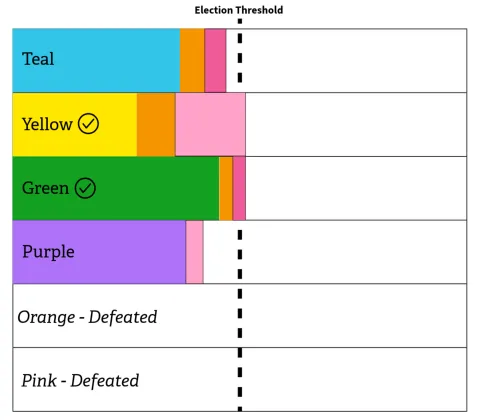
In Round 4, the value of Green’s surplus of votes (shown in light pink) is calculated using the surplus transfer formula. Then, a portion of each vote that was cast for Green is then transferred to the next choice candidate on each of those voters’ ballots.
With this transfer, Yellow gains enough votes to cross the threshold and is elected! They gain exactly enough votes to win and do not have a surplus.
Round 5
In Round 5, Purple has the fewest votes and is defeated. With the votes that Teal gains from Purple, Teal has enough votes to be elected!
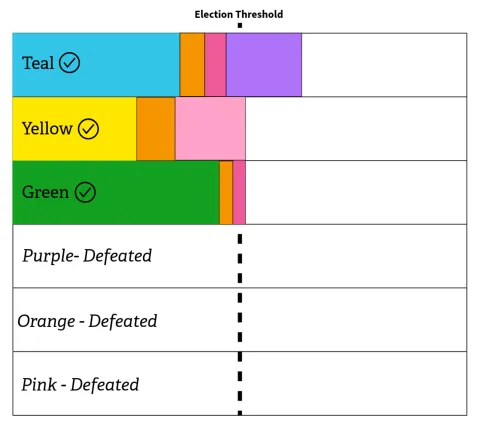
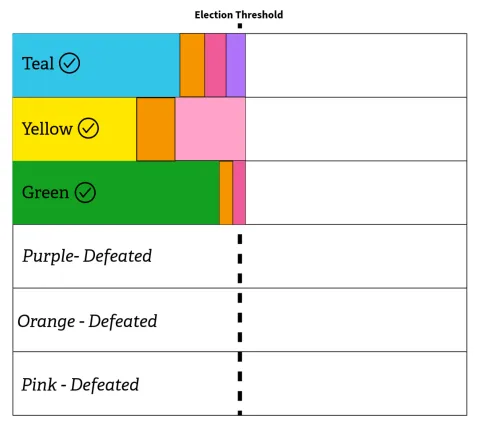
Round 6
Teal, Yellow, and Green are our three winners!
View Results from RCV Elections
Results reports from all City of Portland and Multnomah County ranked choice voting contests can be found at rcvresults.multco.us.
RCV Results Terminology
| Term | Definition |
|---|---|
| Election Threshold | The threshold is the number of votes needed to be elected. For single-winner contests: The threshold is 50% + 1. For three-winner contests for Portland City Council: The threshold is 25% + 1. |
| Round | A round is a unit of vote counting in a larger tabulation process. In each round, a candidate is either defeated or passes the election threshold and votes are transferred. Each preliminary results update will show round-by-round tabulation until the correct number of candidates reach the threshold for election. Past RCV contest results show examples of preliminary and final results reports with round-by-round tabulation. |
| Leading/Leads | A candidate will be listed as leading/in the lead in a preliminary results report when they have reached the threshold for election in the tabulation process. ‘Leading’ in a preliminary report does not mean that the candidate will stay in the lead indefinitely. Results are not declared final until they are certified. All preliminary results updates show who is leading and how they got there, they do not declare who is elected. |
| Defeated | A candidate is ‘defeated’ in the tabulation process when they receive the least number of votes in a round and their votes are transferred to their voters’ next highest ranked choices. In preliminary results, ‘defeated’ does not mean that the candidate is out of the contest and will not be included in future tabulation. Every time we release a new preliminary results update, we will run tabulation from scratch with all of the ballots we have received. |
| Batch Elimination | Batch elimination is the simultaneous defeat of multiple candidates whose vote totals combined is less than the vote total of any other candidate – making their election impossible. Batch elimination simplifies results reporting, but does not affect the voting experience or change the final results of an election. Batch elimination is only used for Multnomah County candidate contests. Download the PDF to learn more: Document
Batch Elimination in MultCo RCV Contests.pdf
(353.1 KB)
|
| Votes Transferred | Votes can be transferred from candidates who have been defeated in a round of tabulation (single & multi-winner) and from candidates who reach the threshold for election with more votes than 25%+1 (multi-winner only). |
| Surplus Votes | In a three-winner RCV contest (such as for Portland City Council), if a candidate crosses the threshold with more than 25% + 1 votes, this is known as a surplus. When a candidate receives a surplus of votes, a portion of every vote that candidate received is shifted to their voters’ next choices. |
| Residual Surplus | When surplus votes are transferred in multi-winner contests (see below for example), each ballot counting for a candidate who has reached the threshold is assigned a new transfer value by multiplying the ballot’s current transfer value by the surplus fraction for the elected candidate, with the result truncated after four decimal places. The residual surplus represents the number of surplus votes not transferred due to truncating the transfer value. |
| Inactive Ballots | An inactive ballot (also known as an exhausted ballot) does not count for any candidate. A ballot can become inactive if it does not contain any valid rankings for any candidates or if it no longer contains any rankings for any active candidates. For example, if only 1st and 2nd ranks are marked on the ballot and those candidates are defeated before tabulation ends, the ballot will become inactive since there are no more choices to count. |