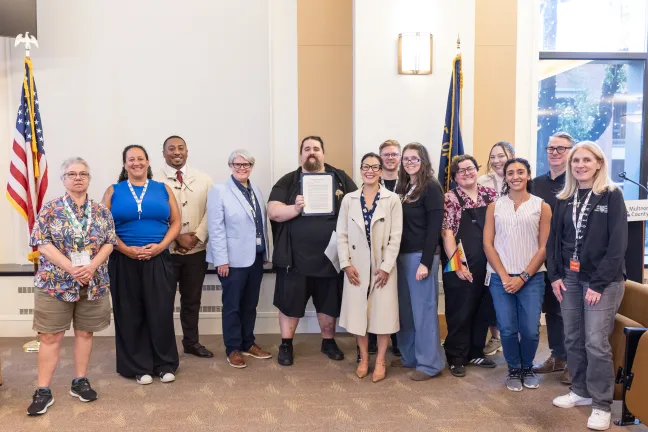
The Multnomah County Board of Commissioners on Wednesday, July 1, celebrated its monthly Proclamation Day, adopting four proclamations highlighting community supervision, recognition and support for human rights and historical remembrance, LGBTQIA2S+ pride, and disability inclusion across the county.
“As we know, proclamations serve to honor, celebrate and recognize groups and individuals for their contributions and achievements or to raise awareness of significant issues affecting our community here in Multnomah County,” Chair Jessica Vega Pederson said.
Probation, Parole and Post-Prison Supervision Week
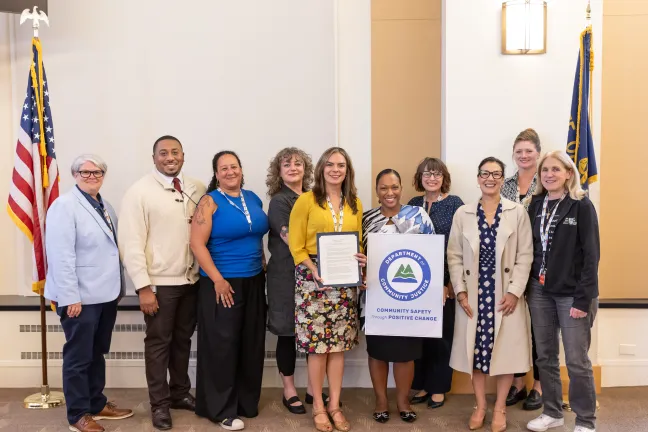
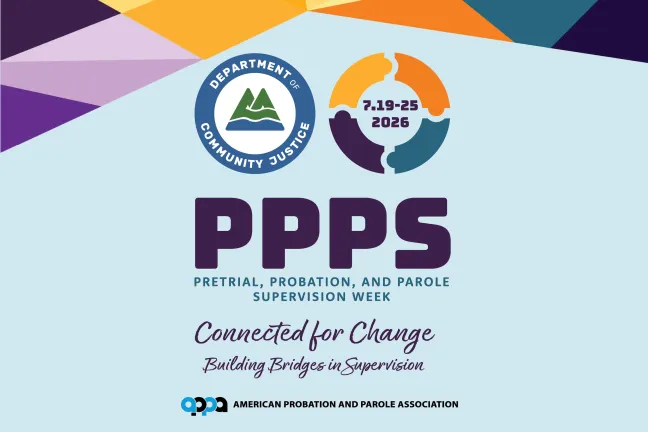
The Board opened with a proclamation designating the week of July 19 through July 25, 2026, as Probation, Parole and Post-Prison Supervision Week in Multnomah County. Sponsored by Commissioner Julia Brim-Edwards, who chairs the Local Public Safety Coordinating Council, the proclamation honored the staff of the Department of Community Justice (DCJ).
“Whether serving as parole and probation officers, juvenile court counselors, victim advocates, custody support specialists, or administrative professionals — every day, DCJ staff help make our communities safer, while also honoring victims’ rights, reducing recidivism and helping individuals successfully reenter our communities,” said Commissioner Brim-Edwards.
Denise Peña, director of the Department of Community Justice, Deputy Director Suzanne Brown-McBride, Juvenile Services Director Dr. Kyla Armstrong-Romero and Adult Services Director Tira Hubbard read the proclamation. The proclamation focuses on the department’s vision of “community safety throughout positive change,” driven by a staff of more than 400 professionals. The 2026 national theme, “Connected for Change: Building Bridges in Supervision,” highlights the efforts of roughly 90,000 community supervision professionals nationwide who oversee around 6 million justice-involved individuals.
“We affirm our commitment to upholding victim and survivor’s rights post-conviction and aim to inclusively lead with race by recognizing and addressing the history of systematic inequities to become an equitable, inclusive and racially just organization,” reads the proclamation.
Day of Reflection on the 1994 Genocide against the Tutsi in Rwanda
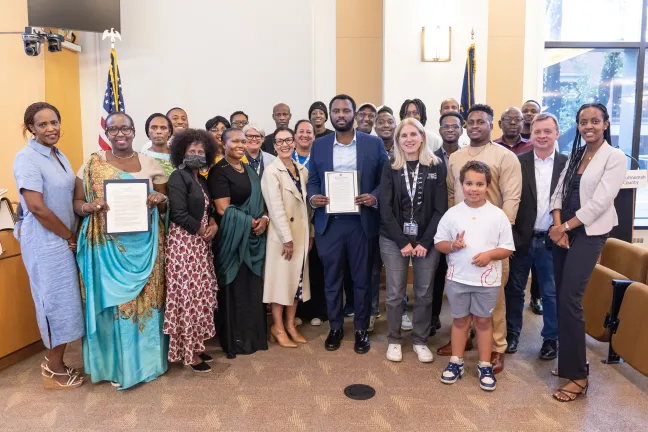
The Board next adopted a historic proclamation, sponsored by Commissioner Vince Jones-Dixon, formally declaring April 7 as the Day of Reflection on the 1994 Genocide against the Tutsi in Rwanda. With it, Multnomah County became the first county in Oregon to officially recognize this day of remembrance.
April 7 was established as the International Day of Reflection on the 1994 Genocide against the Tutsi in Rwanda by the United Nations General Assembly, marking “the beginning of a 100-day period during which over one million innocent lives were systematically and deliberately murdered, a historical tragedy recognized globally by the United Nations, the International Criminal Tribunal for Rwanda, the African Union and survivor communities worldwide,” according to the proclamation.
Commissioner Jones-Dixon shared a personal reflection on his time working in Rwanda, describing the country’s post-genocide reconstruction as a powerful example of what is possible when a society confronts its history. He noted that the period of commemoration, known as Kwibuka, meaning “to remember” in Kinyarwanda, spans three months from April to July, reinforcing a collective commitment to ensuring such atrocities never happen again.
“For me personally, it’s a true example of what can happen when you actually look at the whole truth and you work with the community and your legislation to move your country forward,” Commissioner Jones-Dixon said.
Bonus Kayumba, president of the Rwandan Community of Oregon, expressed deep gratitude to the Board for standing with survivors. He spoke about the growth in the local Rwandan community, noting that gatherings that consisted of four to six people in 2007 have now grown into large-scale events, including a 2024 partnership enabling local members to participate in the Rwandan presidential election.
Kayumba was joined by Nasira Mukabuliza, Egide Dukuzumuremyi and Felicete Mukawera — women’s representative, vice president and a member of the Rwandan Community of Oregon, respectively — along with Emmanuel Turaturanye, chairman of the Ibuka Oregon (Association of Survivors of the 1994 Genocide Against the Tutsi in Rwanda).
“Remembering the past must inspire us to speak out against such atrocities wherever they occur to protect innocent lives and to ensure that the promise of never again is not just a slogan but shared responsibility,” said Kayumba.
Pride Month
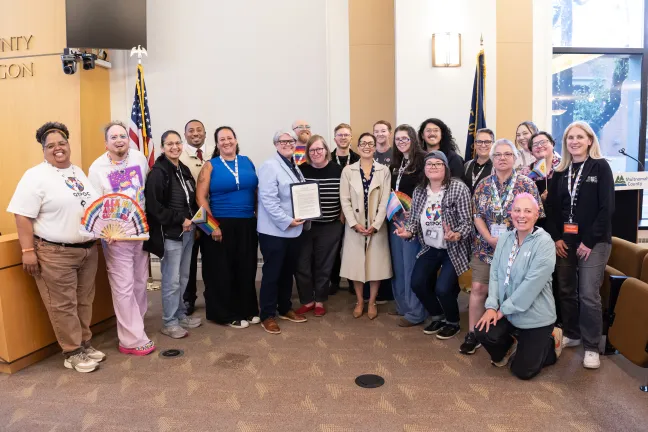
The Board then adopted a proclamation declaring June 2026 as Pride Month. Co-sponsored by Commissioners Meghan Moyer and Shannon Singleton, the proclamation celebrates lesbian, gay, bisexual, transgender, queer, intersex, asexual and two-spirit (LGBTQIA2S+) identities, as well as the LGBTQIA2S+ community’s resistance against growing nationwide threats to queer rights.
Chair Vega Pederson reaffirmed the County’s support for its LGBTQIA2S+ employees and residents amid national rollbacks of civil rights.
“To our queer and transgender youth: you are radiant, you are loved, and you deserve a kinder and safer world to grow up in,” she said.
Commissioner Moyer reflected on her own path as an openly queer elected official and called on the community and County staff to be “visibly proud.”
"I think of Pride not so much now as an act of self love, although it certainly played that role in my life when I was younger. And it meant so much to go to a place where people were proud of being themselves, so that I saw what I could be — because I wasn’t [then]. But today I participate in Pride for others. I am open about loving myself, loving the life that I live, and promoting that you too, if you identify as a member of the LGBTQ2S+ community, you can have the life you want and you do not have to feel shame,” said Commissioner Moyer.
"I am so happy for the community I chose to live in. I want people to think, ‘If I can’t stay where I’m at, maybe I move. Maybe I move and consider Multnomah County’ — because we are proud to be weird. We are proud to accept people as they truly are, to be a place where we affirm people’s authentic selves. I hope this month, particularly during our Pride celebration, we take a moment to be visible, either as members of the queer community or as allies, because we know there is somebody watching in the crowd, or online, or a clip on social media, who isn’t proud yet."
The proclamation also acknowledges the County’s former LGBTQIA2s+ commissioners, including Barbara Willer, the first openly lesbian woman to serve on the board (2010); Jesse Beason, the first openly gay man to serve on the board (2023); and Commissioner Moyer, who is the first openly queer person elected to the board (2025).
The proclamation also recognizes local queer advocate Kathleen Saadat, a Black lesbian activist who played a crucial role in the queer community. She was a key figure in organizing Portland’s first Pride march and drafting Portland’s first civil rights ordinance, which banned discrimination based on sexual orientation, according to the proclamation. Saadat also served as the State of Oregon’s director of affirmative action and was an outspoken opponent of the 1992 anti-queer Measure 9.
Jenna Bazner, executive assistant and constituent relations for Commissioner Singleton, Salomé Chimuku, policy advisor for Commissioner Singleton, and Daisy Maelstrom, co-chair of the Prism Employee Resource Group, read the proclamation.
Disability Pride Month
The final proclamation dedicated July 2026 as Disability Pride Month. Co-sponsored by Commissioners Moyer and Singleton, the proclamation honors the history of disability rights and the ongoing push for universal, everyday inclusion.
Commissioner Moyer, who served as the former public policy director for Disability Rights Oregon and identifies as a person who experiences a disability, spoke about the history of disability rights. She noted that as far back as the 19th century, isolation, eugenics and forced sterilization targeted people who experienced disabilities. In 1990, disability activists crawled up the steps of the U.S. Capitol building as a form of protest to advocate for the passage of the Americans with Disabilities Act, which became the first piece of major federal legislation prohibiting discrimination against people with disabilities in public accommodations.
She also shared that it wasn’t until 1999 that the U.S. Supreme Court issued its historic Olmstead decision, ruling that people with disabilities have a right to live outside of institutional care and in the least restrictive environment possible. However, the federal administration declared in recent weeks that it will no longer defend Olmstead and does not believe that it means people with disabilities have a right to live in community.
"Disability is probably the only marginalized community that we will all spend some time as a member of,” Commissioner Moyer said. “Let us embrace disability pride, not just for a community that has historically been profoundly mistreated, but for a community that we may one day be a part of. And let us advance the full inclusion of people with disabilities in all aspects of life so that we too may experience the world regardless of our ability.”
“I want to appreciate the work that went into these proclamations and the words Commissioner Moyer shared about the history of Pride.” Commissioner Singleton said, “I want to recognize my uncles Maurice, David, and Larry who were adopted when deinstitutionalization for people with disabilities happened and I had the privilege to grow up with… as well as my nephew Jake and his amazing success. And happy Pride to my nephew L, you will continue to do amazing things."
The proclamation states that while more than 1 in 4 adults in the United States live with a disability, yet disparities persist. In 2024, 55% of all fair housing complaints were made on the basis of disability accommodations, while 1 in 5 adults with disabilities reports unmet healthcare needs due to cost. The proclamation also highlighted the County’s commitment of $2 million this fiscal year to build ADA ramps to promote and improve physical accessibility across Multnomah County.
The proclamation was read by Scott Moore and TJ Anderson, members of Multnomah County’s Aging Services Advisory Council, along with Chimuku, the policy advisor for Commissioner Singleton.