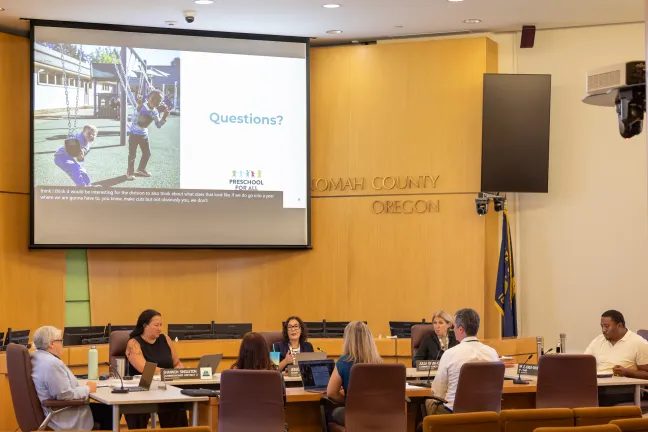
On Tuesday, Aug. 11, the Multnomah County Board of Commissioners held their final Preschool for All work session to determine whether an upcoming 2027 PFA tax increase should be deferred.
Earlier this year, the Board received a recommendation from the Preschool for All Technical Advisory Group, known as the TAG, to delay a potential 0.8% tax increase for two years, from 2027 to 2029.
The Board is scheduled to vote Aug. 20 and 27 on whether to implement the TAG’s recommendation or make any other proposed changes.
Chair Jessica Vega Pederson announced plans to bring forth a proposal to delay the tax increase by two years as laid out by the TAG, adding that this delay will protect the program by ensuring the county is being fiscally responsible and preserving the option to increase the tax in the future.
“Preschool for All is one of my proudest achievements in public service,” the Chair said. “Ultimately, I agree with the recommendation from our independent advisory group and am confident that we can afford to delay this tax increase while sustaining the program’s growth for future generations.”
Prior work sessions and briefings this summer focused on economic models to determine how much it costs to run a successful preschool program and how the tax increase will impact program funding.
Economic scenarios
On July 21, a Preschool for All work session focused on updated economic modeling related to funding Preschool for All, specifically related to revenue collected from the tax and different programmatic assumptions driving changes to program expenses. The models looked at updated population estimates from Portland State University that show the number of seats needed to reach universal preschool coverage is closer to 8,000, approximately 3,000 less than initially forecasted during the program’s development.
The County’s economist, Jeff Renfro, presented Board-requested forecast scenarios based on the updated demographic forecasts and updated preschool operational costs.
“What really moves our expenses assumption is the number of seats we’re providing and how expensive those seats are,” Renfro said.
A baseline model looked at revenue forecasts based on the updated population estimates and the planned .08% tax increase in 2027.
Another model, based on the Technical Advisory Group’s recommendation, included the updated population estimates, a two-year delay to the .08% tax increase and updated seat costs from a True Cost of Care Study. Both of these models were sustainable through 2030, the year the program plans to reach universality.
“The takeaway is we are comfortably above the zero axis, which means we would successfully implement the program as planned,” Renfro said.
Additionally commissioners for districts 1 and 2 requested forecasts for specific funding models.
True Cost of Care Model
Updated seat costs in the financial forecasts were based on True Cost of Care models presented to the Board on July 14. Early results of the True Cost of Care model show that PFA funding has allowed major improvements for providers and puts the program ahead of similar efforts nationwide, but there is still room for growth.
The model, based on 2025 data, is designed to show the true costs of operating a preschool program under Preschool for All which includes increased teacher salaries — Preschool for All providers pay their staff significantly more than the Metro area average — and delivering high quality preschool.
Earlier this year, Commissioners Julia Brim-Edwards and Meghan Moyer proposed a resolution that was unanimously approved to hire a consultant to develop a model of preschool providers operating costs this year and moving forward. The study was included in recommendations by the PFA Technical Advisory Group and endorsed by the Program Advisory Group.
The True Cost of Care model was developed by Prenatal to Five Fiscal Strategies, known as P5, a national nonprofit organization focused on addressing issues within government financial structures that impact children and families.
Jeanna Capito with P5 said modeling tools are impactful compared to market rate research because they include goals and quality models.
“What a family can pay does not directly correlate to what the operating costs are to a provider,” Capito said.
Capito said at market rate compensation, preschool providers are making operational choices to be able to balance their budget including not hiring as many teaching staff, directors taking on teaching roles or not offering health insurance and other benefits.
The True Cost of Care model looks beyond basic operating costs and shows what providers pay to thrive and meet state and Preschool for All standards to run a quality preschool program, pay good wages, support staff education, open new preschool locations and offer additional support to children with specific needs.
While the full report has not been released, early results from the model show that for the current upcoming school year, PFA funding rates are covering about 91% of the true cost of care in a center and 94% in a family child care home.
“Many states would be very happy with those numbers on their subsidy,” Simon Workman with P5 said. “But of course, there is still room for growth.”
That gap in coverage closed even further based on the program's intended funding increase for the 2027-28 school year.
The model shows additional funding may be needed to reach specific goals set by PFA including wage increases, staff education increases and inclusion goals. Still, early results and feedback from providers are promising.
“Clearly the existence of PFA has been a huge benefit to a lot of providers,” Workman said.
The Board will make proposals related to Preschool for All Thursday, Aug 20 and hold a final vote on any proposals Thursday Aug 27.